What is E162?
Beet red, also called betanin — a natural red-violet pigment extracted from beetroot, increasingly used as a natural alternative to synthetic red dyes.
E162 (beet red or betanin) is a natural pigment extracted from beetroot, giving foods a red to purple colour depending on pH. EFSA's 2015 re-evaluation found it wasn't a safety concern at current use levels, reasoning that the amount consumed via this additive is similar to the betanin people already get from eating beetroot as a food. Goodnessly rates it Safe.
Download our app to check additives in everyday foods
Read the FAQ →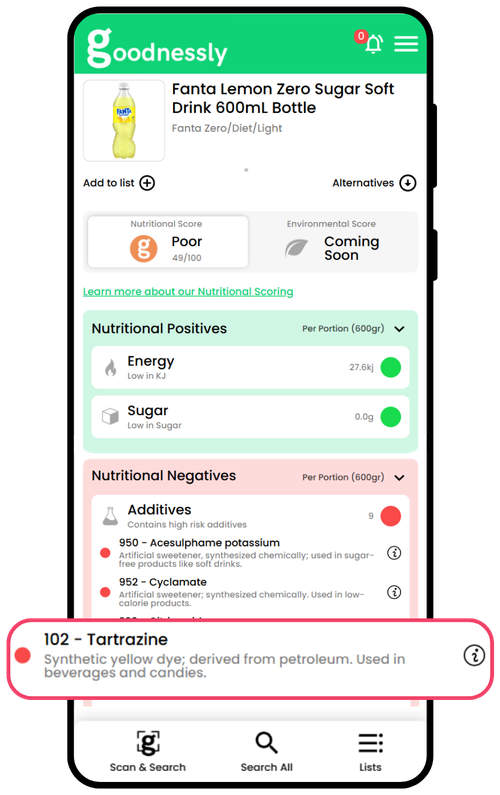
What is beet red?
Beet red is a natural dye extracted from the roots of the beet plant (Beta vulgaris). Its main colouring component is betanin, part of a pigment family called betalains, which also occur naturally in foods like Swiss chard and some cactus fruits. The colour it produces is genuinely pH-dependent: bright bluish-red between pH 4 and 5, shifting toward blue-violet as pH rises, and degrading to yellow-brown in alkaline conditions. It's increasingly used as a natural substitute for synthetic red dyes like Allura Red AC, which is banned in several EU countries.
What's it used for?
- Colouring ice cream a natural pink or red shade
- Colouring fruit juices and powdered soft drink beverages
- Used in some sugar confectionery
- Colouring yoghurts and flavoured milk
- A natural alternative in sauces and processed meats where visual appeal matters
Where you'll find 162 on the shelf
Increasingly common as brands shift away from synthetic red dyes.
Is beet red safe? What the research says
Beet red has a reassuring safety story, though it comes with an honest caveat worth understanding: the long-term toxicity data behind it is thinner than for some other additives.
| Region | Status | What this means |
|---|---|---|
| AU/NZ Australia & New Zealand (FSANZ) | Permitted, no limit | Permitted at quantum satis (as much as needed for the intended purpose). |
| EU European Union (EFSA) | Permitted, no ADI | Listed as E162, authorised at quantum satis. EFSA's 2015 re-evaluation found it wasn't a safety concern at current use levels, though it noted the available chronic toxicity and carcinogenicity studies were too limited to formally establish an Acceptable Daily Intake. |
| US United States (FDA) | GRAS | Holds Generally Recognized As Safe status for general food use. |
EFSA's reasoning for concluding no safety concern, despite the limited formal toxicology database, was that betanin exposure from using E162 as a food additive falls within the same range as the betanin people already consume from eating beetroot as a regular food. A rare allergic sensitivity to betanin has been reported in some individuals.
- Growing use as a synthetic-dye replacement: beet red is increasingly used by manufacturers to replace synthetic red colours like Allura Red AC (E129), which is banned in several EU countries, reflecting a broader industry shift toward natural colourants.
This section is checked periodically rather than continuously — if you're reading this well after the date above, it's worth confirming nothing has changed before citing it.
Who this matters to
- Anyone with a rare betanin sensitivity, though genuine allergic reactions are uncommon
- Otherwise, no population group has a specific safety-based reason to limit E162
Goodnessly rates E162 Safe. It's a natural colourant with betanin exposure comparable to eating beetroot itself, and it's increasingly favoured as a replacement for synthetic red dyes.
How to spot it on a label
E162 is usually declared clearly. Look out for:
- Beet red
- Betanin
- 162 or E162
- "Colour (162)" in the ingredients list
Ice cream, fruit juices and confectionery are the most common places to find it.
Related additives
Frequently asked questions
Is E162 the same as betanin?
Yes — 162 (or E162) is the additive code for beet red, and betanin is its main colouring component, extracted from beetroot.
Why does the colour of E162 change?
Betanin's colour is pH-dependent. It's bright bluish-red between pH 4 and 5, shifts toward blue-violet as pH rises, and degrades to a yellow-brown colour in alkaline conditions.
Does Goodnessly rate E162 as safe, caution, or avoid?
Goodnessly rates E162 (Beet Red) as Safe. EFSA's 2015 re-evaluation found no safety concern at current use levels, reasoning that betanin exposure from the additive is comparable to what people already consume from eating beetroot as a food.
Is E162 vegan and gluten-free?
Yes to both. Beet red is extracted directly from beetroot, with no animal-derived ingredients and no gluten involved.
Don't decode labels by hand
Scan any product with the Goodnessly app to instantly see its full additive breakdown, kept current as new research like this comes to light.
Download our app to check additives in everyday foods