What is E264?
Ammonium acetate — a simple acetate salt used as an acidity regulator and raising agent, distinguished from its sodium and calcium relatives by how the body handles the ammonium ion.
E264 (ammonium acetate) is made by reacting ammonia with acetic acid, forming a white crystalline salt used as an acidity regulator and raising agent. Unlike its close relatives sodium acetate and calcium acetate, which Goodnessly rates Safe, ammonium acetate involves the ammonium ion, which the body processes differently — via the liver, as part of normal nitrogen metabolism. Specific large-scale human safety data for this exact compound is more limited than for many other additives. Goodnessly rates it Avoid.
Download our app to check additives in everyday foods
Read the FAQ →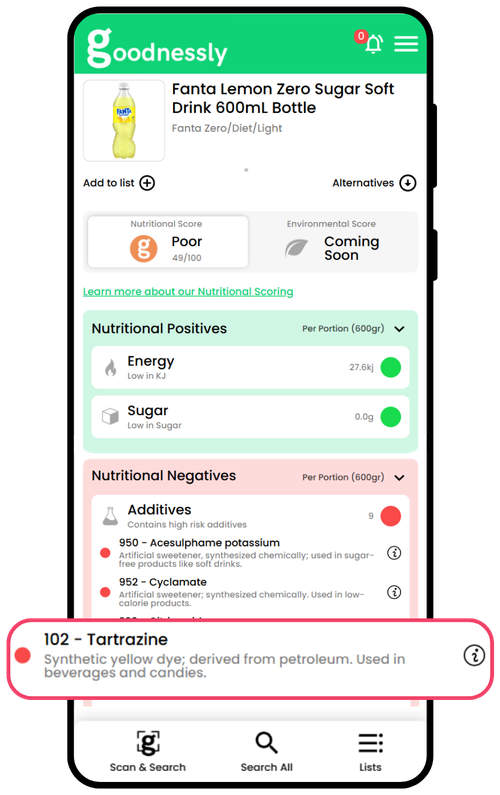
What is ammonium acetate?
Ammonium acetate is formed by reacting ammonia with acetic acid (the acid in vinegar), producing a white crystalline compound with a faint ammonia smell. It's mildly acidic in solution and dissolves easily in water. Chemically, it belongs to the same family as sodium acetate and calcium acetate — all three are simple acetate salts — but the ammonium ion is handled differently by the body than sodium or calcium. Sodium and calcium are essential nutrients the body regulates constantly; ammonium, by contrast, is processed by the liver as part of normal nitrogen and protein metabolism, and the liver converts it to urea for excretion.
What's it used for?
- Acidity regulator in various processed foods
- Raising agent in cakes, cookies and other baked goods
- Used in yeast-based confectionery production
- Also used as a preservative for some meat products
Where you'll find 264 on the shelf
A minor functional ingredient in a small range of baked goods and processed foods.
Is ammonium acetate safe? What the research says
Ammonium acetate is permitted as a food additive, but it hasn't received the same depth of dedicated, large-scale safety review as many other additives in this directory.
| Region | Status | What this means |
|---|---|---|
| AU/NZ Australia & New Zealand (FSANZ) | Permitted | Permitted as an acidity regulator and raising agent. |
| EU European Union (EFSA) | Permitted | Listed as E264, authorised for use in the EU, though it hasn't been the subject of a dedicated, comprehensive EFSA re-evaluation in the same way as many other additives. |
| US United States | Permitted | Used in food production and also has pharmaceutical and industrial applications. |
Related ammonium compounds have some documented sensitisation data in cosmetic safety reviews, and ammonium acetate has occasionally been associated with nausea at higher exposure levels. The ammonium ion itself is processed via the liver as part of normal nitrogen metabolism, distinct from how the body handles sodium or calcium.
- Limited dedicated re-evaluation: unlike many additives covered in this directory, ammonium acetate hasn't been the subject of a comprehensive, additive-specific EFSA safety re-evaluation publishing a formal ADI. This reflects its relatively minor and limited use, not a specific identified hazard.
This section is checked periodically rather than continuously — if you're reading this well after the date above, it's worth confirming nothing has changed before citing it.
Who might want to limit or avoid it
- People with impaired liver function, since the liver is responsible for processing the ammonium ion into urea
- Anyone who has noticed digestive discomfort or nausea associated with ammonium-containing additives
- Anyone who prefers additives with more extensive, dedicated safety re-evaluations behind them
Goodnessly rates E264 Avoid. It remains legally permitted, but the combination of limited dedicated safety review and the ammonium ion's distinct metabolic handling — compared to the well-reviewed sodium and calcium acetate salts — places it in our highest-caution category.
How to spot it on a label
E264 must be declared clearly. Look out for:
- Ammonium acetate
- 264 or E264
- "Acidity regulator (264)" in the ingredients list
Baked goods and yeast-based confectionery are the most likely places to find it.
Related additives
Frequently asked questions
Is E264 the same as sodium acetate?
They're chemically related — both are acetate salts — but E264 is the ammonium version, while E262 is the sodium version. Goodnessly rates sodium acetate Safe and ammonium acetate Avoid, reflecting how differently the body processes the ammonium ion compared to sodium.
Why is ammonium acetate treated differently from other acetate salts?
Sodium and calcium, found in sodium acetate and calcium acetate, are essential nutrients the body regulates as a matter of course. The ammonium ion is different: it's processed by the liver as part of normal nitrogen metabolism, and the liver converts it to urea for excretion. This is a genuine physiological distinction, not an arbitrary one.
Does Goodnessly rate E264 as safe, caution, or avoid?
Goodnessly rates E264 (Ammonium Acetate) as Avoid. It remains legally permitted, but it hasn't received the same depth of dedicated safety re-evaluation as many other additives, and the ammonium ion's distinct metabolic handling sets it apart from its more thoroughly reviewed sodium and calcium counterparts.
Don't decode labels by hand
Scan any product with the Goodnessly app to instantly see its full additive breakdown, kept current as new research like this comes to light.
Download our app to check additives in everyday foods