What is E307?
Alpha-tocopherol — the most active form of Vitamin E, used to stop fats and oils in food from going rancid.
E307 (alpha-tocopherol) is a form of Vitamin E used as an antioxidant to protect fats and oils from oxidative spoilage. It can be extracted from vegetable oils or produced synthetically, and both versions are considered safe by EFSA and the FDA, with no genotoxicity or carcinogenicity concerns identified at food-additive levels. Goodnessly rates it Safe.
Download our app to check additives in everyday foods
Read the FAQ →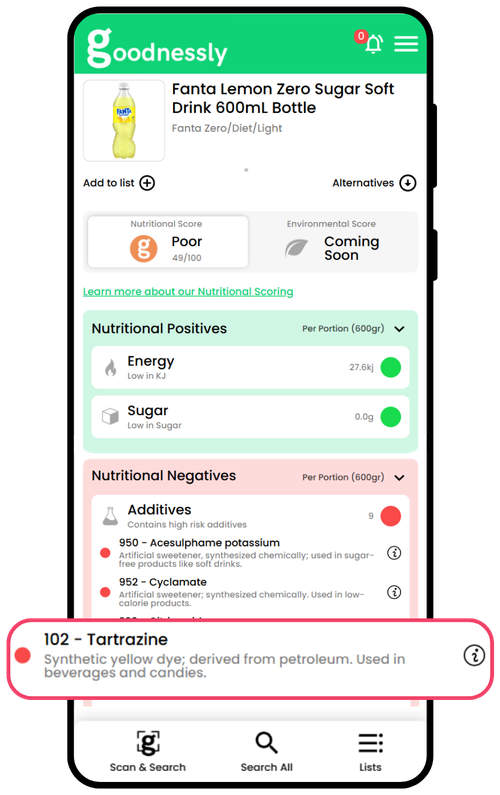
What is alpha-tocopherol?
Alpha-tocopherol is one of eight naturally occurring forms of Vitamin E, and the one your body absorbs and retains most readily. As a food additive, it works as an antioxidant — donating a hydrogen atom to neutralise free radicals before they can degrade the fats and oils in food, which is what causes rancidity. It can be extracted from vegetable oils like sunflower, safflower or wheat germ oil, or produced synthetically from petrochemical precursors as a mix of stereoisomers called "all-rac-alpha-tocopherol." The synthetic version has somewhat lower biological activity than the natural form, but both are used similarly as antioxidants.
What's it used for?
- Preventing fats and oils from turning rancid
- Extending shelf life in margarines and vegetable oils
- Stabilising dessert sauces and ready-made desserts
- Used in infant formula within specific regulatory limits
- Also common in dietary supplements and cosmetics, separate from its food-additive role
Where you'll find 307 on the shelf
Anywhere a fat or oil needs to stay fresh for longer.
Is alpha-tocopherol safe? What the research says
E307 has one of the cleanest safety profiles of any antioxidant additive at the levels used in food — the real nuance is distinguishing food-additive use from high-dose supplement use.
| Region | Status | What this means |
|---|---|---|
| AU/NZ Australia & New Zealand (FSANZ) | Permitted, no limit | Approved for all foods without a general quantity restriction. |
| EU European Union (EFSA) | Permitted, no ADI | Listed as E307. EFSA's 2015 re-evaluation (covering E306–E309 together) found no concern for genotoxicity or carcinogenicity and didn't set a numerical Acceptable Daily Intake. Infant formula is capped at 10mg per decilitre in the EU. |
| US United States (FDA) | GRAS | Holds Generally Recognized As Safe status, with specific serving limits for infant and children's foods. |
EFSA has set a Tolerable Upper Intake Level of 300mg per day for adults from all Vitamin E sources combined. The studies linking Vitamin E to increased stroke or bleeding risk involved high-dose supplements, well above what anyone would realistically consume from E307's use as a food antioxidant — this is a supplement-dosage consideration, not a food-additive safety concern.
- No significant regulatory changes since 2015: EFSA's group re-evaluation of the tocopherol family remains the most recent comprehensive review, and no restrictions on food-additive use have followed.
This section is checked periodically rather than continuously — if you're reading this well after the date above, it's worth confirming nothing has changed before citing it.
Who this matters to
- People taking blood-thinning medication, since very high Vitamin E supplement doses (not food-additive levels) have been linked to increased bleeding risk
- Anyone already taking Vitamin E supplements, who should factor E307 into their total daily Vitamin E intake
- Otherwise, no population group has a specific reason to limit E307 at food-additive levels
Goodnessly rates E307 Safe. The safety concerns reported for Vitamin E involve high-dose supplements, not the small amounts used as a food antioxidant, and EFSA hasn't identified any genotoxicity or carcinogenicity concern at either level.
How to spot it on a label
E307 is usually declared clearly. Look out for:
- Alpha-tocopherol
- Vitamin E
- 307 or E307
- "Antioxidant (307)" in the ingredients list
Margarine, vegetable oils and dessert sauces are the most common places to find it.
Related additives
Frequently asked questions
Is E307 the same as Vitamin E?
Yes — 307 (or E307) is the additive code for alpha-tocopherol, the most biologically active of the eight natural forms of Vitamin E.
Is E307 natural or synthetic?
It can be either. Natural alpha-tocopherol is extracted from vegetable oils like sunflower or wheat germ oil. Synthetic alpha-tocopherol is produced from petrochemical precursors as a mix of stereoisomers, and has somewhat lower biological activity than the natural form, though both are used similarly as food antioxidants.
Does Vitamin E as a food additive cause health risks?
Not at the levels used in food. The stroke and bleeding risks reported in some studies involved high-dose Vitamin E supplements, well above what E307 contributes as a food antioxidant. EFSA hasn't identified a genotoxicity or carcinogenicity concern at either level.
Does Goodnessly rate E307 as safe, caution, or avoid?
Goodnessly rates E307 (Alpha-Tocopherol) as Safe. EFSA's 2015 re-evaluation found no genotoxicity or carcinogenicity concern and didn't set a numerical daily intake limit for food-additive use.
Is E307 vegan?
Usually, but not always. Natural alpha-tocopherol is typically extracted from vegetable oils, but it's worth checking with the manufacturer if the source matters to you, since Vitamin E is occasionally sourced from other materials.
Don't decode labels by hand
Scan any product with the Goodnessly app to instantly see its full additive breakdown, kept current as new research like this comes to light.
Download our app to check additives in everyday foods