E440 food additive: what is pectin?
Also labelled: Pectin · INS 440 · E440(i) pectin · E440(ii) amidated pectin · Gelling agent 440 · Fruit pectin
E440 (INS 440) is pectin, a plant fibre usually made from citrus peel or apple pomace. It is used as a gelling, thickening and stabilising agent in jams, yoghurts, lollies and fruit fillings. Goodnessly rates E440 Risk Free, while food-category permissions and the relevant regulator conditions still apply.
Pectin is a plant fibre from citrus peel or apple that helps jams set and yoghurts stay smooth. EFSA (2017) found no safety concern for the general population at reported uses. Check the food category, amount and full formulation rather than judging one ingredient in isolation.
Download our app to check additives in everyday foods · Eco score: Coming Soon
Read the FAQ →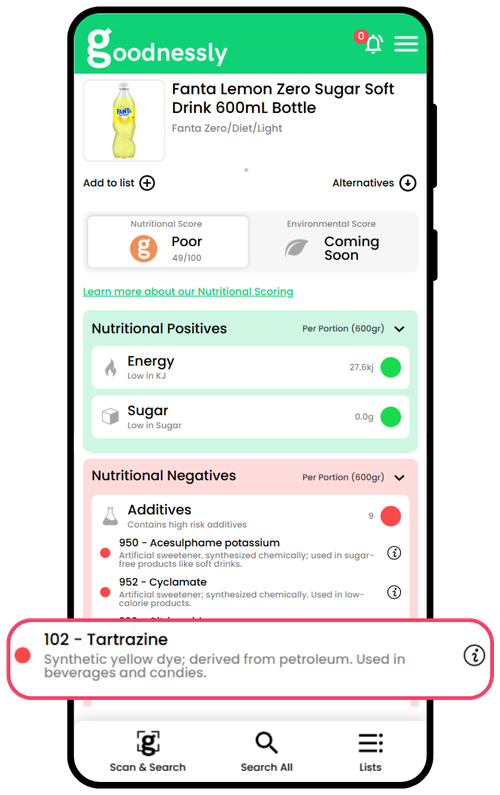
What is Pectin?
Pectin is plant-derived carbohydrate used as a gelling, thickening and stabilising agent. Its function depends on the formulation and the conditions attached to the permitted use.
What's it used for?
- Supporting the stated technical function
- Helping maintain the intended texture or stability
- Contributing to a consistent formulation
- Serving a specified food or nutrient purpose
Where you'll find E440 on the shelf
You may see E440 in packaged foods where its technical function is useful and the food category permits it.
Products containing E440 (INS 440)
Examples from products we've rated where E440 appears in the listed ingredients. Showing 6 of 11 products we've rated that list E440. Formulations change, so always check the current pack.
Is E440 permitted? What the regulators say
Pectin is listed in the checked AU/NZ and EU frameworks with conditions. Permission is conditional: category, level, identity and specifications matter.
| Region | Status | What this means |
|---|---|---|
| AU/NZ Australia & New Zealand (FSANZ) | Permitted with conditions | FSANZ lists 440 for specified food uses in the Food Standards Code. [FSANZ source] |
| EU European Union (EUR-Lex) | Authorised with conditions | The consolidated Union list includes E440 for specified categories and conditions. [EUR-Lex source] |
| US United States (FDA) | Permitted with conditions | FDA sources identify pectin for specified food uses: 21 CFR 173.385 and 184.1588. [FDA source] |
Goodnessly rates E440 Risk Free within its rating system. The rating does not remove the need to consider the product category, amount or full formulation.
- The current consolidated EU Union list was checked for the listed identity and conditions of use.
- The current FDA food-substance and cited regulation records were checked for the listed identity and intended technical use.
- Regulatory permissions can change; confirm the primary source when a product, recipe or use is unusual.
This section is checked periodically rather than continuously — confirm the current primary source before relying on a regulatory detail.
Who might want to limit or avoid it
- People comparing additive functions across products
- People checking the frequency of this ingredient in their usual foods
- People who want to consider the whole formulation and serving pattern
Goodnessly rates E440 Risk Free as a practical prompt to understand the ingredient, the product and the overall formulation.
How to spot it on a label
Look for:
- Pectin
- 440
- E440
- Additive class (440)
Ingredient labels may use the name, the number, or the additive class followed by the number.
Related additives
Frequently asked questions
Is E440 harmful?
Regulators don't consider pectin a safety concern at normal intakes. EFSA's 2017 re-evaluation found no safety concern for the general population and concluded there was no need for a numerical ADI. JECFA and the EU's former Scientific Committee for Food had allocated an ADI 'not specified'. Like other fibres, large amounts may be associated with wind or bloating in some people.
Is E440 vegan?
Yes. Pectin is extracted from plants, usually citrus peel or apple pomace, so it is suitable for vegans and is often used instead of gelatine.
What is the difference between E440 and amidated pectin?
E440(i) is plain pectin. E440(ii) is amidated pectin, treated with ammonia so it can set with less sugar and with calcium. Both are covered by the same EFSA opinion.
Which foods contain E440?
Typical examples are jams and fruit spreads, fruit yoghurts, jelly lollies, fruit fillings, some fruit drinks and confectionery. Check the ingredient list for 'pectin', 'gelling agent (440)' or 'E440'.
Don't decode labels by hand
Scan any product with the Goodnessly app to see its full additive breakdown and understand the label at a glance.
Download our app to check additives in everyday foods · Eco score: Coming Soon