What is E471?
Mono- and diglycerides of fatty acids — a widely used emulsifier that helps oil and water stay mixed in baked goods, margarine, ice cream and many other processed foods.
E471 (mono- and diglycerides of fatty acids) is an emulsifier made by reacting edible fats or fatty acids with glycerol. In the gut it is expected to break down into glycerol and fatty acids, which are also authorised as food additives in their own right. EFSA’s 2017 re-evaluation found no safety concern at reported uses and use levels and said a numerical Acceptable Daily Intake was not needed; a 2021 follow-up reached a similar conclusion for specified infant-formula uses. JECFA lists an ADI of “not limited,” FSANZ permits it under the Food Standards Code, and the US FDA affirms mono- and diglycerides as GRAS (21 CFR 184.1505). Process-related impurities such as 3-MCPD esters and glycidyl esters can form under some manufacturing conditions, which is why the EU tightened E471 specifications in 2023. Goodnessly rates it Caution.
Download our app to check additives in everyday foods
Read the FAQ →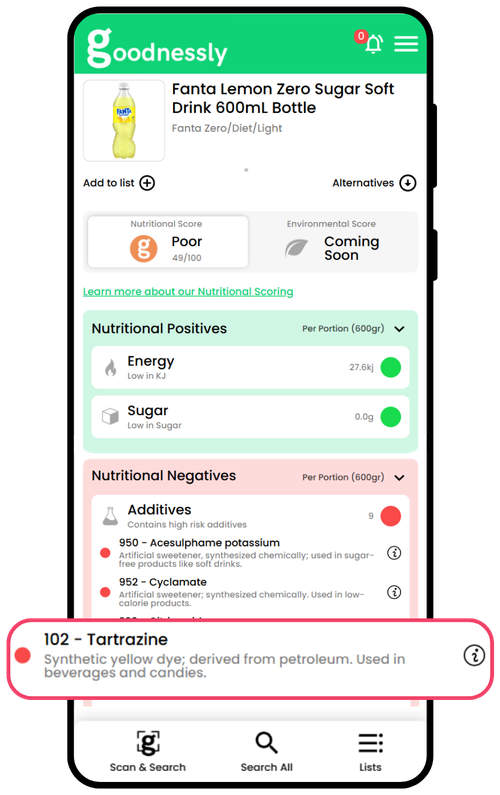
What are mono- and diglycerides of fatty acids?
Mono- and diglycerides are partial glycerides — molecules with one or two fatty-acid chains attached to a glycerol backbone, rather than the three chains found in ordinary dietary fat (triglycerides). Food-grade E471 is manufactured by reacting edible fats or oils, or edible fatty acids, with glycerol, then purifying the mixture. The fatty acids used can come from a range of edible sources, including palm oil and other seed oils; labels rarely name the oil feedstock. Chemically, the finished emulsifier is closely related to substances already present when the body digests dietary fat, which is a key reason major regulators have not set a numerical Acceptable Daily Intake.
What’s it used for?
- Keeping fat and water phases mixed in margarine, spreads and dairy desserts
- Improving crumb softness and shelf life in bread and cakes
- Stabilising ice cream, whipped toppings and other aerated foods
- Acting as a release or surface agent in confectionery and some fruit coatings
Where you’ll find 471 on the shelf
One of the most common emulsifiers in packaged food — especially wherever oil and water need to stay blended through processing and storage.
Are mono- and diglycerides safe? What the research says
Major food regulators treat mono- and diglycerides as a long-established emulsifier that is metabolically similar to dietary lipids. That said, manufacturing can leave process-related impurities, and specifications have been tightened in Europe to keep those impurities within set limits.
| Region | Status | What this means |
|---|---|---|
| AU/NZ Australia & New Zealand (FSANZ) | Permitted | Listed as food additive code 471 (mono- and diglycerides of fatty acids). Permitted in many food categories under the Food Standards Code, typically at good manufacturing practice (GMP) levels; FSANZ has concurred that a numerical ADI is not required, consistent with JECFA. |
| EU European Union (EFSA) | Permitted, no numerical ADI | Listed as E471. EFSA’s 2017 re-evaluation concluded no safety concern at reported uses and use levels and no need for a numerical ADI. A 2021 follow-up found no reason for a safety concern for specified infant-formula categories when used as authorised. Commission Regulation (EU) 2023/1428 later tightened impurity specifications (including 3-MCPD esters and glycidyl esters). |
| US United States (FDA) | GRAS | Affirmed as generally recognized as safe (GRAS) for multiple technical effects under 21 CFR 184.1505, used in food with no limitation other than current good manufacturing practice. |
JECFA (INS 471) assigned an ADI of “not limited” (also described as not specified in later usage), reflecting the view that mono- and diglycerides do not differ significantly from dietary lipids when manufactured to appropriate specifications. Process contaminants are managed through specifications and wider food-contaminant rules rather than by treating the emulsifier itself as unauthorised.
- EU specs update 2023: Commission Regulation (EU) 2023/1428 amended EU purity criteria for E471, including tighter limits for metals, erucic acid, the sum of 3-MCPD and 3-MCPD esters, and glycidyl esters (expressed as glycidol), with stricter values where the additive is used in foods for infants and young children.
- EFSA infant follow-up 2021: EFSA’s FAF Panel concluded there was no reason for a safety concern when E471 is used as authorised in certain infant-formula categories, while also addressing issues flagged in the 2017 re-evaluation.
- Authorisation status unchanged: AU/NZ, the EU and the US continue to permit mono- and diglycerides as a food additive/emulsifier; no jurisdiction reviewed here has removed food authorisation.
This section is checked periodically rather than continuously — if you’re reading this well after the date above, it’s worth confirming nothing has changed before citing it.
Who this matters to
- People who prefer to minimise highly processed emulsifiers on principle, even where regulators report no safety concern at typical uses
- Shoppers watching process-related impurities from refined fats and oils (such as 3-MCPD esters and glycidyl esters), which EFSA highlighted for specification attention and which the EU now limits in E471
- Anyone comparing palm- or seed-oil-derived ingredients across a whole diet — feedstock is informational only and is not declared on every label
- Parents checking infant-formula and young-child foods, where EU impurity limits for E471 are stricter than for general foods
Goodnessly rates E471 Caution, matching our CSV orange rating for this additive. It remains permitted across AU/NZ, the EU and the US, with EFSA and JECFA concluding that a numerical ADI is unnecessary, but the industrial manufacturing route and ongoing impurity-specification work keep it out of our Safe category.
How to spot it on a label
E471 may appear under several names. Look out for:
- Mono- and diglycerides of fatty acids
- Mono- and diglycerides / monoglycerides and diglycerides
- Glyceryl monostearate (GMS) or related glyceride names
- 471, E471, or Emulsifier (471)
Bakery goods, margarine, ice cream and confectionery are among the most common places to find it.
Related additives
Frequently asked questions
Are mono- and diglycerides natural?
Partial glycerides form naturally when dietary fat is digested, but food-additive E471 is manufactured by reacting edible fats or fatty acids with glycerol and then purifying the product. That industrial route is why it is labelled as an emulsifier rather than as plain fat, even though regulators note its similarity to dietary lipids.
Is E471 made from palm oil?
It can be. Manufacturers may use palm oil or other edible seed oils (and their fatty acids) as feedstock. Labels usually list the emulsifier name or code without naming the oil source, so palm content is not something you can reliably confirm from the E471 declaration alone.
Do mono- and diglycerides have a safe intake limit?
EFSA concluded there was no need for a numerical Acceptable Daily Intake and found no safety concern at reported uses and use levels. JECFA assigned an ADI of “not limited.” In practice that usually means the substance is considered acceptable at levels consistent with good manufacturing practice when it meets purity specifications.
Does Goodnessly rate E471 as safe, caution, or avoid?
Goodnessly rates E471 (mono- and diglycerides of fatty acids) as Caution. It is permitted and well reviewed by FSANZ, EFSA, the FDA and JECFA, but the processed manufacturing route and the need to control process-related impurities keep it out of our Safe category.
Don't decode labels by hand
Scan any product with the Goodnessly app to instantly see its full additive breakdown, kept current as new research like this comes to light.
Download our app to check additives in everyday foods