What is E553?
Magnesium silicate and talc (E553) are mineral anticaking agents used in selected food applications. Goodnessly rates E553 Caution as a prompt to notice mineral additives and use limits.
E553 covers magnesium silicate (E553a) and talc (E553b) in the international numbering system. Their technological role is mainly to help powders flow and resist caking.
Download our app to check additives in everyday foods
Read the FAQ →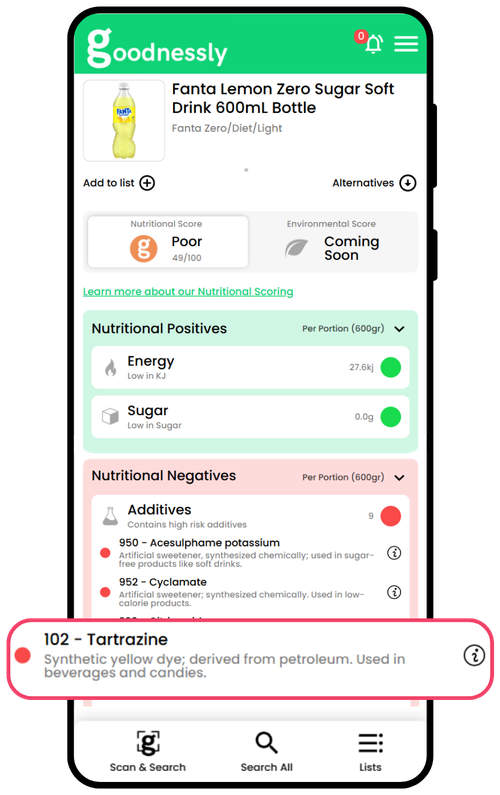
What is Magnesium silicate or Talc?
E553 covers magnesium silicate (E553a) and talc (E553b) in the international numbering system. Their technological role is mainly to help powders flow and resist caking.
What's it used for?
- Reducing caking in powders
- Helping keep salt and dry mixes free-flowing
- Supporting texture or processing in specified uses
Where you'll find E553 on the shelf
Where authorised, it is most relevant to salt, powdered mixes, seasonings and other dry ingredients.
Is E553 safe? What the regulators say
E553 has specified uses rather than a blanket permission. The exact form, purity specification, food category and level are important.
| Region | Status | What this means |
|---|---|---|
| AU/NZ Australia & New Zealand (FSANZ) | Permitted with conditions | FSANZ lists magnesium silicate or talc as additive 553 in its food-additive framework. Schedule 15 conditions and specifications apply. |
| EU European Union (EFSA) | Authorised with conditions | The EU Union list distinguishes E553a magnesium silicate and E553b talc. Their listed food uses and specifications apply. |
| US United States (FDA) | Permitted for specified use | FDA 21 CFR 582.2437 recognises magnesium silicate for use as an anticaking agent in table salt under the stated conditions. |
Goodnessly rates E553 Caution as a preference to notice mineral anticaking agents, not as a statement that authorised E553 use causes harm.
- FSANZ Schedule 15 and additive-numbering materials cover E553.
- EU Regulation (EU) No 1129/2011 lists E553a and E553b in the Union list.
- 21 CFR 582.2437 provides the US magnesium-silicate food-use basis.
This section is checked periodically rather than continuously — if you're reading this well after the date above, it's worth confirming nothing has changed before citing it.
Who might want to limit or avoid it
- People who prefer to minimise anticaking agents
- People comparing salt and powdered seasoning labels
- People following professional dietary advice
Check whether the label identifies magnesium silicate or talc and consider the product category and serving pattern.
How to spot it on a label
Look for:
- Magnesium silicate
- Talc
- 553 or E553
- Anticaking agent (553)
The label may show magnesium silicate, talc, E553a, E553b or the anticaking class followed by the number.
Related additives
Frequently asked questions
What is E553?
E553 covers magnesium silicate and talc, mineral anticaking agents used in selected foods.
Is E553 permitted?
E553 is permitted with conditions in Australia/New Zealand, the EU and the US for specified food uses.
Why is E553 rated Caution?
Goodnessly uses Caution as a preference to notice mineral anticaking agents and check the product context.
How does Goodnessly rate E553?
Goodnessly rates E553 (magnesium silicate or talc) as Caution.
Don't decode labels by hand
Scan any product with the Goodnessly app to instantly see its full additive breakdown, kept current as new research like this comes to light.
Download our app to check additives in everyday foods