E941 (nitrogen): what is packaging gas 941?
E941 is nitrogen, also labelled packaging gas 941 or INS 941. It is an inert gas used to replace oxygen in sealed packs and as a propellant. Goodnessly rates E941 Risk Free, while food-category permissions and regulator conditions still apply.
E941 is nitrogen, the main gas in the air around us. In food it is mostly used to flush oxygen out of packs of chips, nuts, coffee and salad leaves to help keep them fresh. It is permitted in Australia/New Zealand, the EU and the US.
Download our app to check additives in everyday foods · Eco score: Coming Soon
Read the FAQ →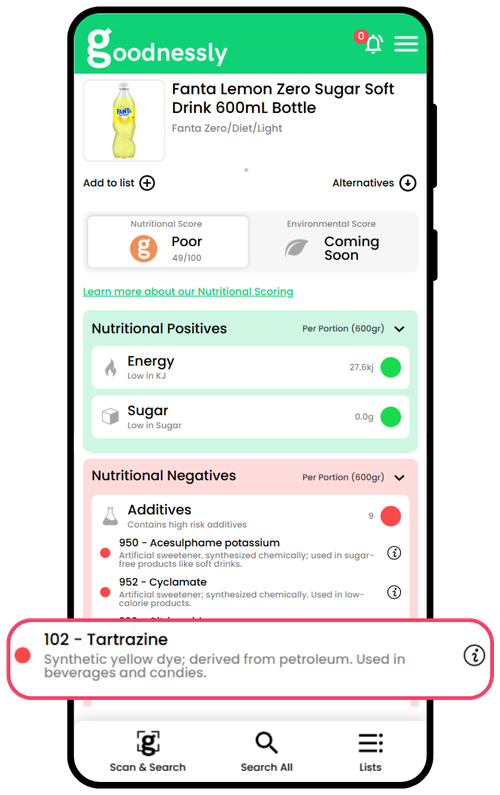
What is nitrogen (E941)?
Nitrogen (N2) is a colourless, odourless, largely unreactive gas that makes up about 78% of air. As a food additive it is listed as E941 in the EU and INS 941 in the Codex system used by Australian labels. Because it doesn't react easily with food, it is useful for protecting products from oxygen rather than changing their taste.
What's it used for?
- Packaging gas: replacing oxygen in modified-atmosphere packs (chips, nuts, coffee, salad, fresh pasta)
- Cushioning: a nitrogen-filled pack protects fragile snacks
- Propellant: in some pressurised cans (e.g. whipped toppings), alongside other gases
- Drinks: "nitro" coffee and some canned drinks use nitrogen for a creamy foam
Where you'll find E941 on the shelf
Nitrogen often does its job in the pack rather than in the food, so you may not always see it listed. When it is declared, look in these aisles.
Is E941 safe? What the regulators say
Nitrogen is permitted in all three regions checked. As with any additive, the food category, purity specifications and conditions of use apply.
| Region | Status | What this means |
|---|---|---|
| AU/NZ Australia & New Zealand (FSANZ) | Permitted with conditions | FSANZ lists 941 for specified food uses in the Food Standards Code. [FSANZ source] |
| EU European Union (EUR-Lex) | Authorised with conditions | The consolidated Union list includes E941 for specified categories and conditions. [EUR-Lex source] |
| US United States (FDA) | GRAS | 21 CFR 184.1540 affirms nitrogen as generally recognised as safe for use in food under good manufacturing practice. [FDA/eCFR source] |
Goodnessly rates E941 Risk Free within its rating system. The rating does not remove the need to consider the product category, amount or full formulation.
- EFSA's 2023 call for data on gaseous food additives included nitrogen. The re-evaluation is ongoing, and no new numerical ADI has been published. [EFSA source]
- Codex GSFA lists nitrogen (INS 941) for use in foods under good manufacturing practice. [FAO/JECFA GSFA source]
- Regulatory permissions can change. Confirm the primary source when a product, recipe or use is unusual.
We check this section periodically rather than continuously. Confirm the current primary source before relying on a regulatory detail.
Who might want to limit or avoid it
- Nitrogen gas in packaging isn't a known dietary concern for most people. Regulators permit it under good manufacturing practice.
- Liquid nitrogen is a different story: the US FDA has advised against consuming foods or drinks (such as "dragon's breath" snacks) while liquid nitrogen is still present, because of the risk of serious injury.
- If you're comparing snacks, the food inside the pack matters far more than the packaging gas.
Goodnessly rates E941 Risk Free. It is a packaging aid rather than an ingredient you eat in meaningful amounts.
How to spot it on a label
Look for:
- Nitrogen
- Packaging gas (941)
- Propellant (941)
- 941 / INS 941 / E941
- "Packed in a protective atmosphere"
Labels may use the name, the number, or the additive class followed by the number. See what E-numbers mean.
Related additives
Frequently asked questions
What is E941 in food?
E941 is nitrogen (INS 941), the same gas that makes up about 78% of the air we breathe. In food it is mainly used as a packaging gas: it replaces oxygen inside a sealed pack to help keep foods like chips, nuts, coffee and salad leaves fresh.
Is packaging gas 941 safe to eat?
Nitrogen is permitted as a food additive in Australia and New Zealand (FSANZ), the EU and the US, where the FDA lists it as generally recognised as safe (21 CFR 184.1540). It is not a nutrient and mostly escapes when you open the pack. EFSA is re-evaluating gaseous food additives, including nitrogen, and no numerical ADI has been set.
Why is nitrogen used in chip packets?
Oxygen is associated with staleness and rancidity in fatty snacks. Filling the pack with nitrogen pushes out most of the oxygen, which helps slow those changes. The gas also cushions the contents so chips are less likely to break in transit.
Is E941 the same as liquid nitrogen?
They are the same substance in different states. E941 on a label usually means nitrogen gas used in packaging. Liquid nitrogen is extremely cold, and the US FDA has advised consumers against eating or drinking products prepared with liquid nitrogen at the point of sale while it is still present, because of the risk of serious injury.
Don't decode labels by hand
Scan any product with the Goodnessly app to see its full additive breakdown and understand the label at a glance.
Download our app to check additives in everyday foods · Eco score: Coming Soon