The best food scanner apps in Australia, compared
Yuka, FoodSwitch, Open Food Facts and Goodnessly all let you scan a barcode and get a score — but they score products differently and aren't all equally useful in an Australian supermarket. Here's how they actually compare.
Food scanner apps in Australia, side by side
Snapshot as of 2026 — features and pricing change, so it's worth double-checking anything decision-critical against the app's current store listing.
| App | Based in | Price | 🧪 Additives itemised | 🌿 Seed oil detection | 🌱 Organic factored in | 🥗 Diet filters | 🛒 Shopping list | 🌍 Eco score |
|---|---|---|---|---|---|---|---|---|
| Goodnessly | Australia | Free + paid | ✓ YesProducts flagged + check list | ✓ Yes | ✓ Yes | ✓ YesKeto, Paleo, Vegan, Vegetarian, Kosher, Halaal | ✓ Yes | ✓ Yes |
| Yuka | France | Free + paid | ✓ YesFlagged only | — No | ✓ Yes | ✓ YesPaid tier, no paleo/keto | — | ✓ Yes |
| FoodSwitch | Australia | Free | — No | — No | — No | — No | — | — No |
| Open Food Facts | France | Free | ≈ Varies | — No | ≈ Varies | ≈ Varies | — | ✓ Yes |
Goodnessly publishes this guide, so weigh the framing accordingly — each app has genuine strengths depending on what you're scanning. The "shopping list" column reflects a feature Goodnessly offers; it isn't a confirmed absence on the other three, just not the focus of this comparison.
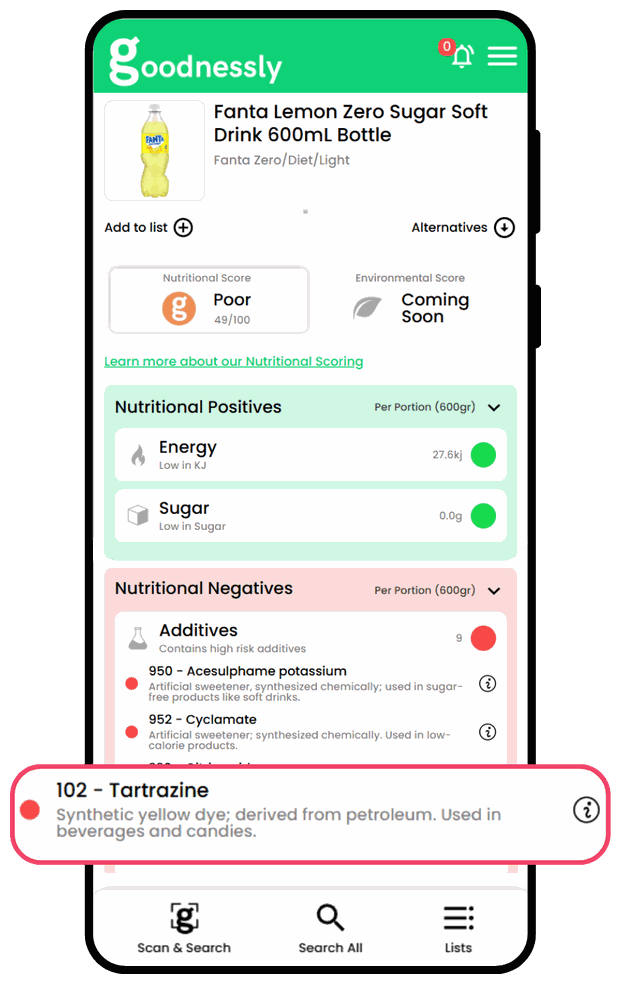
Goodnessly scores products using nutritional panel data (60%), a per-additive check against 335+ rated ingredients (30%), and organic content (10%) — then shows you exactly which additives and oils are in a product, backed by a built-in additives glossary you can browse any time, not just while scanning. It also flags seed and vegetable oils, which isn't standard elsewhere, and includes a shopping list to save what you scan. The free version covers scores, the additives glossary and the shopping list; the paid version adds diet filters (Keto, Paleo, Vegan, Vegetarian, Kosher, Halaal) and a deeper seed oil breakdown.
Good to know: the environmental/eco score is live, alongside the health, additives and organic content scoring.
Yuka is the app most people mean when they say "the scanning app" — it's the one with the biggest name recognition. It flags individual additives of concern (like carrageenan or BHA) alongside an overall blended 0–100 score, shows an environmental/eco-score too, and its paid version includes diet filters for vegetarian, vegan, pork-free, gluten-free, lactose-free, palm oil-free and sulfite-free — though not paleo or keto, and it doesn't offer a comprehensive additives glossary the way Goodnessly does.
Good to know: the free version covers scanning; the paid version adds diet filters plus extras like offline scanning and an ad-free experience.
FoodSwitch was built by The George Institute for Global Health in Sydney, using the government's Health Star Rating system alongside traffic-light labels for fat, saturated fat, sugar and salt. It's a solid, credible nutrition tool — it just doesn't go into additive-level detail or ingredient scrutiny, which is where it differs most from Goodnessly and Yuka.
Good to know: it also suggests healthier "switch" alternatives for a scanned product, which the others don't do in the same structured way.
Open Food Facts shows a Nutri-Score, a NOVA ultra-processed classification and an Eco-Score (environmental grade) per product — on paper, the most feature-complete free option in this list. It doesn't offer diet-specific filtering or an itemised additive breakdown the way Goodnessly does.
Good to know: Goodnessly and Yuka also show an environmental/eco score alongside their main score. A good complement to a curated app rather than a full replacement.
A quick note on how this list was put together
Goodnessly publishes this guide, so it's fair to expect some bias in the ranking — take the ordering with that in mind. The feature comparison above, though, is factual and drawn from each app's own published pricing, help documentation and store listings. If anything looks out of date, the app's current store listing is always the source of truth.
Frequently asked questions
What is the best food scanner app in Australia?
It depends what you want from it. For additive-level detail, Goodnessly is built specifically for that, with a comprehensive additives glossary and dedicated seed oil detection. For a quick Health Star Rating check, FoodSwitch is a solid, free option. For a widely recognised, single-score scanning app, Yuka is the most established name.
Is Yuka available in Australia?
Yes, Yuka can be downloaded and used in Australia. It flags individual additives of concern alongside an overall blended score, which is a different approach from Goodnessly's comprehensive, itemised additive breakdown and glossary.
Is FoodSwitch better than Yuka?
They're built for different things. FoodSwitch focuses on Health Star Rating and nutrient traffic lights, with no diet-specific filtering. Yuka combines nutrition, additives and organic status into one score, flags individual additives of concern along the way, and its paid version offers diet filters (vegetarian, vegan, gluten-free, lactose-free, pork-free, palm oil-free, sulfite-free) — though not paleo or keto. Neither matches Goodnessly's full additives glossary.
Do any food scanner apps check for seed oils specifically?
Goodnessly flags seed and vegetable oils (canola, sunflower, soybean, rapeseed and similar) as a dedicated check within its ingredient analysis. This isn't a standard feature across the other apps compared here.
Are food scanner apps free?
FoodSwitch and Open Food Facts are free to use. Goodnessly and Yuka are both free to download with an optional paid version — Goodnessly's paid version unlocks diet filters (Keto, Paleo, Vegan, Vegetarian, Kosher, Halaal) and a deeper seed oil breakdown; Yuka's paid version adds diet filters of its own (vegetarian, vegan, gluten-free, lactose-free, pork-free, palm oil-free, sulfite-free — but not paleo or keto), plus extras like offline scanning and an ad-free experience.
Where is each food scanner app based?
Goodnessly and FoodSwitch are both based in Australia. Yuka and Open Food Facts are both based in France.
Which food scanner app lets you filter by diet type, like keto or vegan?
Goodnessly's Premium tier includes filters for Keto, Paleo, Vegan, Vegetarian, Kosher, Halaal. Yuka's paid version also has diet filters (vegetarian, vegan, gluten-free, lactose-free, pork-free, palm oil-free, sulfite-free), but not paleo or keto specifically; FoodSwitch and Open Food Facts don't offer diet-specific filtering.
Does any food scanner app have a shopping list or additives glossary?
Goodnessly includes a shopping list so you can save products as you scan them, plus a built-in additives glossary you can browse independently of a scan — useful for looking up an ingredient you've seen on a label before you're standing in the aisle.
Scan any product at the supermarket
Goodnessly is free to download and scores products on health, additives and organic content, with a built-in additives glossary and shopping list. The paid version unlocks diet filters and a deeper seed oil breakdown.