What is E122?
Azorubine, also called Carmoisine — a synthetic red dye that carries the EU's mandatory Southampton Six hyperactivity warning label and has never been approved for food use in the United States.
Azorubine (E122), also known as Carmoisine, is a synthetic azo dye used to colour foods and drinks red to maroon. It's permitted in Australia, New Zealand and the EU, but it's one of the "Southampton Six" colours the EU requires a mandatory hyperactivity warning label on, following a 2007 UK study. It has never been approved for use in the US food supply. Goodnessly rates it Avoid.
Download our app to check additives in everyday foods
Read the FAQ →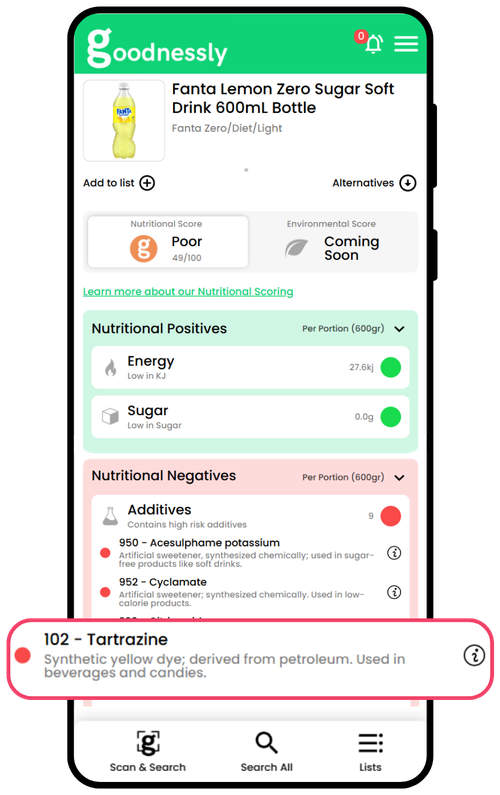
What is azorubine (carmoisine)?
Azorubine, most commonly known as Carmoisine, is a synthetic azo dye manufactured from petroleum-derived aromatic compounds. Despite being sometimes described using older terms like "coal tar dye," it isn't found in nature and is produced entirely through industrial chemical synthesis. It's used to give foods and drinks a red to maroon colour, particularly where a stable, vivid, inexpensive colour is wanted and natural alternatives are considered less consistent or more costly.
What's it used for?
- Red/maroon colouring in confectionery and lollies
- Colouring in soft drinks and cordials
- Colouring in jams, sauces and some processed foods
Where you'll find E122 on the shelf
It's a common colouring in confectionery and drinks marketed with bright, bold colours, including many products aimed at children.
Is azorubine (carmoisine) safe? What the research says
Azorubine's biggest controversy traces back to the 2007 Southampton Study, which examined mixtures of artificial colours, including Azorubine, combined with the preservative sodium benzoate, and found a possible link to increased hyperactivity in children. Regulators have responded very differently since, and the US has never approved it at all.
| Region | Status | What this means |
|---|---|---|
| AU/NZ Australia & New Zealand (FSANZ) | Permitted | Must be declared by name or number (122). No hyperactivity warning label required — FSANZ found insufficient evidence of a causal link at permitted levels. |
| EU European Union (EFSA) | Permitted with warning | Must carry the label "may have an adverse effect on activity and attention in children" — part of the "Southampton Six" colours. EFSA's 2009 re-evaluation set an Acceptable Daily Intake of 4 milligrams per kilogram of body weight per day. |
| US United States (FDA) | Not approved | Azorubine/Carmoisine has never been on the FDA's list of approved colour additives and isn't permitted in the US food supply. |
EFSA's exposure assessments have generally found that estimated intake of Azorubine sits within its Acceptable Daily Intake for most population groups, separate from the ongoing debate over the Southampton Study's hyperactivity findings, which is a behavioural question rather than a question about exceeding a numerical safety threshold.
- The 2007 Southampton Study: the original UK research tested mixtures of artificial colours, including Azorubine, together with the preservative sodium benzoate, and found a possible association with increased hyperactivity in children in the general population, not just children already diagnosed with ADHD.
- Divergent regulatory responses: the EU responded with a precautionary mandatory warning label on Azorubine and five related dyes (the Southampton Six), while FSANZ concluded the evidence wasn't strong enough to establish a clear causal link and did not introduce an equivalent Australian requirement.
- Reformulation trend: a number of manufacturers, particularly those selling into the EU or targeting health-conscious consumers, have shifted toward natural colour alternatives such as anthocyanins or beetroot red in products previously coloured with Azorubine, especially products marketed to children.
This section is checked periodically rather than continuously — if you're reading this well after the date above, it's worth confirming nothing has changed before citing it.
Who might want to limit or avoid it
- Parents of children who seem to react to artificial colours with increased hyperactivity or attention difficulties, given the Southampton Study's findings and the EU's resulting warning label requirement
- People with known azo dye sensitivities, since Azorubine belongs to the same chemical family as other azo dyes linked to rare allergic-type reactions
- Anyone who prefers to minimise synthetic dye intake generally, given Azorubine has never been approved in the US and remains one of only six EU-flagged colours
Goodnessly rates E122 Avoid. It's permitted in Australia and the EU, but its inclusion in the EU's mandatory Southampton Six warning label, combined with its complete lack of approval in the US, place it in our highest-caution category.
How to spot it on a label
E122 must be declared clearly. Look out for:
- Azorubine
- Carmoisine
- 122 or E122
- Colour (122)
It's most common in brightly coloured confectionery, cordials and soft drinks, particularly imported or European-style products.
Related additives
Frequently asked questions
What is Azorubine (E122) made from?
Azorubine, also known as Carmoisine, is a synthetic azo dye manufactured from petroleum-derived aromatic compounds through industrial chemical synthesis. It isn't found in nature and isn't derived from plants, insects or minerals.
Why does the EU require a warning label on Azorubine but Australia doesn't?
Both regulators reviewed the same 2007 Southampton Study, which found a possible link between mixtures of artificial colours, including Azorubine, combined with the preservative sodium benzoate, and increased hyperactivity in some children. The EU took a precautionary approach and made a warning label mandatory for Azorubine and five related colours, known as the Southampton Six. FSANZ concluded the evidence wasn't strong enough to establish a causal link for the general population and did not introduce an equivalent requirement.
Is Azorubine banned in the United States?
It has never been approved for use in the US food supply in the first place, so there's no ban to speak of. Azorubine/Carmoisine simply isn't on the FDA's list of permitted colour additives.
Does Goodnessly rate E122 as safe, caution or avoid?
Goodnessly rates E122 (Azorubine/Carmoisine) as Avoid. It's permitted in Australia and the EU, but its inclusion in the EU's mandatory Southampton Six warning label, combined with its lack of approval in the US, place it in our highest-caution category.
Don't decode labels by hand
Scan any product with the Goodnessly app to instantly see its full additive breakdown, kept current as new research like this comes to light.
Download our app to check additives in everyday foods