What is E155?
Brown HT — a synthetic chocolate-brown dye banned in nine countries including the US, yet still approved in the EU as a substitute for cocoa colouring.
E155 (Brown HT) is a fully synthetic azo dye used to give food a chocolate-brown colour, often as a cheaper substitute for cocoa or caramel colouring. It's one of the "Southampton Six" dyes requiring a mandatory EU warning label, and EFSA actually reduced its safe daily intake limit in 2010 after review, with a later assessment finding some population groups at high risk of exceeding it. It's banned outright in nine countries, including the US. Goodnessly rates it Avoid.
Download our app to check additives in everyday foods
Read the FAQ →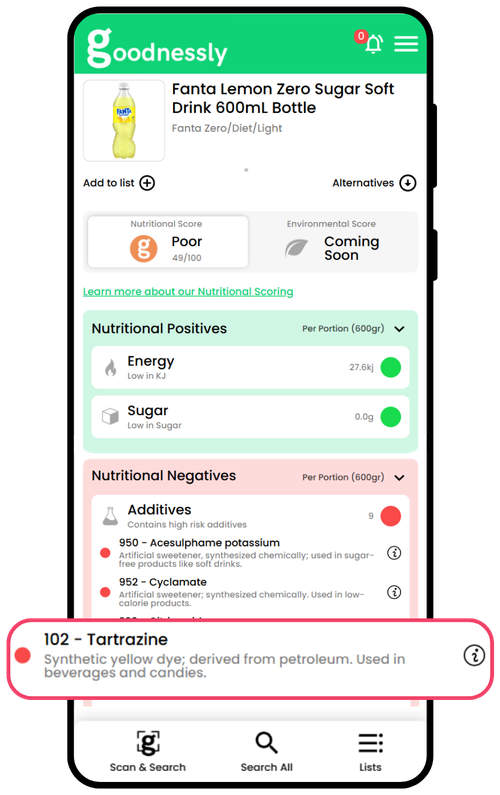
What is Brown HT?
Brown HT (also called Chocolate Brown HT) is a fully synthetic azo dye, historically developed from coal tar and petroleum derivatives, valued because it's more stable under heat and light than natural cocoa or caramel colouring and gives manufacturers a cheaper, more consistent way to achieve a chocolate-brown shade. It's highly soluble in water and holds its colour well through processing and storage, which is part of why it became popular in the confectionery industry despite the controversy that's followed it.
What's it used for?
- Colouring chocolate cakes and desserts
- Some milk and cheese products
- Yoghurt, jams and fruit products
- Occasionally used in fish products
Where you'll find 155 on the shelf
Anywhere a chocolate-brown colour is needed, often instead of real cocoa.
Is Brown HT safe? What the research says
E155's regulatory trajectory moved in the more cautious direction over time, alongside a genuinely wide multi-country ban.
| Region | Status | What this means |
|---|---|---|
| AU/NZ Australia & New Zealand (FSANZ) | Permitted | Permitted as a food colour, must be declared by name or number on the ingredient list. |
| EU European Union (EFSA) | Permitted, ADI reduced | Listed as E155. In April 2010, EFSA reduced the Acceptable Daily Intake to 1.5mg per kilogram of bodyweight per day after reviewing new evidence. A 2014 refined exposure assessment found some population groups at high risk of consuming more than this limit. It's one of the "Southampton Six" colours requiring a mandatory warning label about possible effects on children's activity and attention. |
| US United States | Not approved | Not approved for food use. Also banned in Austria, Belgium, Denmark, France, Germany, Norway, Sweden and Switzerland. |
Like other azo dyes, Brown HT can trigger histamine release in sensitive individuals, and has been linked to urticaria (hives), angioedema and bronchospasm particularly in people with aspirin sensitivity or salicylate intolerance.
- EFSA's own exposure findings: EFSA's 2014 refined exposure assessment specifically flagged that some population groups have a high risk of exceeding the safe daily intake for E155, a notable finding directly from the regulator responsible for its approval.
- No recent reconsideration for a wider ban: E155's status has remained unchanged in most major markets for years, reflecting an ongoing, unresolved gap between EU approval and the wide list of countries that have chosen not to permit it.
This section is checked periodically rather than continuously — if you're reading this well after the date above, it's worth confirming nothing has changed before citing it.
Who might want to limit or avoid it
- People with aspirin sensitivity or salicylate intolerance, who may be more prone to reactions like hives or bronchospasm with azo dyes
- Anyone with asthma, given documented reports of azo dyes exacerbating symptoms in sensitive individuals
- Anyone who prefers ingredients with current approval across major regulatory regions, given E155's absence from the US and eight European countries
Goodnessly rates E155 Avoid. It remains legally approved in the EU and Australia, but EFSA's own decision to reduce its ADI, combined with a wide multi-country ban and its place among the Southampton Six, places it in our highest-caution category.
How to spot it on a label
E155 must be declared clearly, along with the mandatory EU warning. Look out for:
- Brown HT
- Chocolate Brown HT
- 155 or E155
- "Colour (155)" in the ingredients list, with the accompanying activity/attention warning
Chocolate cakes and desserts are the most common places to find it.
Related additives
Frequently asked questions
Is Brown HT used instead of real chocolate colouring?
Yes — it's often used as a cheaper, more stable substitute for cocoa or caramel colouring, since it holds up better under heat, light and long storage than natural brown colourants.
Why is E155 banned in the US but not the EU?
Regulatory bodies in different regions have reached different conclusions from the same broad body of evidence. The US and eight European countries outside EU-wide harmonisation have chosen not to approve it, while the EU permits it with a reduced Acceptable Daily Intake and mandatory warning label.
Does Goodnessly rate E155 as safe, caution, or avoid?
Goodnessly rates E155 (Brown HT) as Avoid. It remains legally approved in the EU and Australia, but EFSA's own decision to reduce its ADI, combined with a wide multi-country ban and its place among the Southampton Six, places it in our highest-caution category.
Don't decode labels by hand
Scan any product with the Goodnessly app to instantly see its full additive breakdown, kept current as new research like this comes to light.
Download our app to check additives in everyday foods