What is E151?
Brilliant Black BN (Black PN) — a synthetic azo black food colour used in confectionery, desserts and some sauces in markets that authorise it.
Brilliant Black BN (E151), also called Black PN or Brilliant Black PN, is a synthetic azo dye used to colour foods black or dark purple-black. It is permitted in Australia/NZ and the EU within set limits; EFSA's 2010 re-evaluation confirmed an ADI of 5 mg/kg body weight per day, with some high-percentile child estimates able to exceed that ADI at then-current maximum reported uses (a 2015 refined exposure assessment found refined scenarios below the ADI). It has never been authorised by the FDA as a US food colour additive — the same pattern as colours such as Ponceau 4R (E124). Goodnessly rates it Avoid.
Download our app to check additives in everyday foods
Read the FAQ →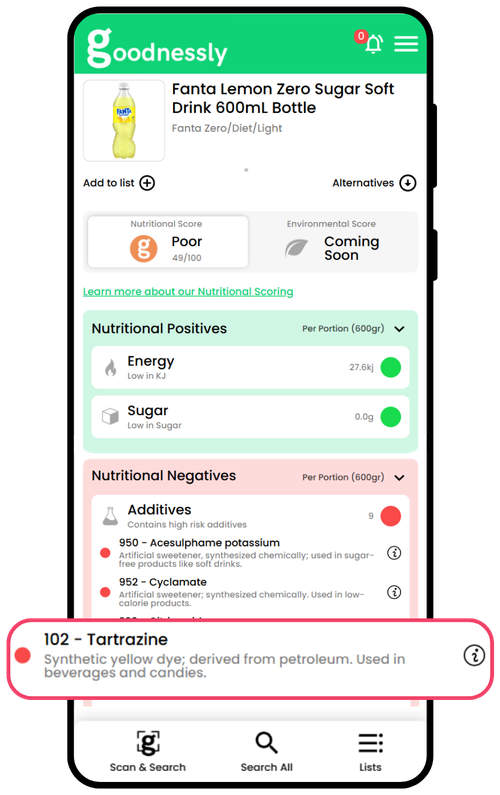
What is Brilliant Black BN?
Brilliant Black BN (E151) is a synthetic bis-azo dye (CI Food Black 1) that produces a black to bluish-black shade. It is also known as Black PN or Brilliant Black PN. It is not the same as vegetable carbon (E153), which is a different black colouring. On labels you may see "Brilliant Black BN", "Brilliant Black PN", "Black PN", "151", "E151", or "colour (151)".
What's it used for?
- Black colouring in confectionery, decorations and coatings
- Colouring desserts, jellies and ice creams where authorised
- Used in some sauces, fish pastes and savoury products in markets that allow it
- Used in selected soft drinks and flavoured products where black/purple shades are wanted
Where you'll find E151 on the shelf
Less ubiquitous than red or yellow azo dyes, but still worth checking on black confectionery, novelty desserts and some savoury sauces in AU/EU-formulated products.
Is Brilliant Black BN safe? What the research says
Brilliant Black BN remains authorised in Australia/NZ and the EU with a numerical ADI, but it is not an FDA-listed US food colour. EFSA's 2010 opinion confirmed the SCF ADI of 5 mg/kg bw/day and noted that some high-percentile child intakes at maximum reported uses could exceed it; the 2015 refined exposure assessment brought refined brand-loyal and non-brand-loyal estimates below the ADI for the population groups assessed. It is not on the EU Southampton Six Annex V warning list.
| Region | Status | What this means |
|---|---|---|
| AU/NZ Australia & New Zealand (FSANZ) | Permitted (colour) | Listed as Brilliant black BN or Brilliant Black PN (151) in the Australia New Zealand Food Standards Code among permitted colours for specified categories. Must be declared by name or number when used as a food additive colour. |
| EU European Union (EFSA) | Authorised; ADI 5 mg/kg bw/day | Authorised as E151 under Regulation (EC) No 1333/2008 for specified categories with maximum levels. EFSA's 2010 re-evaluation confirmed an ADI of 5 mg/kg bw/day. A 2015 refined exposure assessment found mean and high-level refined exposures below the ADI for assessed population groups. E151 is not among the Annex V Southampton Six warning colours. |
| US United States (FDA) | Not authorised as a US food colour | Brilliant Black BN / Black PN is not listed among FDA-certified colour additives for food. Products sold as US food generally cannot use it as a colour additive the way FD&C Blue No. 1 or Yellow No. 6 are used. Finding 151 on a label usually points to an AU/NZ or EU-formulated product (or an import path), not a standard US-certified colour. |
Not being FDA-listed is a regional permission fact, not by itself a proof of harm at authorised EU/AU uses. Goodnessly's Avoid rating reflects our preference to minimise non-essential synthetic azo colours when alternatives exist. In vitro genotoxicity signals discussed in EFSA's 2010 opinion were weighed against negative long-term carcinogenicity data — the Panel did not revise the ADI on that basis.
- EFSA 2010 (E151): ADI of 5 mg/kg bw/day confirmed; some high-percentile child estimates at maximum reported uses could exceed the ADI.
- EFSA 2015 refined exposure: refined brand-loyal and non-brand-loyal scenarios below the ADI for assessed groups (usage data covered a subset of authorised categories).
- US status: still not authorised as an FDA food colour additive (same broad pattern as E104/E124) as of this draft check (September 2026).
This section is checked periodically rather than continuously — if you're reading this well after the date above, it's worth confirming nothing has changed before citing it.
Who might want to limit or avoid it
- People who prefer to minimise synthetic azo food colours
- Shoppers comparing black confectionery who would rather see vegetable carbon (E153) or no added colour — noting E153 is a different additive with its own page
- Anyone with a clinician-recognised sensitivity to synthetic food dyes
Goodnessly rates E151 Avoid. Brilliant Black BN remains permitted within set rules in Australia/NZ and the EU, and is not authorised as a US food colour, but colour is rarely nutritionally essential, and our consumer stance is stricter than bare legal permission for synthetic azo dyes.
How to spot it on a label
Look for the name or number on black or dark purple-black products:
- Brilliant Black BN / Brilliant Black PN / Black PN
- 151 or E151
- Colour (151) or food colouring (151)
- Not the same as vegetable carbon (153)
If a US-made product is black, it is unlikely to be using E151 — check the actual colour name or number.
Related additives
Frequently asked questions
What is Brilliant Black BN (E151) made from?
It is a synthetic bis-azo dye (also called Black PN) manufactured for food colouring. It is not the same as vegetable carbon (E153).
Is Brilliant Black allowed in the US?
No. It is not an FDA-authorised food colour additive. It remains authorised for specified uses in Australia/NZ and the EU. That regional split is similar to colours such as Ponceau 4R (E124).
Is E151 one of the Southampton Six?
No. The EU Annex V hyperactivity warning list covers six other colours (E102, E104, E110, E122, E124, E129). E151 is not on that list, but Goodnessly still rates it Avoid.
Does Goodnessly rate E151 as safe, caution or avoid?
Goodnessly rates E151 (Brilliant Black BN) as Avoid.
Don't decode labels by hand
Scan any product with the Goodnessly app to instantly see its full additive breakdown, kept current as new research like this comes to light.
Download our app to check additives in everyday foods