What is E270?
Lactic acid (E270) is an acidity regulator and preservative used in a wide range of foods. Goodnessly rates it Caution as a preference to notice frequent acidity-regulator use.
E270 is an organic acid used to adjust acidity and support preservation or fermentation-related food processes. It can be produced by fermentation or other food-manufacturing routes.
Download our app to check additives in everyday foods
Read the FAQ →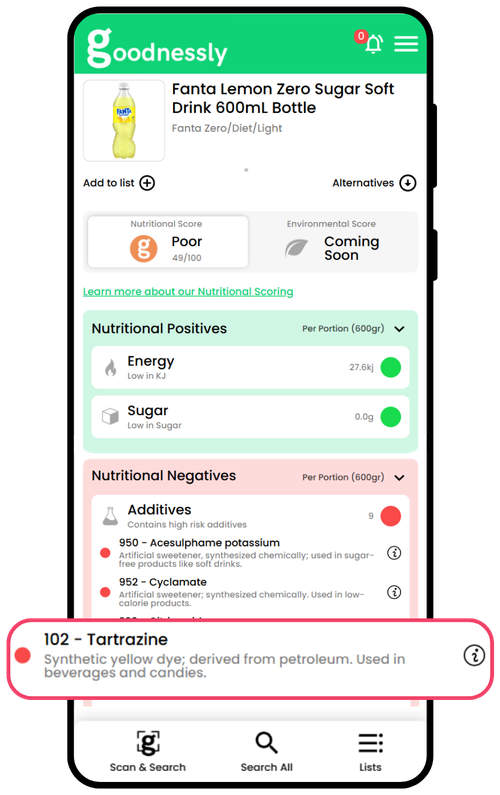
What is Lactic acid?
E270 is an organic acid used to adjust acidity and support preservation or fermentation-related food processes. It can be produced by fermentation or other food-manufacturing routes.
What's it used for?
- Adjusting acidity and pH
- Supporting preservation systems
- Providing tartness in selected foods and drinks
- Supporting fermentation-related processing
Where you'll find E270 on the shelf
It appears across acidic foods, fermented foods, dressings and prepared products.
Is E270 safe? What the regulators say
Lactic acid is widely permitted, but its use levels and technological function are controlled by the applicable food standard. EFSA included it in a 2026 monitoring/data call.
| Region | Status | What this means |
|---|---|---|
| AU/NZ Australia & New Zealand (FSANZ) | Permitted with conditions | FSANZ lists lactic acid as additive 270 in Schedule 15 and sets category-specific conditions. |
| EU European Union (EFSA) | Authorised with conditions | E270 is on the EU Union list for specified uses under Regulation (EC) No 1333/2008. |
| US United States (FDA) | Permitted under applicable food-additive rules | FDA recognises lactic acid for specified food uses; the exact regulatory basis depends on the use and formulation. |
Caution is a preference-based reminder to look at the whole product, not a claim that food-grade lactic acid in authorised use causes harm.
- EFSA’s 2026 call includes lactic acid E270 and related lactates for analytical and use-level data.
- FSANZ Schedule 15 contains the AU/NZ permissions.
- EU conditions are set through the Union list.
This section is checked periodically rather than continuously — if you're reading this well after the date above, it's worth confirming nothing has changed before citing it.
Who might want to limit or avoid it
- People who prefer fewer functional additives
- People comparing highly acidic or formulated foods
- People with an individual sensitivity identified by a clinician
Goodnessly rates E270 Caution as a moderation preference; lactic acid remains a permitted food additive under specified conditions.
How to spot it on a label
Look for:
- Lactic acid
- 270 or E270
- Acidity regulator (270)
- Lactic acid in an acidity-regulator system
Do not confuse food-additive E270 with a diagnosis or with lactic acid made naturally during fermentation.
Related additives
Frequently asked questions
What is E270?
E270 is lactic acid, an acidity regulator used in selected foods and drinks.
Is E270 permitted?
Yes. E270 is permitted with conditions in Australia/New Zealand, the EU and the US.
Why is E270 rated Caution?
Goodnessly uses Caution as a preference to notice frequent acidity-regulator use, not as a claim of definite harm.
How does Goodnessly rate E270?
Goodnessly rates E270 (lactic acid) as Caution.
Don't decode labels by hand
Scan any product with the Goodnessly app to instantly see its full additive breakdown, kept current as new research like this comes to light.
Download our app to check additives in everyday foods