What is E302?
Calcium ascorbate — a gentler, non-acidic form of Vitamin C, used as an antioxidant and calcium source.
E302 (calcium ascorbate) is made by combining calcium with ascorbic acid (Vitamin C). It works as an antioxidant in a similar way to ascorbic acid itself, but is less acidic, which makes it useful in products where a lower acidity or extra calcium is preferred. Goodnessly rates it Safe.
Download our app to check additives in everyday foods
Read the FAQ →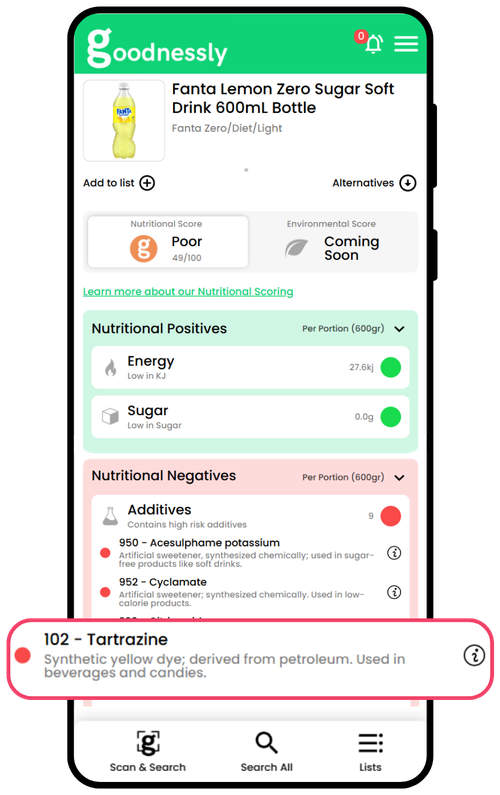
What is calcium ascorbate?
Calcium ascorbate is made by combining calcium with ascorbic acid, the chemical name for Vitamin C. Because it's a neutralised salt rather than a free acid, it's much less acidic and less likely to affect the taste of a product than ascorbic acid on its own, which is part of why manufacturers reach for it when they want the antioxidant benefits of Vitamin C without adding sourness.
What's it used for?
- Antioxidant to prevent browning and spoilage in fruit and vegetable products
- Vitamin C and calcium fortification in juices and supplements
- Used in cured meats as part of the curing process
Where you'll find 302 on the shelf
Common wherever Vitamin C's antioxidant effect is needed without added tartness.
Is calcium ascorbate safe? What the research says
Calcium ascorbate is derived from Vitamin C, one of the most extensively studied and universally recognised nutrients, with a very clean regulatory record.
| Region | Status | What this means |
|---|---|---|
| AU/NZ Australia & New Zealand (FSANZ) | Permitted, no limit | Permitted at quantum satis (as much as needed for the intended purpose). |
| EU European Union (EFSA) | Permitted, no ADI | Listed as E302, with no numerical Acceptable Daily Intake needed. |
| US United States (FDA) | GRAS | Holds Generally Recognized As Safe status under 21 CFR 182.3189. |
As a salt of Vitamin C, calcium ascorbate is metabolised in the body in essentially the same way as ascorbic acid, an essential nutrient the body cannot produce on its own and must obtain from food.
- No significant regulatory changes: calcium ascorbate's approval status has remained stable, reflecting its long, low-controversy safety record as a Vitamin C derivative.
This section is checked periodically rather than continuously — if you're reading this well after the date above, it's worth confirming nothing has changed before citing it.
Who this matters to
- No population group has a specific safety-based reason to limit E302 at typical food-additive levels
Goodnessly rates E302 Safe. It's derived from Vitamin C, one of the most extensively studied and universally recognised nutrients.
How to spot it on a label
E302 is usually declared clearly. Look out for:
- Calcium ascorbate
- 302 or E302
- "Antioxidant (302)" in the ingredients list
Fruit and vegetable products and cured meats are the most common places to find it.
Related additives
Frequently asked questions
Is calcium ascorbate the same as Vitamin C?
Closely related but not identical. Calcium ascorbate is made by combining calcium with ascorbic acid (Vitamin C), producing a less acidic salt with the same antioxidant properties.
Why use calcium ascorbate instead of ascorbic acid?
Calcium ascorbate is less acidic than ascorbic acid, so it can provide the same antioxidant benefits without adding noticeable sourness to a product, while also contributing a small amount of calcium.
Does Goodnessly rate E302 as safe, caution, or avoid?
Goodnessly rates E302 (Calcium Ascorbate) as Safe. It's derived from Vitamin C, one of the most extensively studied and universally recognised nutrients, with no formal daily intake limit needed.
Don't decode labels by hand
Scan any product with the Goodnessly app to instantly see its full additive breakdown, kept current as new research like this comes to light.
Download our app to check additives in everyday foods