What is E327?
Calcium lactate — a simple calcium salt of lactic acid, used as an acidity regulator, firming agent and calcium fortification ingredient.
E327 (calcium lactate) is made by combining calcium with lactic acid, a common food acid also produced naturally during fermentation. JECFA has assigned it an Acceptable Daily Intake of "not limited," reflecting very low toxicological concern, and it belongs to the well-reviewed lactate family. Goodnessly rates it Safe.
Download our app to check additives in everyday foods
Read the FAQ →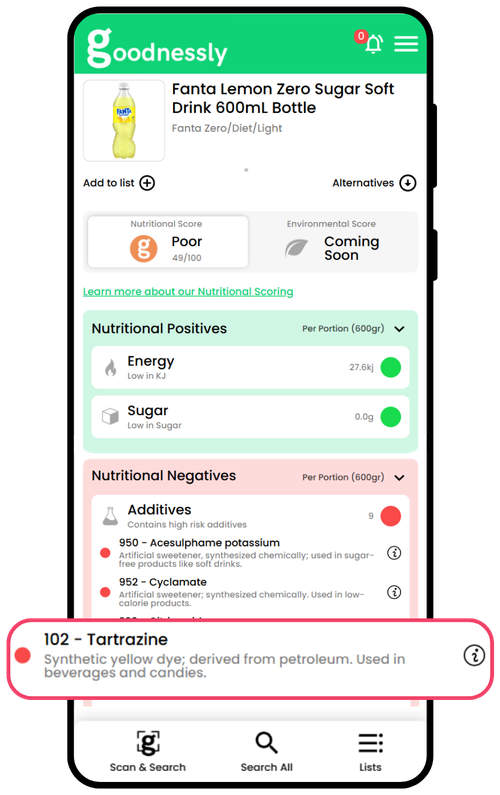
What is calcium lactate?
Calcium lactate is made by combining calcium with lactic acid, the same acid that gives yoghurt and sourdough their tang and is produced naturally during fermentation. It's a white, largely tasteless powder, often chosen over other calcium compounds because it dissolves well and doesn't add a noticeable flavour. Beyond its additive role, it's also used as a calcium supplement.
What's it used for?
- Firming agent in canned and processed fruits and vegetables
- Calcium fortification in juices, cereals and plant-based milk alternatives
- Acidity regulator in a range of processed foods
- Used in some cheese production
Where you'll find 327 on the shelf
Common in canned produce and calcium-fortified products.
Is calcium lactate safe? What the research says
Calcium lactate belongs to the well-reviewed lactate family, with a clean regulatory record.
| Region | Status | What this means |
|---|---|---|
| AU/NZ Australia & New Zealand (FSANZ) | Permitted | Permitted as a firming agent and acidity regulator with no specific quantity restriction in most categories. |
| EU European Union (EFSA) | Permitted, no ADI | Listed as E327, permitted in a variety of foods including jams, cheese and canned fruits and vegetables under Regulation 1333/2008. |
| US United States (FDA) | GRAS | Holds Generally Recognized As Safe status under 21 CFR 184.1207. |
JECFA (the joint WHO/FAO expert committee) has assigned lactic acid and calcium lactate an Acceptable Daily Intake of "not limited," the designation used for additives of very low toxicological concern. That same evaluation carries one caveat: the D(-) and DL forms of lactic acid should not be used in foods for infants, so lactates in infant products are restricted to the L(+) form.
- No significant regulatory changes: calcium lactate's approval status has remained stable, reflecting its long, low-controversy safety record.
This section is checked periodically rather than continuously — if you're reading this well after the date above, it's worth confirming nothing has changed before citing it.
Who this matters to
- Infant foods are the one exception — the D(-) and DL forms of lactic acid aren't considered suitable for infants, so lactates used in infant products are limited to the L(+) form
- Otherwise, no population group has a specific safety-based reason to limit E327 at typical food-additive levels
Goodnessly rates E327 Safe. It's part of the well-reviewed lactate family, carrying JECFA's "not limited" ADI designation for very low toxicological concern.
How to spot it on a label
E327 is usually declared clearly. Look out for:
- Calcium lactate
- 327 or E327
- "Firming agent (327)" in the ingredients list
Canned produce and fortified juices are the most common places to find it.
Related additives
Frequently asked questions
Is calcium lactate the same as lactic acid?
Closely related but not identical. Calcium lactate is made by combining calcium with lactic acid, producing a salt used both as an additive and as a calcium supplement.
Why is calcium lactate used in canned fruits and vegetables?
It acts as a firming agent, helping produce keep its texture through the canning process rather than becoming soft or mushy.
Does Goodnessly rate E327 as safe, caution, or avoid?
Goodnessly rates E327 (Calcium Lactate) as Safe. It's part of the well-reviewed lactate family, and JECFA has assigned it an Acceptable Daily Intake of "not limited," reflecting very low toxicological concern.
Don't decode labels by hand
Scan any product with the Goodnessly app to instantly see its full additive breakdown, kept current as new research like this comes to light.
Download our app to check additives in everyday foods