INS 340ii (E340): what is potassium phosphate?
Also labelled: Mineral salt 340 · INS340ii · INS 340(ii) · Dipotassium phosphate · Potassium phosphate dibasic · E340
INS 340ii, also written INS340ii, E340(ii) or mineral salt 340, is dipotassium phosphate. It is one of three potassium phosphates grouped under E340: 340(i) monopotassium, 340(ii) dipotassium and 340(iii) tripotassium phosphate. It works as a buffer and stabiliser, for example in coffee sachets and creamers. Goodnessly rates E340 Hazardous Risk under its precautionary scoring, reflecting EFSA’s findings on total phosphate intake.
E340 covers the potassium phosphates. Dipotassium phosphate (340ii) helps buffer acidity and keep milk proteins stable, which is why it turns up in instant coffee mixes and creamers. It is permitted with conditions in Australia/New Zealand, the EU and the US. EFSA’s 2019 re-evaluation set a group ADI of 40 mg phosphorus per kilogram of body weight per day for phosphates, counting phosphorus from all dietary sources.
Download our app to check additives in everyday foods
Read the FAQ →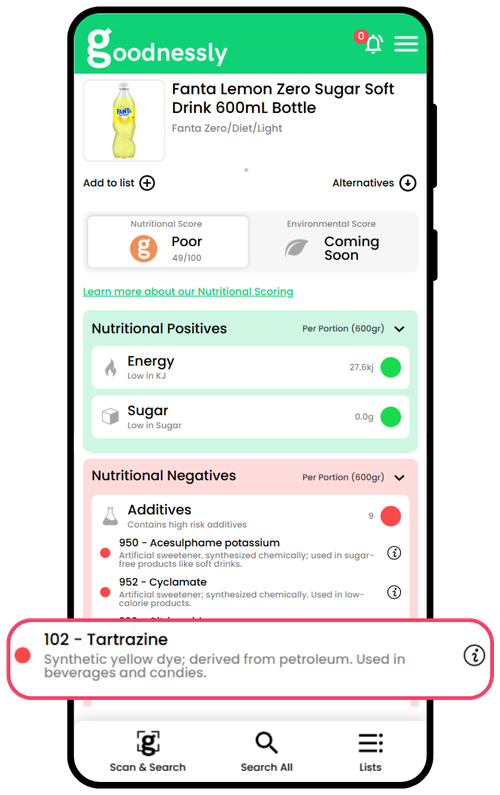
What is Potassium phosphate?
Potassium phosphate refers to phosphate salts of potassium. Different E340 forms can support buffering, acidity control and mineral functions in food formulations.
What's it used for?
- Buffering acidity
- Supporting emulsifying and stabilising functions
- Managing mineral balance in selected foods
- Supporting processing where authorised
Where you'll find E340 on the shelf
It is most relevant to processed foods, beverages, dairy-style products and formulations that need phosphate buffering or stabilisation.
Products containing E340 (INS 340)
Examples from products we've rated where E340 appears in the listed ingredients. Formulations change, so always check the current pack.
Is E340 permitted? What the regulators say
Potassium phosphate is permitted or authorised in the three systems checked, but the permitted purpose, food category and amount matter.
| Region | Status | What this means |
|---|---|---|
| AU/NZ Australia & New Zealand (FSANZ) | Permitted with conditions | FSANZ lists potassium phosphates as additive 340; Schedule 15 category and maximum-level conditions apply. |
| EU European Union (EFSA) | Authorised with conditions | E340(i)–(iii) potassium phosphates are on the EU Union list for specified categories and conditions. |
| US United States (FDA) | Permitted for specified uses | FDA 21 CFR 182.6285 covers dipotassium phosphate as GRAS when used in accordance with good manufacturing practice; the exact salt and use matter. |
Regulators including FSANZ permit potassium phosphates within set limits. Goodnessly rates E340 Hazardous Risk under its precautionary scoring, because EFSA’s 2019 re-evaluation of phosphate additives found that estimated total phosphorus intake can exceed its group ADI (40 mg phosphorus/kg body weight per day) in some younger age groups, and noted that the ADI does not apply to people with moderate to severe reduced kidney function. This is not a claim that permitted use is harmful.
EFSA set a group ADI of 40 mg phosphorus/kg body weight/day for phosphates, including E340, in its 2019 re-evaluation.
- EFSA 2019 re-evaluation set a group ADI for phosphates of 40 mg phosphorus/kg body weight/day, including E340; this covers total dietary phosphorus, not only the additive
- FSANZ August 2026 Food Standards Code, Schedule 15
- EUR-Lex Union list and FDA 21 CFR 182.6285
This section is checked periodically rather than continuously — if you're reading this well after the date above, it's worth confirming nothing has changed before citing it.
Who might want to limit or avoid it
- People checking total phosphorus intake
- People comparing buffering salts
- People reading the wider formulation of processed foods
Goodnessly rates E340 Hazardous Risk as a practical prompt to understand the ingredient, the product and the overall formulation.
How to spot it on a label
Look for:
- Potassium phosphate
- Dipotassium phosphate
- 340 or E340
- Acidity regulator (340)
Labels may use the additive name, its number, or a functional class followed by the number.
Related additives
Frequently asked questions
What is INS 340ii?
INS 340ii is dipotassium phosphate, also called potassium phosphate dibasic, a potassium salt of phosphoric acid. On Australian labels it may appear as mineral salt (340), stabiliser (340) or acidity regulator (340), and in the EU as E340(ii).
What is the difference between 340i, 340ii and 340iii?
They are three potassium phosphates: 340(i) is monopotassium phosphate, 340(ii) is dipotassium phosphate and 340(iii) is tripotassium phosphate. They differ in how many potassium atoms they carry and how alkaline they are. Labels often just say 340.
Why is dipotassium phosphate in coffee sachets and creamers?
It acts as a buffer and stabiliser. In instant coffee mixes and creamers it helps keep dairy or plant proteins evenly dispersed when they meet hot, slightly acidic coffee, so the drink stays smooth instead of feathering.
What ADI did EFSA set for phosphates?
In its 2019 re-evaluation, EFSA set a group ADI of 40 mg phosphorus per kilogram of body weight per day for phosphates, including E340. The ADI covers phosphorus from the whole diet, not only food additives. Goodnessly rates E340 Hazardous Risk under its precautionary scoring, reflecting EFSA’s findings on total phosphate intake.
Don't decode labels by hand
Scan any product with the Goodnessly app to instantly see its full additive breakdown, kept current as new research like this comes to light.
Download our app to check additives in everyday foods