What is E355?
Adipic acid — a simple acid best known as the raw material for nylon, used in small amounts in food to adjust tartness and act as a gelling aid.
E355 (adipic acid) is a white crystalline acid, occurring naturally in trace amounts in sugar beet, but almost always produced synthetically for food use. The vast majority of the world's adipic acid production actually goes into making nylon, not food — food use is a tiny fraction of total output. No harmful effects have been identified at the levels used as a food additive. Goodnessly rates it Safe.
Download our app to check additives in everyday foods
Read the FAQ →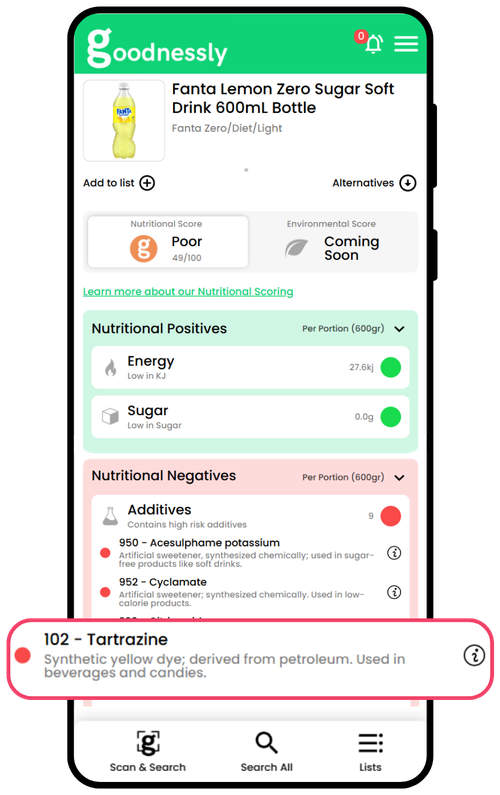
What is adipic acid?
Adipic acid (also called hexanedioic acid) is a simple organic acid with two carboxyl groups. It occurs naturally in trace amounts in sugar beet, but is almost never extracted from plants for commercial use — instead, it's synthesised industrially from cyclohexane. Globally, adipic acid is an enormous industrial chemical, with around 2.5 billion kilograms produced every year, the overwhelming majority destined for making nylon and other plastics. Only a small fraction of that production is food-grade and used as an additive.
What's it used for?
- Acidity regulator, adjusting tartness in a range of foods
- Gelling aid in confectionery
- Buffering agent to stabilise pH
- Used in fillings and icings for baked goods
Where you'll find 355 on the shelf
A minor, functional ingredient in a small range of processed foods.
Is adipic acid safe? What the research says
Adipic acid has a long, uncontroversial history as a food additive, separate from its enormous industrial role in plastics manufacturing.
| Region | Status | What this means |
|---|---|---|
| AU/NZ Australia & New Zealand (FSANZ) | Permitted | Permitted as an acidity regulator and gelling aid. |
| EU European Union (EFSA) | Permitted | Listed as E355, approved for use in specific food categories including confectionery and desserts. |
| US United States (FDA) | GRAS | Holds Generally Recognized As Safe status for general food use. |
No harmful side effects have been identified from adipic acid at food-additive levels. Adipic acid is also approved for food contact materials (like packaging), separate from its use as a direct food additive.
- No significant regulatory changes: adipic acid's approval status has remained stable, reflecting its long, low-controversy safety record as a food additive.
This section is checked periodically rather than continuously — if you're reading this well after the date above, it's worth confirming nothing has changed before citing it.
Who this matters to
- No population group has a specific safety-based reason to limit E355 at typical food-additive levels
Goodnessly rates E355 Safe. It has a long, uncontroversial history as a food additive, with no harmful effects identified at the levels used.
How to spot it on a label
E355 is usually declared clearly. Look out for:
- Adipic acid
- 355 or E355
- "Acidity regulator (355)" in the ingredients list
Confectionery, gelling desserts and cake fillings are the most common places to find it.
Related additives
Frequently asked questions
Is adipic acid the same chemical used to make nylon?
Yes — adipic acid is the same chemical compound used as a starting material for nylon and other plastics, which accounts for the vast majority of its production worldwide. Only a small fraction is food-grade and used as an additive.
Is E355 natural or synthetic?
It occurs naturally in trace amounts in sugar beet, but commercial adipic acid, including the food-grade version, is almost always produced synthetically from cyclohexane.
Does Goodnessly rate E355 as safe, caution, or avoid?
Goodnessly rates E355 (Adipic Acid) as Safe. It has a long, uncontroversial history as a food additive, with no harmful effects identified at the levels used.
Is E355 vegan?
Yes. Adipic acid used as a food additive is produced synthetically and doesn't involve animal-derived ingredients.
Don't decode labels by hand
Scan any product with the Goodnessly app to instantly see its full additive breakdown, kept current as new research like this comes to light.
Download our app to check additives in everyday foods