What is E359?
Ammonium adipate — a simple salt made by neutralising adipic acid with ammonia, permitted in Australia and New Zealand as an acidity regulator in salt substitutes.
E359 (ammonium adipate) is made by neutralising adipic acid — an acid used industrially at enormous scale, mainly to make nylon — with ammonia. It belongs to the well-reviewed adipate family alongside adipic acid (355), sodium adipate (356) and potassium adipate (357), all of which share a JECFA group Acceptable Daily Intake. Its permitted use is narrow: in Australia and New Zealand it's allowed in salt substitutes, and it isn't an approved additive in the EU or the US. Goodnessly rates it Safe.
Download our app to check additives in everyday foods
Read the FAQ →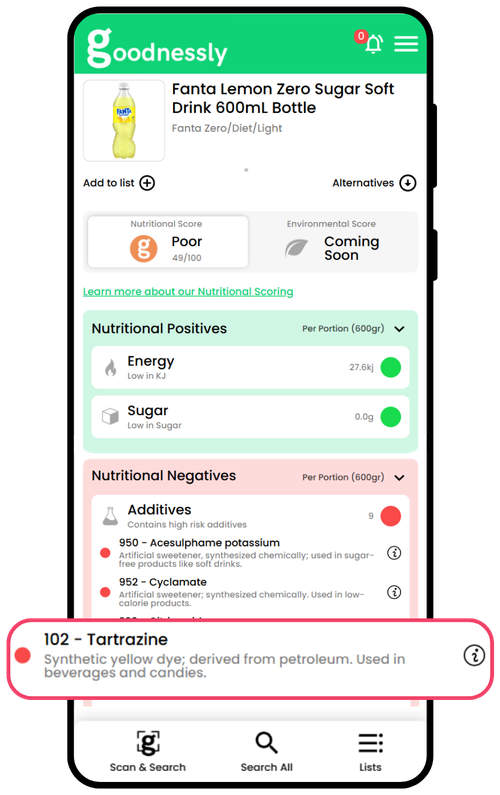
What is ammonium adipate?
Ammonium adipate is made by neutralising adipic acid with ammonia. Adipic acid itself is a common food acid, used industrially at enormous scale, mainly to make nylon, so ammonium adipate is a straightforward derivative of a well-established food ingredient. It's part of a small family of adipate salts used across the food industry — sodium adipate (356) and potassium adipate (357) are the others — and JECFA evaluated the whole group together.
What's it used for?
- Acidity regulator in salt substitutes, its one permitted use in Australia and New Zealand
- Buffering agent to stabilise pH
- Supplies the ammonium ion in place of sodium in salt-replacement blends
Where you'll find 359 on the shelf
A narrowly permitted ingredient — in Australia and New Zealand, salt substitutes are its only approved use.
Is ammonium adipate safe? What the research says
Ammonium adipate belongs to the well-reviewed adipate family, with a clean regulatory record.
| Region | Status | What this means |
|---|---|---|
| AU/NZ Australia & New Zealand (FSANZ) | Permitted | Permitted at GMP, but only in salt substitutes (food category 12.1.3) — not a general-purpose additive. |
| EU European Union (EFSA) | Not authorised | Not on the EU additives list. The authorised adipates are E355 (adipic acid), E356 (sodium adipate) and E357 (potassium adipate). |
| US United States (FDA) | Not listed | No separate US clearance for ammonium adipate. Adipic acid itself is GRAS under 21 CFR 184.1009. |
JECFA (the joint WHO/FAO expert committee) has set a group Acceptable Daily Intake of 0–5 mg per kg of body weight covering adipic acid together with its ammonium, sodium and potassium salts. Adipic acid occurs naturally in small amounts in beet juice, though the adipic acid used to make food additives is manufactured synthetically.
- No significant regulatory changes: ammonium adipate's approval status has remained stable, reflecting its long, low-controversy safety record.
This section is checked periodically rather than continuously — if you're reading this well after the date above, it's worth confirming nothing has changed before citing it.
Who this matters to
- No population group has a specific safety-based reason to limit E359 at typical food-additive levels
- Anyone using salt substitutes regularly — that's the one product type it turns up in, and those products are often used daily
Goodnessly rates E359 Safe. It's part of the adipate family covered by JECFA's group Acceptable Daily Intake, and its limited approvals reflect how narrowly it's used rather than a safety finding against it.
How to spot it on a label
E359 is usually declared clearly. Look out for:
- Ammonium adipate
- 359 or E359
- Ammonium adipates
- "Acidity regulator (359)" in the ingredients list
Salt substitutes are the place to look for it.
Related additives
Frequently asked questions
Is ammonium adipate the same as adipic acid?
Closely related but not identical. Ammonium adipate is made by neutralising adipic acid with ammonia, producing a salt with similar acidity-regulating properties.
Does Goodnessly rate E359 as safe, caution, or avoid?
Goodnessly rates E359 (Ammonium Adipates) as Safe. It's covered by JECFA's group Acceptable Daily Intake for adipic acid and its salts, and its narrow approvals reflect how little it's used rather than a safety finding against it.
Is E359 vegan?
Yes. Ammonium adipate is produced synthetically from adipic acid and ammonia, with no animal-derived ingredients involved.
Is E359 allowed in the EU and the US?
No. Ammonium adipate isn't on the EU additives list — the authorised adipates there are E355 (adipic acid), E356 (sodium adipate) and E357 (potassium adipate) — and it has no separate US clearance, although adipic acid itself is GRAS. In Australia and New Zealand it is permitted, but only in salt substitutes.
Don't decode labels by hand
Scan any product with the Goodnessly app to instantly see its full additive breakdown, kept current as new research like this comes to light.
Download our app to check additives in everyday foods