What is E368?
Ammonium fumarate — a simple salt made by neutralising fumaric acid with ammonia, used as an acidity regulator.
E368 (ammonium fumarate) is made by neutralising fumaric acid with ammonia. Fumaric acid is a naturally occurring acid found in some plants and produced by the body itself as part of normal cellular energy production (the Krebs cycle). Ammonium fumarate is used as an acidity regulator in a small range of processed foods. Goodnessly rates it Safe.
Download our app to check additives in everyday foods
Read the FAQ →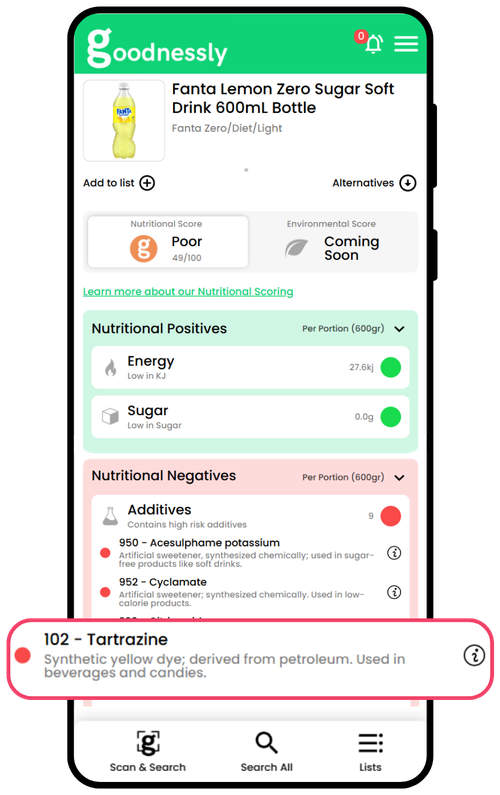
What is ammonium fumarate?
Ammonium fumarate is made by neutralising fumaric acid with ammonia. Fumaric acid itself is a naturally occurring organic acid, found in some plants like bolete mushrooms and Iceland moss, and it's also produced inside every cell in your body as an intermediate step in the Krebs cycle, the core metabolic pathway that generates cellular energy. Ammonium fumarate is a straightforward derivative of this well-established compound.
What's it used for?
- Acidity regulator in a range of processed foods
- Buffering agent to stabilise pH
Where you'll find 368 on the shelf
A minor, functional ingredient in a small range of processed foods.
Is ammonium fumarate safe? What the research says
Ammonium fumarate is derived from fumaric acid, a compound the body already produces as part of normal metabolism, with a clean regulatory record.
| Region | Status | What this means |
|---|---|---|
| AU/NZ Australia & New Zealand (FSANZ) | Permitted | Permitted as an acidity regulator with no specific quantity restriction in most categories. |
| EU European Union (EFSA) | Permitted | Listed as E368, approved for general food use. |
| US United States (FDA) | GRAS | Holds Generally Recognized As Safe status for use as a food additive. |
Fumaric acid is produced naturally inside every human cell as part of the Krebs cycle, the metabolic pathway responsible for generating cellular energy.
- No significant regulatory changes: ammonium fumarate's approval status has remained stable, reflecting its long, low-controversy safety record.
This section is checked periodically rather than continuously — if you're reading this well after the date above, it's worth confirming nothing has changed before citing it.
Who this matters to
- No population group has a specific safety-based reason to limit E368 at typical food-additive levels
Goodnessly rates E368 Safe. It's derived from fumaric acid, a compound the body already produces naturally, with a long, uncontroversial history as a food additive.
How to spot it on a label
E368 is usually declared clearly. Look out for:
- Ammonium fumarate
- 368 or E368
- "Acidity regulator (368)" in the ingredients list
Related additives
Frequently asked questions
Is ammonium fumarate the same as fumaric acid?
Closely related but not identical. Ammonium fumarate is made by neutralising fumaric acid with ammonia, producing a salt with similar acidity-regulating properties.
Is fumaric acid found naturally in the body?
Yes — fumaric acid is produced inside every cell as part of the Krebs cycle, the metabolic pathway responsible for generating cellular energy. It's also found naturally in some plants, including bolete mushrooms.
Does Goodnessly rate E368 as safe, caution, or avoid?
Goodnessly rates E368 (Ammonium Fumarate) as Safe. It's derived from fumaric acid, a compound the body already produces naturally, with a long, uncontroversial safety record.
Don't decode labels by hand
Scan any product with the Goodnessly app to instantly see its full additive breakdown, kept current as new research like this comes to light.
Download our app to check additives in everyday foods