What is E385?
Calcium disodium EDTA (E385) is a sequestrant used in specific foods to bind trace metals and help protect quality. Goodnessly rates E385 Safe, while food-category permissions and the relevant regulator assessment still apply.
Calcium disodium EDTA (E385) is a sequestrant used in specific foods to bind trace metals and help protect quality. Check the food category, amount and full formulation rather than judging one ingredient in isolation.
Download our app to check additives in everyday foods · Eco score: Coming Soon
Read the FAQ →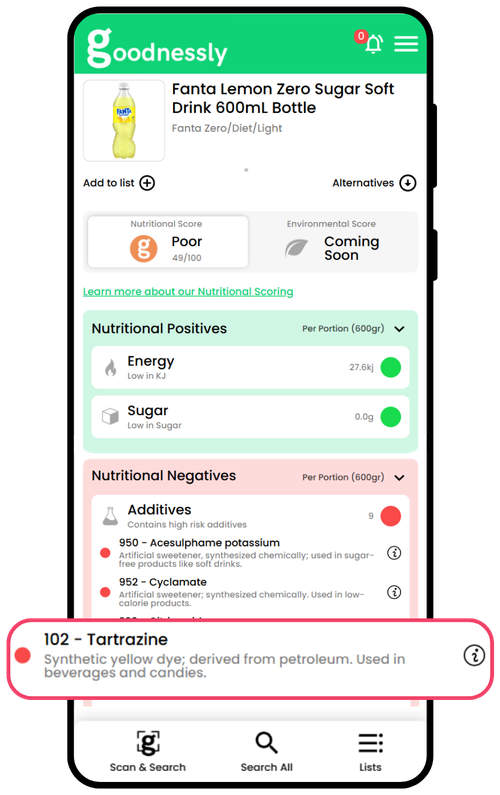
What is Calcium disodium EDTA?
E385 is a calcium disodium salt of EDTA. Its technological role is to bind certain metal ions in tightly defined food applications.
What's it used for?
- Sequestering trace metal ions
- Helping protect colour and flavour in selected foods
- Supporting stability in specified formulations
- Working as a technological aid rather than a bulk ingredient
Where you'll find E385 on the shelf
You may see E385 in selected dressings, spreads, canned foods or other products where a sequestrant is permitted.
Is E385 permitted? What the regulators say
E385 is listed or permitted in the three systems checked, with category, level and specification conditions applying.
| Region | Status | What this means |
|---|---|---|
| AU/NZ Australia & New Zealand (FSANZ) | Permitted with conditions | FSANZ lists 385 calcium disodium EDTA with Schedule 15 food-category conditions and levels. [FSANZ source] |
| EU European Union (EUR-Lex) | Authorised with conditions | The Union list includes E385 calcium disodium EDTA for specified food categories and conditions. [EUR-Lex source] |
| US United States (FDA) | Permitted with conditions | FDA permits calcium disodium EDTA for specified food uses under 21 CFR 172.120 and related applicable conditions. |
Goodnessly rates E385 Safe within its rating system. The rating does not remove the need to consider the product category, amount or full formulation.
- EFSA’s 2024 call for data covers the re-evaluation of calcium disodium EDTA. JECFA’s 0–2.5 mg/kg body-weight ADI and the food-category limits in each jurisdiction should not be treated as interchangeable.
- JECFA’s ADI for calcium disodium EDTA is 0–2.5 mg/kg body weight. EFSA opened a call for data for the re-evaluation of E385 in 2024, so the assessment programme remains relevant.
- An ADI or “not specified” conclusion is a population risk-assessment reference, not a statement that a particular food is unsafe.
This section is checked periodically rather than continuously — confirm the current primary source before relying on a regulatory detail.
Who might want to limit or avoid it
- People comparing sequestrants in processed foods
- People checking the frequency of permitted EDTA uses
- People who want to consider the whole formulation and serving pattern
Goodnessly rates E385 Safe as a practical prompt to understand the ingredient, the product and the overall formulation.
How to spot it on a label
Look for:
- Calcium disodium EDTA
- Calcium disodium ethylenediaminetetraacetate
- 385 or E385
- Sequestrant (385)
Ingredient labels may use the name, the number, or the additive class followed by the number.
Related additives
Frequently asked questions
What is E385?
E385 is calcium disodium EDTA, a sequestrant used in specific foods to bind trace metal ions.
Is E385 permitted?
E385 is listed with conditions in Australia/New Zealand and the EU. FDA also permits specified uses under 21 CFR 172.120.
What is the E385 ADI?
JECFA’s ADI for calcium disodium EDTA is 0–2.5 mg/kg body weight.
How does Goodnessly rate E385?
Goodnessly rates E385 (calcium disodium EDTA) as Safe within its rating system.
Don't decode labels by hand
Scan any product with the Goodnessly app to see its full additive breakdown and understand the label at a glance.
Download our app to check additives in everyday foods · Eco score: Coming Soon