Raising agent 500 (E500): what are sodium carbonates?
Also labelled: Raising agent 500 · Mineral salt 500 · Acidity regulator 500 · Sodium carbonate · Sodium bicarbonate · Bicarb soda · Baking soda · Sodium hydrogen carbonate · Sodium sesquicarbonate · INS 500 · E500
Raising agent 500, also labelled mineral salt 500, E500 or INS 500, covers the sodium carbonates, including bicarb soda (sodium bicarbonate, 500ii). It helps biscuits, crackers and batters rise and adjusts acidity. Goodnessly rates E500 Safe.
E500 covers three related sodium salts: sodium carbonate (500i), sodium hydrogen carbonate, also called sodium bicarbonate or bicarb soda (500ii), and sodium sesquicarbonate (500iii). When bicarb soda meets an acid or heat it releases carbon dioxide, which lightens doughs and batters; the carbonates also adjust acidity, for example when alkalising cocoa. It is permitted in Australia/New Zealand, the EU and the US. JECFA allocated sodium carbonate and sodium hydrogen carbonate an ADI “not limited”, and the FDA lists both as GRAS. Goodnessly rates it Safe.
Download our app to check additives in everyday foods
Read the FAQ →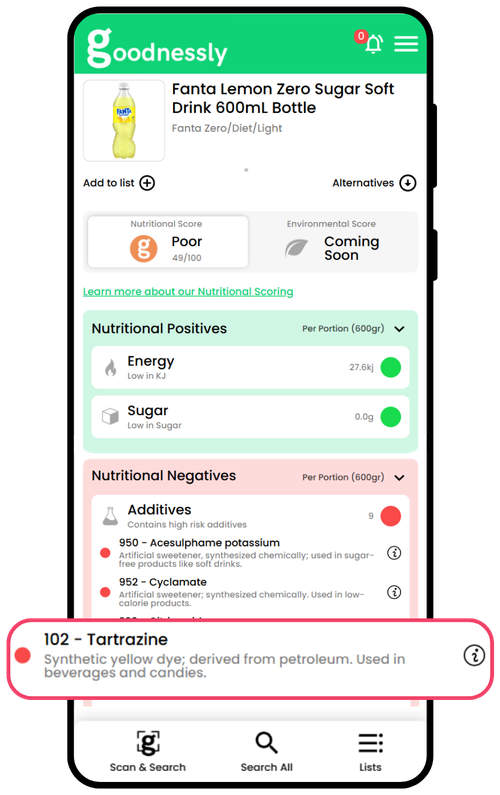
What are sodium carbonates?
E500 is a shared code for three sodium salts of carbonic acid. Sodium carbonate (500i) is the strongly alkaline salt also known as soda ash or washing soda. Sodium hydrogen carbonate (500ii) is the familiar bicarb soda, or baking soda, used in home kitchens. Sodium sesquicarbonate (500iii) is a combination of the two. In food, bicarb soda reacts with acids in a dough or batter, or breaks down with heat, releasing carbon dioxide bubbles that make baked goods rise. Unlike ammonium carbonate (503), it leaves a sodium salt behind in the finished food.
What's it used for?
- Raising agent in biscuits, crackers, cakes and batters (often bicarb soda)
- Acidity regulator, for example when alkalising cocoa or in some noodles
- An ingredient of baking powder, combined with a food acid
Where you'll find E500 on the shelf
Look for it wherever a light, crisp or airy texture matters, and in some chocolate and cocoa products.
Products containing E500 (INS 500)
Examples from products we've rated where E500 (sodium carbonates) appears in the listed ingredients. Showing 6 of 21 products we've rated that list E500. Formulations change, so always check the current pack.
Is sodium carbonate safe? What regulators say
The sodium carbonates have a long history in food and baking, and current regulatory treatment reflects that.
| Region | Status | What this means |
|---|---|---|
| AU/NZ Australia & New Zealand (FSANZ) | Permitted | Listed in Schedule 16 of the Food Standards Code among additives permitted at GMP (good manufacturing practice) in processed foods; must be declared by name or number on the ingredient list. [FSANZ Food Standards Code] |
| EU European Union | Permitted | Listed as E500(i), E500(ii) and E500(iii) in the Union list of food additives, permitted at quantum satis (as much as needed for the intended technological purpose) in many food categories. [EUR-Lex] |
| US United States (FDA) | GRAS | Sodium carbonate (21 CFR 184.1742) and sodium bicarbonate (21 CFR 184.1736) are each affirmed as Generally Recognized As Safe, used under good manufacturing practice. [eCFR] |
JECFA evaluated sodium carbonate and sodium hydrogen carbonate in 1965 and allocated an ADI “not limited”, the older form of its category for substances of very low toxicological concern at the levels used in food; specifications were revised in 2002. The main nutritional consideration is that E500 adds sodium, which counts toward total daily sodium intake.
- Stable regulatory status: FSANZ continues to list 500 among additives permitted at GMP, and the FDA’s GRAS affirmations for sodium carbonate and sodium bicarbonate remain in place.
- Sodium is the practical consideration: public-health advice focuses on total sodium intake. Bicarb soda contributes some sodium to baked goods, alongside salt and other sodium-containing ingredients.
This section is checked periodically rather than continuously — if you're reading this well after the date above, it's worth confirming nothing has changed before citing it.
Who might want to limit or avoid it
- Regulators don't flag a specific population group that needs to limit E500 at typical dietary levels
- People advised to follow a sodium-restricted diet may want to count it, along with salt, toward their overall sodium intake
Goodnessly rates E500 Safe. It is a long-established raising agent and acidity regulator, and regulators have not identified a safety concern that warrants a numerical intake limit.
How to spot it on a label
E500 must be declared clearly. Look out for:
- Raising agent (500), mineral salt (500) or acidity regulator (500)
- Sodium carbonate, sodium bicarbonate or sodium hydrogen carbonate
- Bicarb soda or baking soda
- 500, E500, 500(i), 500(ii) or 500(iii)
It often appears alongside a food acid or another raising agent, such as 450 or 503, in biscuits and baking mixes.
Related additives
Frequently asked questions
What is raising agent 500?
Raising agent 500 (E500) is the code for the sodium carbonates: sodium carbonate (500i), sodium hydrogen carbonate, better known as bicarb soda or baking soda (500ii), and sodium sesquicarbonate (500iii). On Australian labels it may appear as raising agent (500), mineral salt (500) or acidity regulator (500).
Is 500 the same as bicarb soda?
Partly. Bicarb soda (baking soda) is sodium hydrogen carbonate, numbered 500(ii). The code 500 also covers sodium carbonate (500i) and sodium sesquicarbonate (500iii), so a label that just says 500 could mean any of them. In biscuits, crackers and batters it is most often bicarb soda.
Is mineral salt 500 safe?
It is permitted in Australia/New Zealand, the EU and the US. JECFA allocated sodium carbonate and sodium hydrogen carbonate an ADI 'not limited', and the FDA lists both as generally recognised as safe (21 CFR 184.1742 and 184.1736). It does add a little sodium to a food. Goodnessly rates E500 Safe.
What is the difference between 500 and 503?
Both are raising agents. 500 covers the sodium carbonates, such as bicarb soda, which release carbon dioxide and leave a sodium salt behind in the food. 503 covers the ammonium carbonates (baker's ammonia), which break down completely into gases and water, so they suit only thin, crisp biscuits.
Don't decode labels by hand
Scan any product with the Goodnessly app to instantly see its full additive breakdown, kept current as new research like this comes to light.
Download our app to check additives in everyday foods