What is E170?
Calcium carbonate — a naturally occurring mineral, chemically identical to chalk and limestone, used as a calcium source, colour and anti-caking agent.
E170 (calcium carbonate) is a naturally abundant mineral, the same compound found in limestone, chalk and eggshells. It's used as a calcium fortification ingredient, a white food colour, and an acidity regulator. It's one of the most widely used minerals in food and medicine, including as a common antacid and calcium supplement. Goodnessly rates it Safe.
Download our app to check additives in everyday foods
Read the FAQ →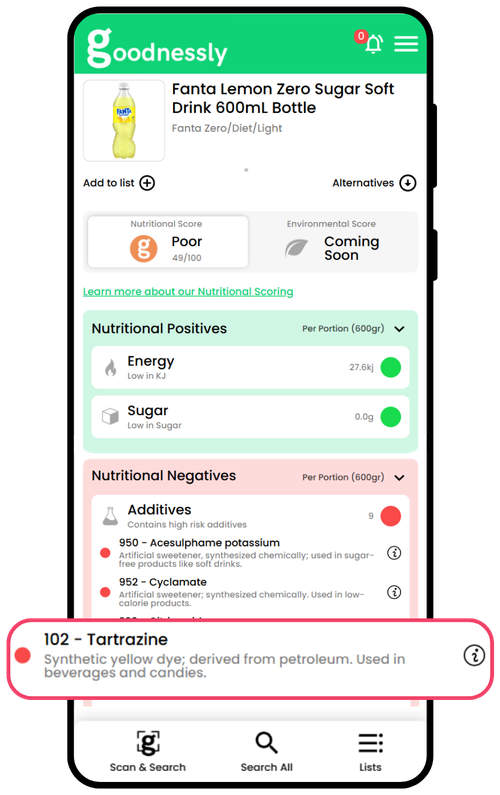
What is calcium carbonate?
Calcium carbonate is one of the most abundant minerals on Earth, forming limestone, marble and chalk, and it's also the main component of eggshells and many seashells. As a food additive, it's typically ground into a fine powder from mined limestone or precipitated in a purified form. It's also one of the most widely used calcium supplements and the active ingredient in many over-the-counter antacids, separate from its food-additive role.
What's it used for?
- Calcium fortification in flour, cereals and plant-based milk alternatives
- White food colouring
- Anti-caking agent
- Acidity regulator
Where you'll find 170 on the shelf
A common calcium-fortification ingredient across many staple foods.
Is calcium carbonate safe? What the research says
Calcium carbonate is one of the most extensively used minerals in both food and medicine, with a very long safety record.
| Region | Status | What this means |
|---|---|---|
| AU/NZ Australia & New Zealand (FSANZ) | Permitted, no limit | Permitted at quantum satis (as much as needed for the intended purpose) for most uses. |
| EU European Union (EFSA) | Permitted, no ADI | Listed as E170, with no numerical Acceptable Daily Intake needed. |
| US United States (FDA) | GRAS | Holds Generally Recognized As Safe status under 21 CFR 184.1191. |
Calcium carbonate is also the active ingredient in many over-the-counter antacids and a common calcium supplement, reflecting decades of established clinical safety data alongside its food-additive approval.
- No significant regulatory changes: calcium carbonate's approval status has remained stable, reflecting its long, low-controversy safety record.
This section is checked periodically rather than continuously — if you're reading this well after the date above, it's worth confirming nothing has changed before citing it.
Who this matters to
- Anyone taking large amounts of calcium supplements alongside fortified foods, who may want to keep total calcium intake in mind
- Otherwise, no population group has a specific safety-based reason to limit E170
Goodnessly rates E170 Safe. It's one of the most extensively used minerals in both food and medicine, with a very long safety record.
How to spot it on a label
E170 is usually declared clearly. Look out for:
- Calcium carbonate
- 170 or E170
- "Colour (170)" or "Anti-caking agent (170)" in the ingredients list
Fortified flour, cereals and plant-based milks are the most common places to find it.
Related additives
Frequently asked questions
Is E170 the same as chalk?
Yes, chemically — calcium carbonate is the compound that makes up chalk, limestone, marble and the shells of eggs and many sea creatures. The food-grade version is purified for consumption.
Is calcium carbonate used in medicine?
Yes — separate from its food-additive role, calcium carbonate is the active ingredient in many over-the-counter antacids and is also widely used as a calcium supplement.
Does Goodnessly rate E170 as safe, caution, or avoid?
Goodnessly rates E170 (Calcium Carbonate) as Safe. It's one of the most extensively used minerals in both food and medicine, with a very long safety record and no formal daily intake limit.
Don't decode labels by hand
Scan any product with the Goodnessly app to instantly see its full additive breakdown, kept current as new research like this comes to light.
Download our app to check additives in everyday foods