What is 512?
A tin compound used as an antioxidant and colour retention agent, mainly in canned and bottled vegetables.
Stannous chloride (512), also called tin(II) chloride, is a tin salt used to protect colour and flavour in some canned and bottled foods. It is permitted in Australia and New Zealand. In the EU, E512 is authorised only for canned and bottled white asparagus, and in the US it is Generally Recognised as Safe. JECFA has set a Provisional Tolerable Weekly Intake for tin. Goodnessly rates it Moderate Risk.
Download our app to check additives in everyday foods
Read the FAQ →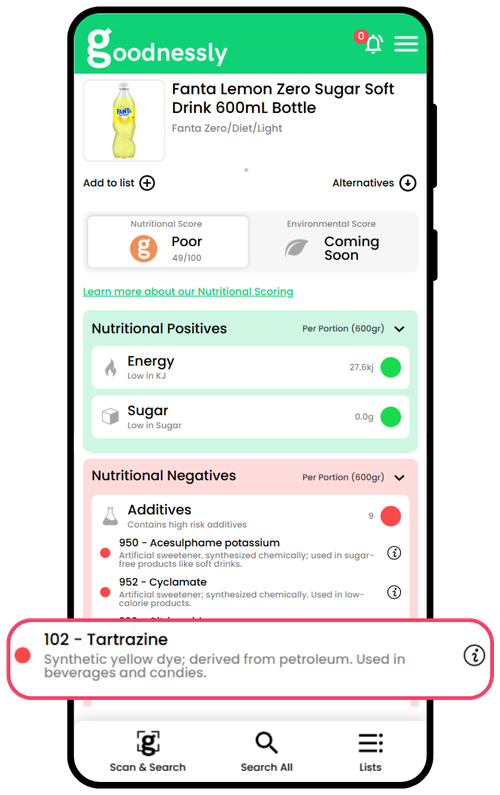
What is stannous chloride (tin(II) chloride)?
Stannous chloride is an inorganic tin compound. In food it acts as a reducing agent and antioxidant, helping stop light-coloured vegetables discolouring during processing and storage. It is used in very small amounts.
What's it used for?
- Colour retention in canned and bottled white asparagus
- Antioxidant in some canned vegetables
- Occasional use in canned drinks and processed foods
- Also used outside food, for example in some toothpastes
Where you'll find 512 on the shelf
It is uncommon on labels and mostly found in canned and bottled vegetables.
Is stannous chloride safe? What the research says
At permitted levels regulators consider stannous chloride acceptable. Tin itself is poorly absorbed, but JECFA has noted that high tin concentrations in canned foods have been associated with short-term stomach upset, which is why tin intake is limited. Use as an additive is a small contributor compared with tin from cans.
| Region | Status | What this means |
|---|---|---|
| AU/NZ Australia & New Zealand (FSANZ) | Permitted | Listed in the Food Standards Code as an antioxidant. FSANZ also sets a maximum level for tin in canned foods. |
| EU European Union (EFSA) | Restricted | Authorised as E512 only for canned and bottled white asparagus (maximum 25 milligrams per kilogram, as tin) under Regulation (EC) No 1333/2008. |
| US United States (FDA) | Permitted | Stannous chloride is Generally Recognised as Safe under 21 CFR 184.1845. |
JECFA established a Provisional Tolerable Weekly Intake for tin of 14 milligrams per kilogram of body weight, and has advised keeping tin levels in canned foods as low as practical.
- JECFA tin intake limit: The Provisional Tolerable Weekly Intake of 14 milligrams per kilogram of body weight remains JECFA's reference point for tin.
- EU restricted use: The EU continues to limit E512 to canned and bottled white asparagus.
- EFSA 2018 re-evaluation: EFSA re-evaluated E512 in 2018 and concluded it is of no safety concern at its current authorised use and levels.
This section is checked periodically rather than continuously — if you're reading this well after the date above, it's worth confirming nothing has changed before citing it.
Who might want to limit or avoid it
- People who eat a lot of canned vegetables and prefer to limit tin exposure
- Anyone with a sensitive stomach who notices reactions to canned foods
- People who prefer fresh or frozen vegetables over canned where possible
Goodnessly rates 512 Moderate Risk. It is permitted, but its tight EU restriction and tin intake limits put it in our Moderate Risk category.
How to spot it on a label
Look out for:
- Stannous chloride
- Tin chloride or tin(II) chloride
- 512 or E512
- Antioxidant (512)
Check canned and bottled asparagus and other pale vegetables.
Related additives
Frequently asked questions
What is stannous chloride used for in food?
It helps light-coloured vegetables such as white asparagus keep their colour and flavour in cans and jars by acting as an antioxidant.
Is tin in food harmful?
Tin is poorly absorbed by the body. JECFA has noted that very high tin levels in some canned foods have been associated with short-term stomach upset, and it set a weekly intake limit to keep exposure low.
Is stannous chloride allowed in Europe?
Yes, but only in canned and bottled white asparagus. It is permitted more broadly in Australia, New Zealand and the US.
How does Goodnessly rate 512?
Goodnessly rates 512 (stannous chloride) as Moderate Risk. It is permitted, but its tight EU restriction and tin intake limits put it in this category.
Don't decode labels by hand
Scan any product with the Goodnessly app to instantly see its full additive breakdown, kept current as new research like this comes to light.
Download our app to check additives in everyday foods