Isomalt 953 (E953): what is it?
Also labelled: Sweetener 953 · Humectant 953 · Isomalt · Isomaltitol · INS 953 · E953
Isomalt 953, also labelled sweetener 953, E953 or INS 953, is a sugar alcohol (polyol) made from sucrose. It adds sweetness and bulk in sugar-free lollies and other confectionery. Goodnessly rates E953 Risk Free, while larger amounts may be uncomfortable for some people.
Isomalt is made by converting sucrose into isomaltulose and then hydrogenating it. JECFA assigned it an ADI “not specified”. In Australia and New Zealand, foods containing 25 g or more of isomalt per 100 g must carry an advisory statement that excess consumption may have a laxative effect. Check the serving size and the full formulation rather than judging one ingredient in isolation.
Download our app to check additives in everyday foods · Eco score: Coming Soon
Read the FAQ →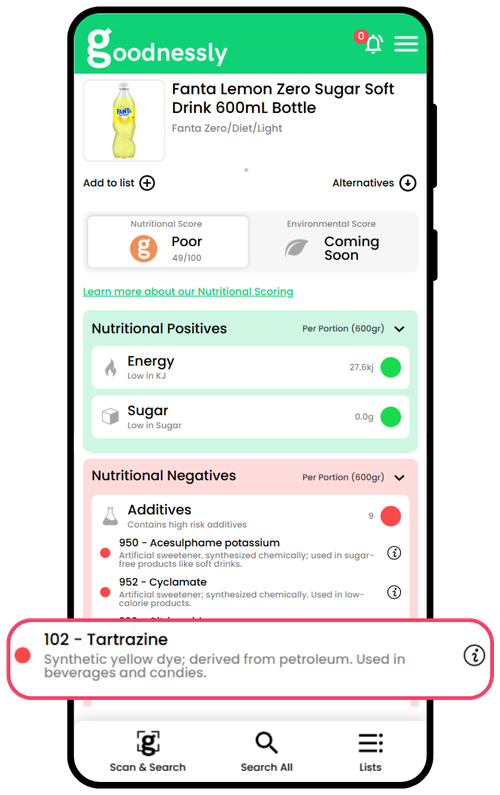
What is Isomalt?
Isomalt is a sugar alcohol, also called hydrogenated isomaltulose, used mainly for sweetness, bulk and texture.
What's it used for?
- Sweetening foods
- Providing bulk in reduced-sugar formulations
- Supporting confectionery texture
- Replacing some sucrose functions
Where you'll find E953 on the shelf
It is commonly associated with sugar-free confectionery, chewing gum, baked goods and other reduced-sugar formulations.
Is E953 permitted? What the regulators say
E953 is authorised or permitted in the three systems checked, with food-category, labelling and good manufacturing practice conditions applying.
| Region | Status | What this means |
|---|---|---|
| AU/NZ Australia & New Zealand (FSANZ) | Permitted with conditions | FSANZ Schedule 15 includes additive 953 isomalt, with category-specific permissions and levels applying. |
| EU European Union (EFSA) | Authorised with conditions | E953 isomalt is on the EU Union list for specified food categories and conditions. |
| US United States (FDA) | Permitted with conditions | FDA 21 CFR 101.80 lists isomalt among eligible noncariogenic carbohydrate sweeteners for specified health-claim conditions; food use and labelling still depend on the applicable FDA rules. |
Goodnessly rates E953 Risk Free within its rating system. The rating does not remove the need to consider the product category, amount or full formulation.
- JECFA assigned isomalt an ADI of “not specified” in 1985, meaning a numerical ADI was not considered necessary when used according to good manufacturing practice.
- EFSA’s re-evaluation of isomalt was not finalised in the latest check; no newer EFSA numerical ADI is stated here.
- Like other sugar alcohols, larger amounts may be associated with digestive discomfort for some people; individual tolerance varies.
This section is checked periodically rather than continuously — if you're reading this well after the date above, it's worth confirming nothing has changed before citing it.
Who might want to limit or avoid it
- People who notice digestive effects from sugar alcohols
- People comparing reduced-sugar confectionery
- People checking total sweetener intake and the rest of the ingredient list
Goodnessly rates E953 Risk Free as a practical prompt to understand the ingredient, the product and the overall formulation.
How to spot it on a label
Look for:
- Isomalt
- Hydrogenated isomaltulose
- 953 or E953
- Sweetener (953)
Ingredient labels may use the name, the number, or the additive class followed by the number.
Related additives
Frequently asked questions
What is isomalt 953?
Isomalt 953 (E953) is a sugar alcohol, or polyol, made from sucrose. It is used for sweetness, bulk and texture in sugar-free lollies, chewing gum and other confectionery.
Does isomalt 953 have a laxative effect?
In larger amounts it can. Like other polyols, isomalt is only partly absorbed, and eating a lot at once is associated with digestive discomfort in some people. In Australia and New Zealand, foods containing 25 g or more of isomalt per 100 g must carry an advisory statement that excess consumption may have a laxative effect.
Is isomalt a sugar or an artificial sweetener?
Neither, exactly. Isomalt is a sugar alcohol (polyol) made from sucrose. It is not an intense sweetener like aspartame, and it provides fewer kilojoules per gram than sugar.
How does Goodnessly rate E953?
Goodnessly rates E953 (isomalt) as Risk Free. JECFA assigned an ADI 'not specified', and it is permitted with conditions in Australia/New Zealand and the EU. Serving size and individual tolerance still matter.
Don't decode labels by hand
Scan any product with the Goodnessly app to see its full additive breakdown and understand the label at a glance.
Download our app to check additives in everyday foods · Eco score: Coming Soon