What is E153?
Vegetable carbon — an intense black colouring made by charring plant material, approved in the EU but never permitted in the US due to a genuine contamination risk from the manufacturing process itself.
E153 (vegetable carbon) is produced by carbonising plant material like wood or coconut shells at very high temperature, leaving behind an intensely black, nearly pure carbon powder. The manufacturing process, charring organic material, can generate polycyclic aromatic hydrocarbons (PAHs), a known class of carcinogens, if not tightly controlled. JECFA and EFSA consider it safe when properly manufactured with negligible PAH contamination, but the US has never approved carbon black for food use, specifically because of this contamination risk. Goodnessly rates it Avoid.
Download our app to check additives in everyday foods
Read the FAQ →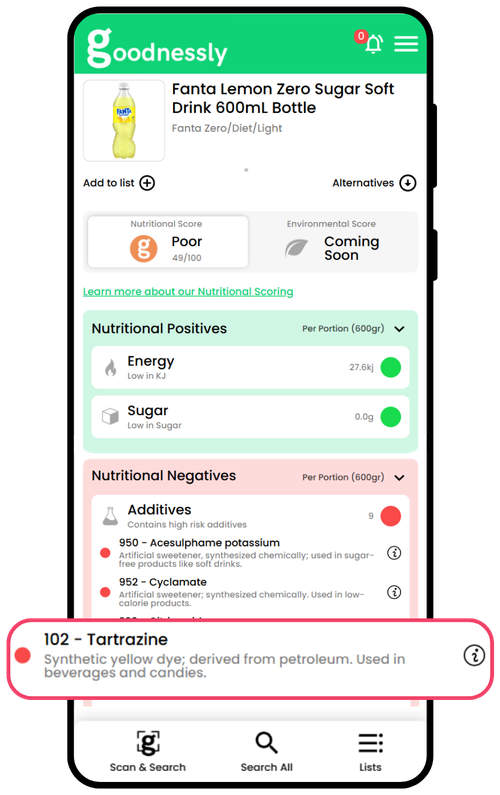
What is vegetable carbon?
Vegetable carbon is produced by carbonising plant material such as wood, cellulose residues, peat or coconut shells at very high temperature, essentially the same process used to make charcoal, refined into a fine powder that's over 95% pure carbon. It's odourless, tasteless, completely insoluble in water and oil, and its intense black colour and heat/light stability make it useful wherever an intense black shade is needed. The manufacturing process itself is the source of the main safety consideration: incomplete combustion of organic material can produce polycyclic aromatic hydrocarbons (PAHs), a well-established class of carcinogenic compounds, which is why regulatory specifications require testing to confirm PAH levels are kept negligibly low.
What's it used for?
- Colouring liquorice, jellies and dark chocolate
- The traditional black ash coating on French Morbier cheese
- Black wax cheese coatings
- Some spirits and liqueurs
Where you'll find 153 on the shelf
Common wherever an intensely black shade is wanted, especially in Europe.
Is vegetable carbon safe? What the research says
E153's approval status splits sharply along a genuine contamination-risk question, rather than a disagreement about carbon itself.
| Region | Status | What this means |
|---|---|---|
| AU/NZ Australia & New Zealand (FSANZ) | Permitted | Permitted with strict purity guidelines, must be declared by name or number. |
| EU European Union (EFSA) | Permitted, no ADI | Listed as E153. JECFA has assigned it "ADI not specified," and EFSA's estimated dietary exposure ranges from roughly 3 to 30mg per kilogram of bodyweight per day depending on age group, without a specific safety concern identified at these levels when purity specifications are met. |
| US United States (FDA) | Not approved | The FDA has never approved carbon black for food colouring use, though a related grade is batch-certified for use in some cosmetics. |
The specific concern is polycyclic aromatic hydrocarbons (PAHs), a class of compounds that can form during the incomplete combustion of organic material and are established carcinogens. JECFA's manufacturing specification requires a cyclohexane-extraction test to confirm PAH content is negligible, and EU/JECFA safety assessments assume this specification is properly met. The US has taken the more cautious position of not approving the additive for food use at all, rather than relying on manufacturing controls to keep contamination low.
- No recent US reconsideration: the US position has remained unchanged for decades, with no move toward approving carbon black for food use despite its acceptance in the EU and other major markets.
This section is checked periodically rather than continuously — if you're reading this well after the date above, it's worth confirming nothing has changed before citing it.
Who might want to limit or avoid it
- Anyone who prefers ingredients approved across all major regulatory regions, given the US has never permitted carbon black for food use
- Anyone who prefers to rely on outright non-approval rather than manufacturing-quality controls as a safety margin, given the PAH contamination risk depends on production standards being consistently met
Goodnessly rates E153 Avoid. JECFA and EFSA consider it safe when properly manufactured with negligible PAH contamination, but the fact that the US has never approved it for food use, specifically because of this contamination risk, places it in our highest-caution category.
How to spot it on a label
E153 must be declared clearly. Look out for:
- Vegetable carbon
- Carbon black
- 153 or E153
- "Colour (153)" in the ingredients list
Liquorice, jellies and speciality cheeses are the most common places to find it.
Related additives
Frequently asked questions
Is vegetable carbon the same as activated charcoal?
They're related but not identical. Both are made by carbonising organic material at high temperature, but they're processed differently for different purposes, and activated charcoal itself isn't approved as a food or colour additive in the US.
Why hasn't the US approved carbon black for food use?
The primary concern is that the carbonisation process used to make it can generate polycyclic aromatic hydrocarbons (PAHs), a class of established carcinogens, if not tightly controlled. The EU and JECFA rely on manufacturing specifications to keep PAH content negligible, while the US has taken the more cautious approach of not approving it for food use at all.
Does Goodnessly rate E153 as safe, caution, or avoid?
Goodnessly rates E153 (Vegetable Carbon) as Avoid. JECFA and EFSA consider it safe when properly manufactured with negligible PAH contamination, but the US has never approved it for food use, specifically because of this contamination risk, which places it in our highest-caution category.
Don't decode labels by hand
Scan any product with the Goodnessly app to instantly see its full additive breakdown, kept current as new research like this comes to light.
Download our app to check additives in everyday foods