What is E280?
Propionic acid — a short-chain preservative in the E280–E283 propionate group, used especially against mould in bread and bakery products.
Propionic acid (E280) is a preservative used mainly to limit mould in bread, tortillas and other bakery foods. Its sodium, calcium and potassium salts (E281–E283) are assessed with it as a group. It is permitted in Australia/NZ, the EU and the US within set conditions. EFSA's 2014 re-evaluation did not allocate a numerical ADI because the database was insufficient, but concluded that authorised uses at then-current maximum levels would not raise a safety concern for food as consumed. Propionates are also produced naturally by some gut bacteria and occur in some fermented foods. Goodnessly still rates E280 Avoid as a deliberately added bakery preservative.
Download our app to check additives in everyday foods
Read the FAQ →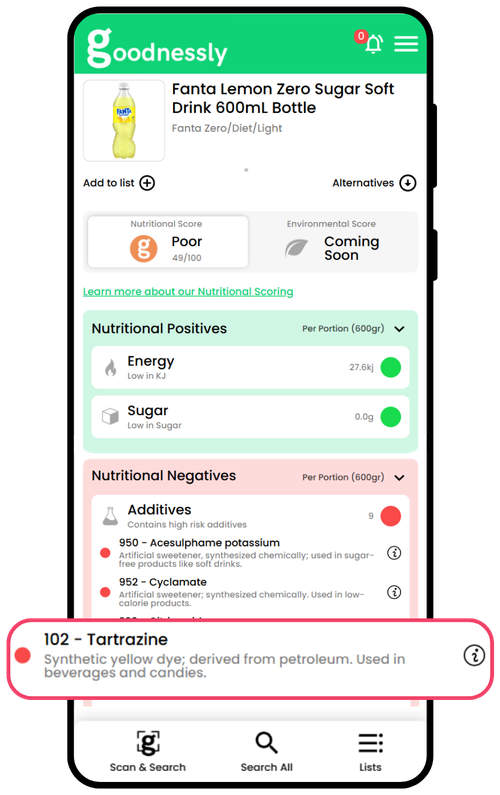
What is propionic acid?
Propionic acid (E280) is a three-carbon carboxylic acid (also called propanoic acid). As a food additive it is used for its antimicrobial effect, particularly against moulds in bakery products. The group includes sodium propionate (281), calcium propionate (282) and potassium propionate (283). Calcium propionate is the form many people notice first on Australian bread labels. On labels you may see "propionic acid", "280", "E280", or "preservative (280)".
What's it used for?
- Inhibiting mould in prepacked bread, rolls, tortillas and similar bakery products
- Preserving some processed cheese and bakery fillings where permitted
- Used in selected meat or fish preparations in markets that authorise those extensions
- Acting as a flavouring/acidulant in some applications in addition to preservation
Where you'll find E280 on the shelf
Most associated with packaged bread and bakery goods — the same shelf as calcium and sodium propionate.
Is propionic acid safe? What the research says
Propionic acid–propionates are widely permitted bakery preservatives. EFSA did not set a numerical ADI in 2014, citing database limits, while still concluding authorised food uses were not a safety concern at the concentrations assessed. Older animal studies reported local irritation effects (including forestomach changes in rodents, which EFSA considered not relevant to humans, and reversible oesophageal epithelial hyperplasia in dogs at higher dietary concentrations). Separate Australian research on calcium propionate and behaviour in some sensitive children is about the calcium salt and should not be over-read as proof that propionic acid alone softens behaviour in the general population.
| Region | Status | What this means |
|---|---|---|
| AU/NZ Australia & New Zealand (FSANZ) | Permitted (propionates group) | Propionic acid and its sodium, potassium and calcium salts appear in the Food Standards Code additive schedules for specified foods (bread and bakery categories are the familiar uses). Declare by name or number when used as a food additive. Unpackaged bread made and sold directly by a bakery may follow different declaration practicalities — always read the pack in front of you. |
| EU European Union (EFSA) | Authorised; no numerical ADI (EFSA 2014) | Authorised as E280 within the E280–E283 group under Regulation (EC) No 1333/2008, with category maximum levels (bakery uses commonly in the 1,000–3,000 mg/kg range depending on product type). EFSA's 2014 re-evaluation did not allocate an ADI; it concluded that for food as consumed there would not be a safety concern from maximum concentrations at authorised uses. A 2016 EFSA opinion on extending sodium propionate uses likewise did not identify a safety concern for the proposed extension. |
| US United States (FDA) | GRAS / permitted antimicrobial | Propionic acid and propionate salts have longstanding US food uses as antimicrobials and flavouring agents. Sodium propionate is affirmed GRAS under 21 CFR 184.1784 for listed foods at current GMP; propionic acid and calcium propionate have parallel GRAS listings in Part 184. Use must match the listed food categories and GMP conditions. |
EFSA's "no safety concern at authorised uses" is not the same as "ADI established" or "unnecessary for every loaf". Goodnessly's Avoid rating is a consumer-minimisation stance for a high-exposure bakery preservative group, not a claim that regulators have banned propionic acid. Behaviour findings tied to calcium propionate in sensitive children are associative and subgroup-specific.
- EFSA 2014 (E280–E283): no numerical ADI allocated; authorised uses at assessed maxima not considered a safety concern for food as consumed; local irritation endpoints discussed with human relevance caveats.
- EFSA 2016 extension (E281 context): proposed higher-use scenarios for sodium propionate in some meat/fish categories were not considered a safety concern in that opinion.
- Bakery labelling remains the practical check: packaged bread in AU/NZ commonly declares propionate preservatives by name or code when used.
This section is checked periodically rather than continuously — if you're reading this well after the date above, it's worth confirming nothing has changed before citing it.
Who might want to limit or avoid it
- People who want to minimise preservatives in daily staple bread and can buy fresh unsliced or preservative-free loaves
- Families who have noticed a personal association between propionate-preserved bread and sleep or behaviour changes (discuss with a clinician; evidence is limited and not general-population proof)
- Anyone already avoiding the wider E280–E283 group for simplicity
Goodnessly rates E280 Avoid. Propionic acid remains permitted in Australia/NZ, the EU and the US, and EFSA did not flag authorised uses as a safety concern in 2014, but the lack of a numerical ADI, the group's heavy use in everyday bread, and our preference to minimise non-essential preservatives in staple foods keep it in Avoid.
How to spot it on a label
On packaged bread and bakery labels, look for:
- Propionic acid / propanoic acid
- 280 or E280
- Preservative (280)
- Related: 281 sodium propionate, 282 calcium propionate, 283 potassium propionate
Calcium propionate (282) is the form you will see most often on Australian supermarket bread.
Related additives
Frequently asked questions
What is Propionic acid (E280) made from?
Propionic acid is a short-chain fatty acid manufactured for food use (and also formed naturally in some fermentation and gut processes). As E280 it is added deliberately as a preservative, especially in bakery foods.
Is propionic acid the same as calcium propionate?
They are related. Propionic acid is E280; calcium propionate is E282 (the calcium salt). Both sit in the EFSA E280–E283 group. Bread labels more often show calcium propionate.
Did EFSA say propionic acid is unsafe?
No. EFSA's 2014 opinion did not allocate a numerical ADI because of database limits, and concluded authorised uses at assessed maxima would not raise a safety concern for food as consumed. Goodnessly's Avoid rating is stricter than that permission.
Does Goodnessly rate E280 as safe, caution or avoid?
Goodnessly rates E280 (Propionic acid) as Avoid.
Don't decode labels by hand
Scan any product with the Goodnessly app to instantly see its full additive breakdown, kept current as new research like this comes to light.
Download our app to check additives in everyday foods