What is E304?
Ascorbyl palmitate (E304) is an antioxidant food additive made from ascorbic acid and palmitic acid. Goodnessly rates E304 Safe within permitted uses and specifications.
Ascorbyl palmitate is used in specified food applications. Check the food category, amount and full formulation rather than judging one ingredient in isolation.
Download our app to check additives in everyday foods · Eco score: Coming Soon
Read the FAQ →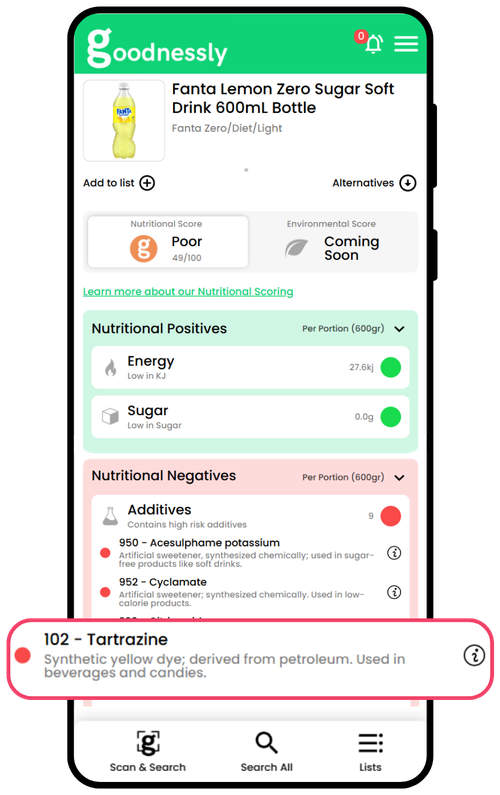
What is Ascorbyl palmitate?
Ascorbyl palmitate is an ester of ascorbic acid and palmitic acid. It is used as an antioxidant in selected food systems.
What's it used for?
- Helping protect fats from oxidation
- Supporting product stability
- Working in antioxidant systems
- Helping maintain quality during storage
Where you'll find E304 on the shelf
It can occur in foods containing fats or oils where antioxidant protection is useful, subject to the relevant category and level conditions.
Is E304 permitted? What the regulators say
E304 is authorised or permitted in the three systems checked, with food-category, specification and good manufacturing practice conditions applying.
| Region | Status | What this means |
|---|---|---|
| AU/NZ Australia & New Zealand (FSANZ) | Permitted with conditions | FSANZ Schedule 15 includes additive 304 ascorbyl palmitate for specified food uses. |
| EU European Union (EFSA) | Authorised with conditions | E304(i) ascorbyl palmitate is on the EU Union list for specified food categories and conditions. |
| US United States (FDA) | Permitted with conditions | FDA 21 CFR 182.3149 affirms ascorbyl palmitate as GRAS when used according to good manufacturing practice. |
Goodnessly rates E304 Safe within its rating system. The rating does not remove the need to consider the product category, amount or full formulation.
- EFSA’s 2015 re-evaluation of ascorbyl palmitate and ascorbyl stearate did not establish a numerical ADI because the toxicological database was limited.
- The Panel concluded there was no safety concern at reported uses and exposure levels.
- A 2019 follow-up found that E304(i) hydrolyses to ascorbic acid and palmitate and did not raise a safety concern for the permitted infant-food uses assessed.
This section is checked periodically rather than continuously — if you're reading this well after the date above, it's worth confirming nothing has changed before citing it.
Who might want to limit or avoid it
- People checking antioxidants in fat-containing foods
- People comparing stability aids in packaged foods
- People who want to understand why an ascorbate name appears beside a fatty-acid name
Goodnessly rates E304 Safe as a practical prompt to understand the ingredient, the product and the overall formulation.
How to spot it on a label
Look for:
- Ascorbyl palmitate
- 304 or E304
- Antioxidant (304)
- Ascorbic acid ester
Ingredient labels may use the name, the number, or the additive class followed by the number.
Related additives
Frequently asked questions
What is E304?
E304 is ascorbyl palmitate, an ester of ascorbic acid used as an antioxidant in selected food systems.
Is E304 permitted?
E304 is permitted with conditions in Australia/New Zealand and the EU, and FDA lists ascorbyl palmitate as GRAS when used according to good manufacturing practice.
Why is ascorbyl palmitate rated Safe?
Goodnessly rates E304 Safe within its rating system, while the food category, amount and specification still matter.
How does Goodnessly rate E304?
Goodnessly rates E304 (ascorbyl palmitate) as Safe.
Don't decode labels by hand
Scan any product with the Goodnessly app to see its full additive breakdown and understand the label at a glance.
Download our app to check additives in everyday foods · Eco score: Coming Soon