What is E407a?
Processed eucheuma seaweed (E407a) is a seaweed-derived thickener and stabiliser used in selected foods. Goodnessly rates it Avoid as a preference to reduce routine texture additives.
E407a is a processed seaweed ingredient related to carrageenan (E407). It can thicken or stabilise a food. EFSA assesses E407 and E407a together in its EU safety work.
Download our app to check additives in everyday foods
Read the FAQ →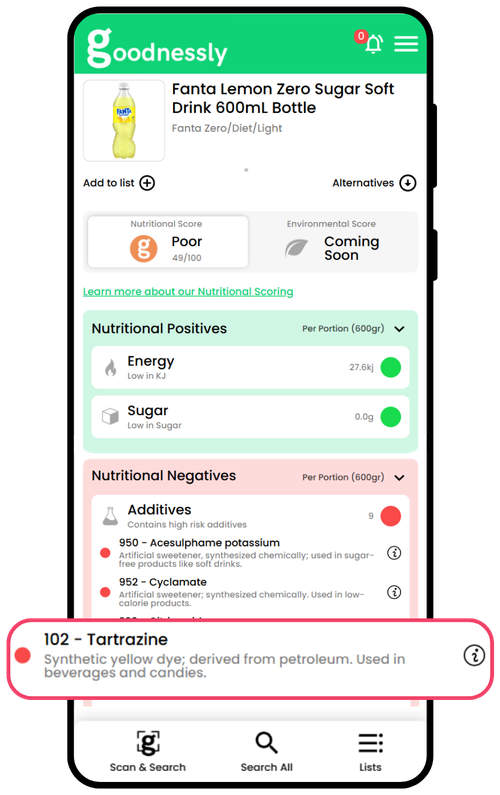
What is Processed eucheuma seaweed?
E407a is a processed seaweed ingredient related to carrageenan (E407). It can thicken or stabilise a food. EFSA assesses E407 and E407a together in its EU safety work.
What's it used for?
- Thickening selected dairy-style foods and desserts
- Helping emulsions and suspensions stay mixed
- Providing texture and stability in formulated foods
Where you'll find E407a on the shelf
Look for it in foods where a smooth, thick or stable texture is important.
Is E407a safe? What the regulators say
Regulators permit E407a under specified conditions. EFSA’s group assessment retained a temporary ADI for E407/E407a while data gaps and use information are followed up.
| Region | Status | What this means |
|---|---|---|
| AU/NZ Australia & New Zealand (FSANZ) | Permitted with conditions | FSANZ lists processed eucheuma seaweed as additive 407a in Schedule 15; use depends on the food category and applicable limits. |
| EU European Union (EFSA) | Authorised; temporary group ADI | E407a is included with E407 in the EU Union list. EFSA’s re-evaluation set a temporary group ADI of 75 mg/kg body weight per day. |
| US United States (FDA) | Permitted as a food ingredient/additive path | US rules and FDA records distinguish food uses and specifications; check the applicable formulation and identity requirements rather than assuming an E-number match. |
E407a is not the same material as laboratory-degraded carrageenan (poligeenan). The Goodnessly tier is preference-based and is not a diagnosis or a claim of definite harm.
- EFSA’s 2018 re-evaluation covered carrageenan E407 and processed eucheuma seaweed E407a together.
- FSANZ’s current Code places 407a in the additive schedules.
- The EU Union list sets category-specific conditions for E407/E407a.
This section is checked periodically rather than continuously — if you're reading this well after the date above, it's worth confirming nothing has changed before citing it.
Who might want to limit or avoid it
- People who prefer fewer texture additives
- People comparing stabilisers in dairy-style desserts and sauces
- People with a known individual sensitivity who are following professional advice
Goodnessly rates E407a Avoid as a preference to limit routine stabilisers, while recognising its authorised uses and EFSA’s temporary group ADI.
How to spot it on a label
Look for:
- Processed eucheuma seaweed
- 407a or E407a
- Stabiliser (407a)
- Eucheuma-derived thickener
Check both the name and the number because labels can use either format.
Related additives
Frequently asked questions
What is E407a?
E407a is processed eucheuma seaweed, a seaweed-derived thickener and stabiliser.
Is E407a the same as poligeenan?
No. Food-grade E407a is distinct from the laboratory-degraded material historically called poligeenan.
What did EFSA set for E407a?
EFSA assessed E407 and E407a together and retained a temporary group ADI of 75 mg/kg body weight per day.
How does Goodnessly rate E407a?
Goodnessly rates E407a (processed eucheuma seaweed) as Avoid.
Don't decode labels by hand
Scan any product with the Goodnessly app to instantly see its full additive breakdown, kept current as new research like this comes to light.
Download our app to check additives in everyday foods