
What is E406?
Agar — a plant-based gelling agent extracted from red seaweed, prized as a vegan alternative to gelatine because it sets firm without refrigeration.
E406 (agar) is a gelling agent extracted from red seaweed, most often the genera Gelidium and Gracilaria. It's been used in Asian cooking for centuries and is now a common vegan and vegetarian substitute for gelatine in jellies, desserts and confectionery. Agar passes through the digestive system largely unabsorbed, similar to dietary fibre, so major regulators haven't set a numerical Acceptable Daily Intake and no safety concerns have been identified. Goodnessly rates it Safe.
Download our app to check additives in everyday foods
Read the FAQ →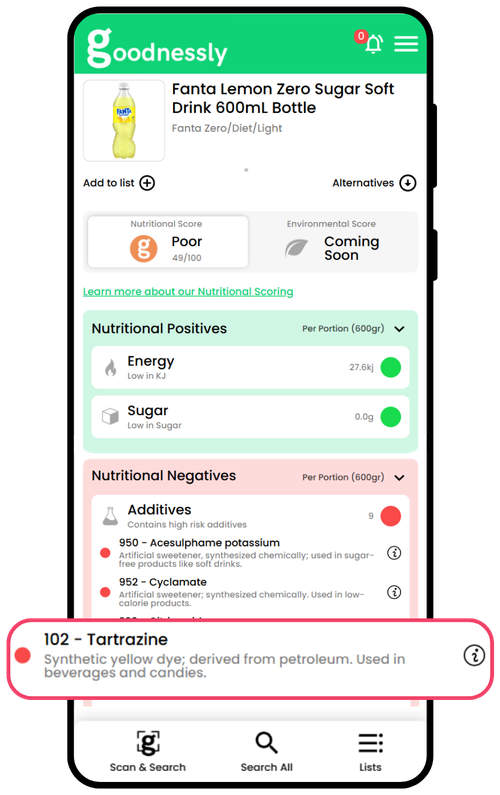
What is agar?
Agar is a gelling polysaccharide extracted from the cell walls of certain red seaweeds, mainly from the genera Gelidium and Gracilaria. Once dried and processed into flakes, strips or powder, it dissolves in hot water and sets into a firm gel as it cools — a gel that, unlike gelatine, holds its shape at room temperature and doesn't melt again once set. It's been a staple of Japanese, Chinese and Southeast Asian cooking for centuries, and its plant origin has made it a go-to substitute for gelatine in vegan and vegetarian desserts.
What's it used for?
- Gelling agent in jellies, puddings and Asian-style desserts
- Setting agent in vegan gummies and confectionery
- Stabilising dairy products, yoghurts and plant-based alternatives
- Thickening jams and bakery fillings
Where you'll find 406 on the shelf
Especially common in vegan desserts and anywhere a firm, shelf-stable gel is needed without gelatine.
Is agar safe? What the research says
Agar has a long history of food use and a consistently favourable safety record across every major regulator that has reviewed it.
| Region | Status | What this means |
|---|---|---|
| AU/NZ Australia & New Zealand (FSANZ) | Permitted | Permitted as a gelling and thickening agent, generally at quantum satis (as much as needed for the intended technological purpose). |
| EU European Union (EFSA) | Permitted, no ADI | Listed as E406. EFSA's 2016 re-evaluation reaffirmed its safety and did not consider a numerical Acceptable Daily Intake necessary, since agar is not absorbed in the gastrointestinal tract. |
| US United States (FDA) | GRAS | Holds Generally Recognized As Safe status for use as a stabiliser, thickener and gelling agent. |
Agar is a form of soluble dietary fibre and is not broken down or absorbed by human digestive enzymes, which is why regulators treat it similarly to other food fibres rather than setting a milligram-based intake limit.
- No significant regulatory changes: agar's approval status has remained stable across AU/NZ, the EU and the US, reflecting its long and well-reviewed safety record as a plant-derived gelling agent.
This section is checked periodically rather than continuously — if you're reading this well after the date above, it's worth confirming nothing has changed before citing it.
Who this matters to
- Vegans and vegetarians looking for a plant-based alternative to gelatine in desserts and confectionery
- Anyone consuming very large amounts of concentrated agar products (well beyond typical culinary use), who may notice a mild laxative effect similar to other high-fibre foods
Goodnessly rates E406 Safe. It's a plant-derived gelling agent with a long history of everyday food use, no identified safety concerns from major regulators, and it passes through the body largely unabsorbed like other dietary fibres.
How to spot it on a label
Agar is usually declared clearly, since it's often a headline selling point on vegan products. Look out for:
- Agar
- Agar agar
- 406 or E406
- "Gelling agent (agar)" in the ingredients list
Vegan jellies, gummies and Asian-style desserts are the most common places to find it.
Related additives
Frequently asked questions
Is agar the same as gelatine?
No. Gelatine is made from animal collagen, while agar is a plant-based gelling agent extracted from red seaweed. Agar sets firmer, holds its shape at room temperature without refrigeration, and is popular as a vegan or vegetarian substitute for gelatine in desserts and confectionery.
Is agar considered safe to eat?
Yes. Agar has a long history of use in Asian cuisine and is approved as a food additive in Australia and New Zealand, the European Union and the United States. EFSA's 2016 re-evaluation reaffirmed its safety and did not set a numerical Acceptable Daily Intake, since agar passes through the digestive system largely unabsorbed, similar to other dietary fibres.
Can eating too much agar cause any issues?
Very large amounts of agar, like other concentrated fibre products, can have a mild laxative effect or, in rare cases, swell and cause discomfort if eaten dry or under-hydrated in large quantities. At the amounts typically used to set jellies, desserts and confectionery, this isn't a practical concern for most people.
Does Goodnessly rate E406 as safe, caution, or avoid?
Goodnessly rates E406 (Agar) as Safe. It's a plant-derived gelling agent with a long history of use, no identified safety concerns from major regulators, and no numerical Acceptable Daily Intake because it isn't absorbed by the body.
Don't decode labels by hand
Scan any product with the Goodnessly app to instantly see its full additive breakdown, kept current as new research like this comes to light.
Download our app to check additives in everyday foods
At Goodnessly we aim to educate and empower individuals to make informed choices about everyday products.
© 2024 . All rights reserved.
Facebook
Instagram
X
TikTok