
What is E407?
Carrageenan — a seaweed-derived thickener and gelling agent widely used in dairy, plant milks and processed foods, permitted by major regulators but flagged by Goodnessly because of ongoing gut-inflammation research.
Carrageenan (E407) is a sulphated polysaccharide extracted from red seaweed, used to thicken, gel and stabilise foods. Food-grade carrageenan is permitted in Australia/NZ, the EU and the US, and is not the same substance as degraded carrageenan (poligeenan), which is not allowed in food. EFSA kept a temporary Acceptable Daily Intake of 75 mg/kg body weight/day in 2018 because of unresolved chemistry and exposure uncertainties, while some human and lab research continues to probe links with gut inflammation and IBD flares. Goodnessly rates it Avoid.
Download our app to check additives in everyday foods
Read the FAQ →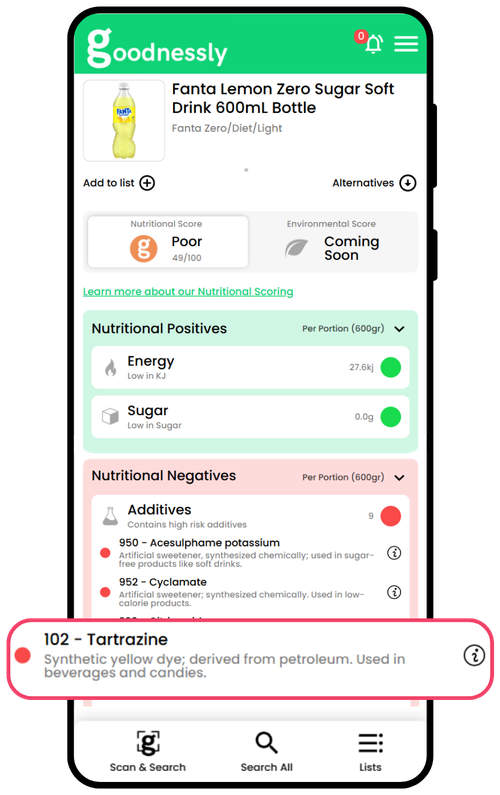
What is carrageenan?
Carrageenan is a family of sulphated polysaccharides extracted from red seaweeds such as Chondrus crispus (Irish moss), Eucheuma and Kappaphycus species. Depending on the type (kappa, iota or lambda), it can form firm gels, soft gels or thicken without gelling. Food-grade carrageenan is a high-molecular-weight ingredient; the low-molecular-weight material historically called poligeenan (or degraded carrageenan) is a different laboratory product and is not authorised as a food additive. A related, less-refined form is listed separately as processed Eucheuma seaweed (E407a).
What's it used for?
- Thickening and stabilising dairy drinks, flavoured milks and cream desserts
- Keeping plant-based milks and chocolate drinks from separating
- Gelling jellies, desserts, processed meats and some confectionery
- Improving mouthfeel and freeze-thaw stability in ice cream and frozen desserts
Where you'll find 407 on the shelf
Unlike tightly restricted colours, carrageenan shows up across everyday dairy, plant-based and processed foods.
Is carrageenan safe? What the research says
Major food regulators still permit food-grade carrageenan, but the science conversation is unfinished: EFSA kept a temporary intake limit while data gaps are filled, and gut-inflammation studies keep the debate alive for people with sensitive guts.
| Region | Status | What this means |
|---|---|---|
| AU/NZ Australia & New Zealand (FSANZ) | Permitted | Listed as 407 (carrageenan) and 407a (processed eucheuma seaweed) in the Food Standards Code Schedule 8. Permitted as a food additive under Standard 1.3.1 conditions and must be declared by name or number on the ingredient list. |
| EU European Union (EFSA) | Permitted; temporary ADI | Authorised as E407 (and E407a). EFSA's 2018 re-evaluation kept a group Acceptable Daily Intake of 75 mg/kg body weight/day but classified it as temporary because of chemistry, exposure and toxicology uncertainties, and asked for more data within five years. |
| US United States (FDA) | Permitted | Listed as a food additive under 21 CFR 172.620 for use as an emulsifier, stabiliser or thickener in the amount needed. Synonyms in FDA inventories include Irish moss extract and chondrus extract. Poligeenan is not authorised for food use. |
JECFA assigns a group ADI of "not specified" for carrageenan and processed Eucheuma seaweed for general food-additive use under good manufacturing practice. That is a different framing from EFSA's temporary numerical ADI, and neither finding settles the separate consumer debate about gut sensitivity.
- EFSA 2018 temporary ADI: the Panel retained 75 mg/kg bw/day for E407/E407a but called it temporary and followed up with data calls covering remaining uncertainties and infant-food uses.
- Food-grade vs poligeenan: many older animal colitis models used acid-degraded low-molecular-weight material (poligeenan), which is not a food additive. Reviews stress that those results cannot be automatically applied to high-molecular-weight food-grade carrageenan.
- Ongoing gut research: newer lab and small human studies continue to explore effects on intestinal inflammation, permeability and metabolic markers. Evidence is mixed and not settled enough to rewrite the regulatory permissions, but it is why sensitive consumers often choose to skip it.
This section is checked periodically rather than continuously — if you're reading this well after the date above, it's worth confirming nothing has changed before citing it.
Who might want to limit or avoid it
- People living with IBD, Crohn's disease, ulcerative colitis or a generally sensitive gut who prefer to minimise emulsifiers and thickeners linked to inflammation research
- Anyone following a low-additive or wholefoods-leaning pattern who wants fewer industrial gelling agents in everyday dairy and plant milks
- Parents choosing infant or medical nutrition products, where regulators have historically taken a more cautious line on carrageenan than for general foods
Goodnessly rates E407 Avoid. Regulators still permit food-grade carrageenan, but EFSA's temporary ADI and the unfinished gut-inflammation debate are enough for us to put it in our highest-caution category rather than everyday-use.
How to spot it on a label
Carrageenan is usually declared clearly when it is used as a thickener or stabiliser. Look out for:
- Carrageenan
- 407 or E407
- Irish moss extract, chondrus extract or Irish moss gelose (less common synonyms)
- Processed eucheuma seaweed, 407a or E407a (related, less-refined form)
- "Thickener (407)" or "Stabiliser (407)" in the ingredients list
Plant milks, flavoured dairy drinks, ice cream and processed meats are among the most common places to find it in Australia.
Related additives
Frequently asked questions
Is food-grade carrageenan the same as poligeenan?
No. Food-grade carrageenan (E407) is a high-molecular-weight seaweed extract used as a thickener and gelling agent. Poligeenan (sometimes called degraded carrageenan) is a low-molecular-weight acid-hydrolysed material used in some laboratory models; it is not authorised as a food additive and is not the same ingredient you see on a supermarket label.
Is carrageenan allowed in Australia, the EU and the US?
Yes. FSANZ lists carrageenan as additive 407 in the Food Standards Code, the EU authorises E407 (with EFSA keeping a temporary ADI of 75 mg/kg body weight/day after its 2018 review), and the US FDA permits it under 21 CFR 172.620 as an emulsifier, stabiliser or thickener. Permission does not mean every consumer will choose to eat it.
Does carrageenan cause IBD or gut inflammation?
The picture is unsettled. Some animal work that raised alarm used poligeenan rather than food-grade carrageenan, and industry and some reviews argue that distinction matters. Separate newer lab work and small human studies still probe inflammatory and permeability effects of food-grade material. Major regulators have not banned it, but people with IBD or a sensitive gut often prefer to avoid it while the evidence catches up.
Does Goodnessly rate E407 as safe, caution, or avoid?
Goodnessly rates E407 (Carrageenan) as Avoid. Regulators still permit food-grade carrageenan, but EFSA's temporary ADI and the unfinished gut-inflammation debate are enough for us to place it in our highest-caution category.
Don't decode labels by hand
Scan any product with the Goodnessly app to instantly see its full additive breakdown, kept current as new research like this comes to light.
Download our app to check additives in everyday foods
At Goodnessly we aim to educate and empower individuals to make informed choices about everyday products.
© 2024 . All rights reserved.
Facebook
Instagram
X
TikTok