What is E501?
Potassium carbonate (E501) is an acidity regulator used to adjust food acidity and support processing. Goodnessly rates it Caution as a prompt to notice the food category, use level and overall formulation.
E501 is potassium carbonate, an alkaline mineral salt used mainly for acidity control and related technical functions. It is permitted in specified uses, but the category and good manufacturing practice limits still matter.
Download our app to check additives in everyday foods
Read the FAQ →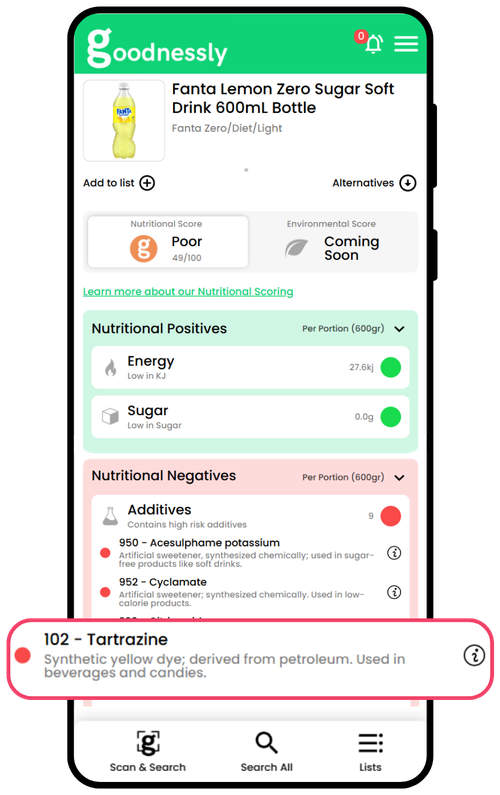
What is Potassium carbonate?
Potassium carbonate is the potassium salt of carbonic acid. In food, E501(i) can adjust acidity and pH and may support other permitted technical functions.
What's it used for?
- Adjusting acidity and pH
- Supporting processing in selected foods
- Providing a permitted source of potassium where the formulation requires it
Where you'll find E501 on the shelf
It is most relevant to foods where acidity control, processing or mineral formulation is needed.
Is E501 permitted? What the regulators say
Potassium carbonate is permitted in the three systems checked, with category, purity and good manufacturing practice conditions.
| Region | Status | What this means |
|---|---|---|
| AU/NZ Australia & New Zealand (FSANZ) | Permitted with conditions | FSANZ lists potassium carbonate (INS 501(i)) in the Food Standards Code; Schedule 15 food-category permissions and GMP conditions apply. |
| EU European Union (EFSA) | Authorised with conditions | The EU Union list includes E501 potassium carbonates, including E501(i) potassium carbonate, with authorised categories and quantum satis conditions where specified. |
| US United States (FDA) | Affirmed GRAS for specified functions | FDA 21 CFR 184.1619 affirms food-grade potassium carbonate as GRAS for functions including pH control and processing aid, at levels no higher than current good manufacturing practice. |
Goodnessly rates E501 Caution to encourage label and formulation awareness. This does not say authorised potassium carbonate use is harmful.
Eco score: Coming Soon.
- FSANZ August 2026 Food Standards Code compilation, Schedule 15 and INS 501(i).
- EUR-Lex Regulation (EC) No 1333/2008 Union list, E501 potassium carbonates.
- FDA 21 CFR 184.1619 sets the US direct-food GRAS conditions.
This section is checked periodically rather than continuously — if you're reading this well after the date above, it's worth confirming nothing has changed before citing it.
Who might want to limit or avoid it
- People who need to track potassium or mineral intake
- People comparing highly formulated foods
- People who prefer to understand why acidity regulators are used
Goodnessly rates E501 Caution as a practical prompt to understand the ingredient, the product and the overall formulation.
How to spot it on a label
Look for:
- Potassium carbonate
- 501 or E501
- 501(i) or INS 501(i)
- Acidity regulator (501)
The label may use the additive name, the number, or the functional class followed by the number.
Related additives
Frequently asked questions
What is E501?
E501 is potassium carbonate, an acidity regulator used in specified food applications.
Is E501 permitted?
E501 is permitted with conditions in Australia/New Zealand, the EU and the US. The food category and good manufacturing practice conditions still matter.
Why is potassium carbonate rated Caution?
Goodnessly uses Caution as a label-reading prompt to notice the additive function, use level and overall formulation.
How does Goodnessly rate E501?
Goodnessly rates E501 (potassium carbonate) as Caution.
Don't decode labels by hand
Scan any product with the Goodnessly app to instantly see its full additive breakdown, kept current as new research like this comes to light.
Download our app to check additives in everyday foods