
The EU Just Banned "Forever Chemicals" From Food Packaging — Where Does Australia Stand?
If you've ever wondered why your takeaway box doesn't go soggy, or why a bakery bag doesn't leak butter, the answer is often PFAS — a family of thousands of synthetic chemicals used for decades to make packaging grease-, oil- and water-resistant. They're also known as "forever chemicals," because they don't break down in the environment or in the human body.
From 12 August 2026, the European Union is banning them from food packaging outright. Here's what changed, what's happening in the US, and — the question we get asked most — what Australia has actually done about it.
What Is PFAS, and Why Does It Matter?
PFAS stands for per- and polyfluoroalkyl substances — a group of more than 4,000 synthetic chemicals built around an exceptionally strong carbon-fluorine bond, a bond that essentially doesn't exist in nature. That bond is exactly why PFAS became so useful commercially from the 1940s onward: it makes materials resist water, grease, oil and stains, which is why PFAS ended up in everything from nonstick cookware and waterproof clothing to firefighting foam and, relevantly here, food packaging.
The same bond that makes PFAS useful is also what makes it a problem. It doesn't break down in the environment, and it doesn't break down efficiently in the human body either — PFAS can persist in blood for years, sometimes decades, after exposure. That persistence is why it's earned the nickname "forever chemicals," and why exposure tends to accumulate over a lifetime rather than pass through.
The health evidence, while still developing in places, is substantial enough that both the US Environmental Protection Agency and the European Parliament have described PFAS exposure as a health crisis. Research has associated PFAS with:
Cancer risk — studies have found associations with thyroid, kidney and testicular cancer, with research into ovarian, endometrial and breast cancer links ongoing
Endocrine disruption — PFAS can interfere with thyroid hormone production and function, potentially leading to both an underactive or overactive thyroid
Immune suppression — evidence suggests PFAS can reduce the body's ability to fight infection, and may lower vaccine effectiveness, particularly in children
Reproductive and developmental effects — links have been found to reduced fertility, pregnancy complications such as preeclampsia, and developmental effects in children exposed prenatally
Liver damage and high cholesterol — among the more consistently observed effects across population studies
It's worth being precise about the strength of this evidence: proving direct causation in humans is genuinely difficult, and researchers are careful to describe most of these as associations rather than settled causal facts. But the pattern is consistent across multiple independent studies and populations, which is exactly why regulators have moved from "monitor it" to "start banning it," even while some of the underlying biology is still being worked out.
What the EU Just Did
Under the EU's Packaging and Packaging Waste Regulation (PPWR), food-contact packaging sold in the EU cannot contain PFAS above strict thresholds from 12 August 2026: 25 parts per billion for any single PFAS substance, 250 parts per billion for the combined total, and 50 parts per million for total fluorine content across all PFAS types, including the polymer-based kind.
Two details make this a genuinely hard deadline rather than a soft target. First, there's no grandfathering — packaging manufactured before the deadline still can't be sold into the EU after it, regardless of when it was made. Second, the burden of proof sits with the seller: if a fluorine test comes back high, the packaging is treated as non-compliant until proven otherwise, not the reverse.
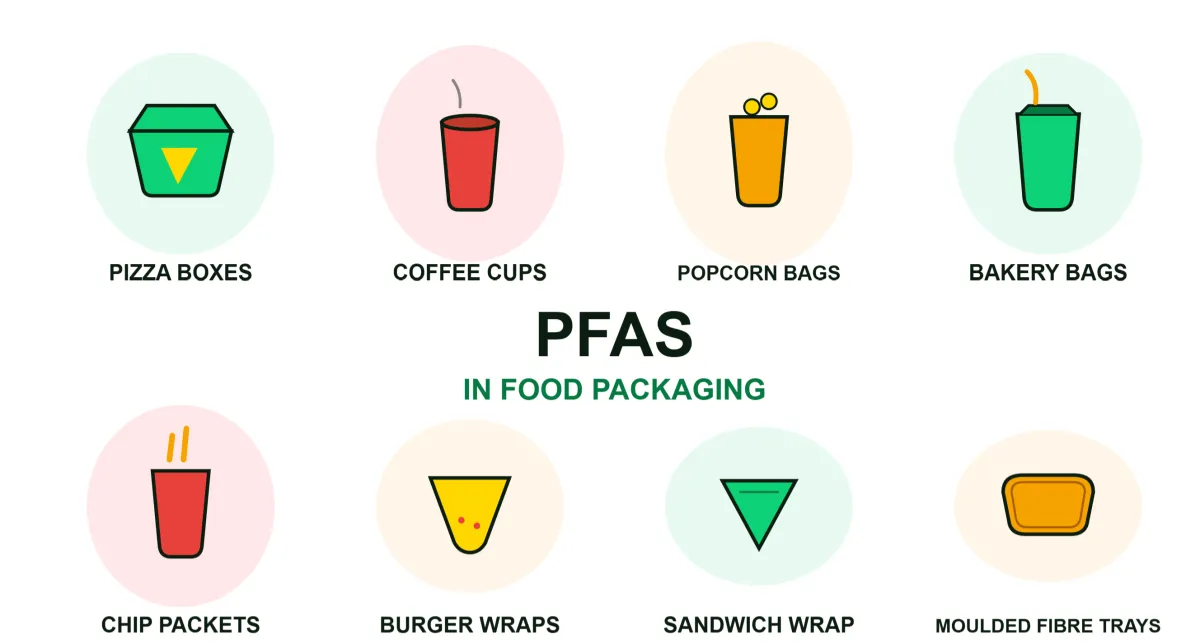
The formats most affected are the ones doing the "unglamorous but valuable job" PFAS has done for decades: grease-resistant bakery bags, pizza boxes, burger wraps, moulded fibre bowls and trays, and paper cups for hot drinks.
What's Happening in the US
The US doesn't have a single federal ban yet. A bill called the No Toxics in Food Packaging Act was introduced in Congress in mid-2026, aiming to prohibit PFAS along with phthalates, BPA and styrene polymers from food packaging and processing materials. It hasn't passed. In the meantime, individual states have moved faster — Illinois and Maine both have PFAS packaging bans already in effect, and California has PFAS prohibitions covering food packaging, cosmetics and other categories phasing in between 2025 and 2028.
Where Australia Actually Stands
This is the part most coverage skips. Australia has taken real regulatory action on PFAS — just not specifically aimed at food packaging.
Legacy PFAS are banned. As of 1 July 2025, Australia banned the manufacture, import, export and use of three PFAS chemicals — PFOS, PFOA and PFHxS — along with roughly 500 related substances. This is a broad industrial chemicals ban, not a food-packaging-specific rule.
There's no dedicated food-packaging PFAS standard. The Food Standards Code used to include a specific standard for food-contact materials (Standard 1.4.3), but it was removed in 2016 and replaced with a general obligation that packaging must not be "likely to cause bodily harm, distress or discomfort" — no specific chemical thresholds, no PFAS-specific testing regime.
Available testing suggests low levels, but it's limited. FSANZ's most recent Australian Total Diet Study found PFAS levels in the general food supply to be very low. That's reassuring, but it's a periodic survey, not the kind of mandatory, threshold-based testing regime the EU is now requiring of every food-contact packaging supplier.
The direction of travel is the same. Australia's PFAS National Environmental Management Plan (NEMP 3.0), released in 2025, signals a broader move toward reducing PFAS use over time, and legal commentators have noted this could extend to specific food-packaging rules — but as of mid-2026, no legislated packaging-specific ban exists.
In short: Australia has banned the chemicals themselves in a broad sense, but hasn't yet built the packaging-specific rulebook the EU just finished building.
What This Means for You
Nothing changes at the checkout tomorrow — Australian packaging isn't suddenly unsafe, and the available testing data is reassuring. But it does mean Australian shoppers currently have less regulatory certainty than EU shoppers will have from August, particularly around grease-resistant paper packaging: bakery bags, takeaway boxes, and wrapped snack items.
Practical steps in the meantime:
Glass and metal packaging are the cleanest choices where available — they sidestep both the PFAS-in-paper issue and the separate, well-documented concern around microplastics and chemical migration (like BPA and phthalates) from plastic packaging. Plastic isn't a clean alternative to PFAS-treated paper, just a different trade-off.
If choosing between paper and plastic, there's no clearly "safer" default — grease-resistant paper carries the PFAS risk this article covers, while plastic carries its own separate microplastics and additive-leaching concerns. Reducing packaged and takeaway food generally, rather than swapping one packaging type for another, is the more reliable lever.
Be cautious with very hot, greasy takeaway food in any packaging — heat and fat both increase the chance of chemical migration, whether the concern is PFAS in paper or plasticisers in plastic.
Watch for "PFAS-free" labelling — as EU-facing brands reformulate for the August deadline, many will roll the same PFAS-free packaging out globally, including to Australia.
The Bottom Line
The EU now has a hard, enforceable, threshold-based ban on PFAS in food packaging. The US has a patchwork of state bans and a pending federal bill. Australia has banned the underlying legacy chemicals broadly, but still relies on a general safety obligation rather than a packaging-specific standard — a genuine regulatory gap compared to where Europe now sits. It's a space worth watching, and one where global brands reformulating for the EU deadline may end up doing Australian regulators' work for them.

Facebook
Instagram
X
TikTok