
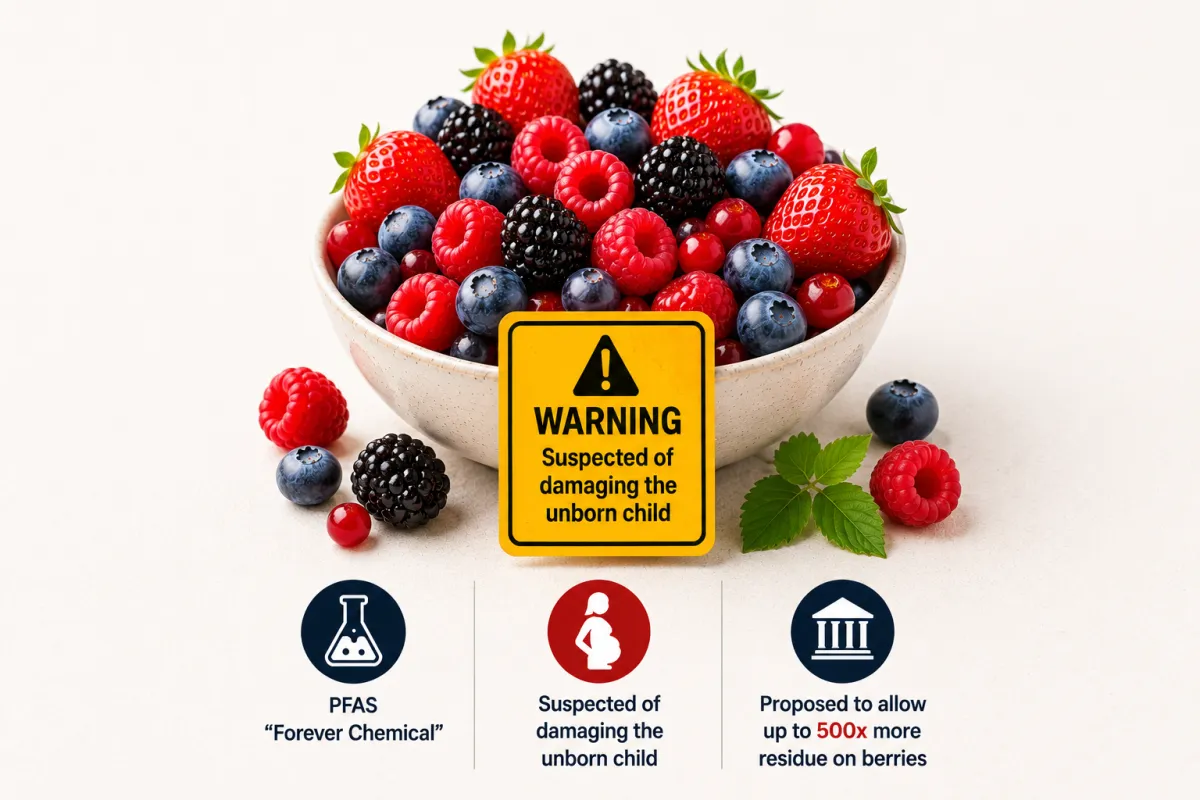
Australia Just Proposed Allowing 500x More "Forever Chemical" Residue on Berries
Australian regulators have proposed allowing up to 500 times more residue of a pesticide called isocycloseram on some berries. The pesticide is classified as a PFAS "forever chemical" by international bodies, and its label is required to carry one of the most serious warnings in agricultural chemistry: suspected of damaging the unborn child.
The regulator says none of this poses a risk to consumers. Here's what's actually being proposed, why researchers and advocates are pushing back, and what it means if berries are a regular part of your family's shopping list.
What's Actually Changing
The Australian Pesticides and Veterinary Medicines Authority (APVMA) has proposed lifting the maximum residue limits (MRLs) — the legal ceiling on how much pesticide residue can remain on food sold to consumers — for isocycloseram on several berry crops:
Raspberries and blackberries: up to 500 times higher
Blueberries and currants: up to 300 times higher
Strawberries and cranberries: up to 70 times higher
Isocycloseram is already approved in Australia for use on a wide range of crops, including broccoli, cauliflower, corn and garlic. Australia was the first country in the world to approve it, five years ago. Public consultation on these specific berry changes was scheduled to close in late July 2026.
Why It's Classified Differently Depending on Who You Ask
Here's where it gets genuinely strange. The OECD, the European Chemicals Agency and Australia's own environment departments all classify isocycloseram as a PFAS compound — the same broad chemical family behind "forever chemicals" in firefighting foam and non-stick cookware. But when it comes to regulating it as a farm chemical, the APVMA uses a narrower definition borrowed from the US EPA, one that doesn't count isocycloseram as a forever chemical at all. Same molecule, different bureaucratic box, depending on which part of government is doing the classifying.
It matters because isocycloseram breaks down into trifluoroacetic acid (TFA) — a genuine forever chemical that scientists say is rising sharply in human blood and drinking water worldwide, and which the European Chemicals Agency recently classified as toxic to reproduction.
What the Animal Studies Found
The safety data behind isocycloseram's approval came primarily from studies submitted by its manufacturer, the agrochemical company Syngenta. Those studies found testicle degeneration, lower sperm counts and liver damage in rats. A separate study reviewed by Australian regulators found birth defects in the offspring of pregnant rats given high doses of the chemical. That evidence is exactly why the internationally recognised warning — suspected of damaging the unborn child — is legally required on the product label, even though the APVMA maintains there's no risk to people from eating treated food.
Isocycloseram's US approval is currently facing a legal challenge from environmental groups, who argue the EPA failed to properly weigh the risks to children and developing fetuses.
The Regulator's Defence
The APVMA's position is that a "500-fold" headline figure is technically accurate but misleading in isolation, since it doesn't reflect the layers of safety margin built into the underlying assessment. According to the regulator, the safety limits assume a person eats all 39 foods that might carry isocycloseram residue, every single day, for their entire life — and then apply a further 100-times safety buffer on top of the dose where any health effect was observed in animal testing. Real-world exposure, the APVMA says, ends up hundreds or even thousands of times below the level that would cause harm.
Why Some Experts Aren't Reassured
Pesticide Action Australia, a non-profit focused on reducing pesticide use, argues the underlying problem is that the safety case rests heavily on studies funded and submitted by the same company profiting from approval — a conflict of interest its executive director says shouldn't be relied on so heavily. The group is calling for regulators to pause and allow independent, peer-reviewed research time to catch up before residue limits are loosened further.
There's also a political dimension. NSW Greens MLC Cate Faehrmann has pointed out the awkward timing: the federal government is currently pursuing a class action against 3M over the damage caused by PFAS-contaminated firefighting foam, while a different arm of government considers approving more PFAS-linked residue on food specifically marketed to families as healthy.
Isocycloseram is also toxic to bees and other pollinators, which are responsible for roughly one in three bites of food humans eat. The APVMA says its assessment accounts for this, with label restrictions designed to limit run-off and colony exposure.
What This Means for Your Family
To be clear about where the genuine uncertainty sits: this isn't a case of a chemical being secretly added at unsafe levels. It's a regulatory proposal, still open for consultation, defended by scientists who say the safety margins are real and substantial. The disagreement is less about the raw numbers and more about how much weight to put on manufacturer-funded safety data, and how quickly a genuinely novel forever chemical should be allowed to scale up in the food supply before independent research has had time to catch up.
Berries have exploded in popularity in Australia — around three-quarters of households now buy them, and the annual crop is worth $1.3 billion. That popularity is exactly why residue limits on berries specifically matter more than they might for a less commonly eaten crop.
Practical steps if you want to reduce exposure while this plays out:
Raspberries and blackberries carry the largest proposed increase (500x) — if you're prioritising where to go organic first, these are the most logical starting point right now.
Berries can't be washed clean of systemic pesticide residue — unlike surface residue, chemicals absorbed into the fruit itself aren't removed by rinsing.
Consider making your voice heard during public consultation periods — APVMA consultations are open to public submissions, not just industry.
This doesn't mean cutting berries out — they remain a genuinely nutritious food, and the regulatory disagreement here is about margin of safety, not about berries being acutely dangerous.
The Bottom Line
Australia has proposed allowing significantly more residue of a chemical that international bodies classify as PFAS, that breaks down into a forever chemical linked to reproductive harm, and that carries a birth-defect warning based on manufacturer-funded animal studies — while Australian regulators maintain the safety margins mean none of this translates to real-world risk. Both things can be true at once: the APVMA's math may well be sound, and it's still reasonable to want more independent scrutiny before residue limits move in this direction. Worth watching closely, and worth remembering that "no immediate risk" and "no reason for scrutiny" aren't the same claim.

Facebook
Instagram
X
TikTok