
How Common Are PFAS Pesticides in Your Fruit and Veg, Really?
We've covered several individual PFAS pesticide stories recently, from a proposed residue increase on berries and new approvals in the US to the forever chemical TFA turning up in multiple unrelated places.
This time, rather than one chemical or one crop, it's worth stepping back to the bigger picture: just how common is PFAS pesticide exposure across produce generally?
What the Testing Actually Found
The Environmental Working Group's 2026 Shopper's Guide to Pesticides in Produce, based on US Department of Agriculture testing of more than 54,000 samples across 47 different fruits and vegetables, found that more than a third of non-organic produce samples tested positive for at least one of 31 pesticides that meet the internationally recognised definition of PFAS.
The single most frequently detected pesticide across all produce tested, not just PFAS pesticides, was fludioxonil, a PFAS fungicide. It showed up in 14% of every produce sample tested and in nearly 90% of peaches and plums specifically.
Two other PFAS pesticides, fluopyram and bifenthrin, also ranked among the ten most frequently detected chemicals overall.
Which Produce Is Most and Least Affected?
Contamination wasn't evenly spread.
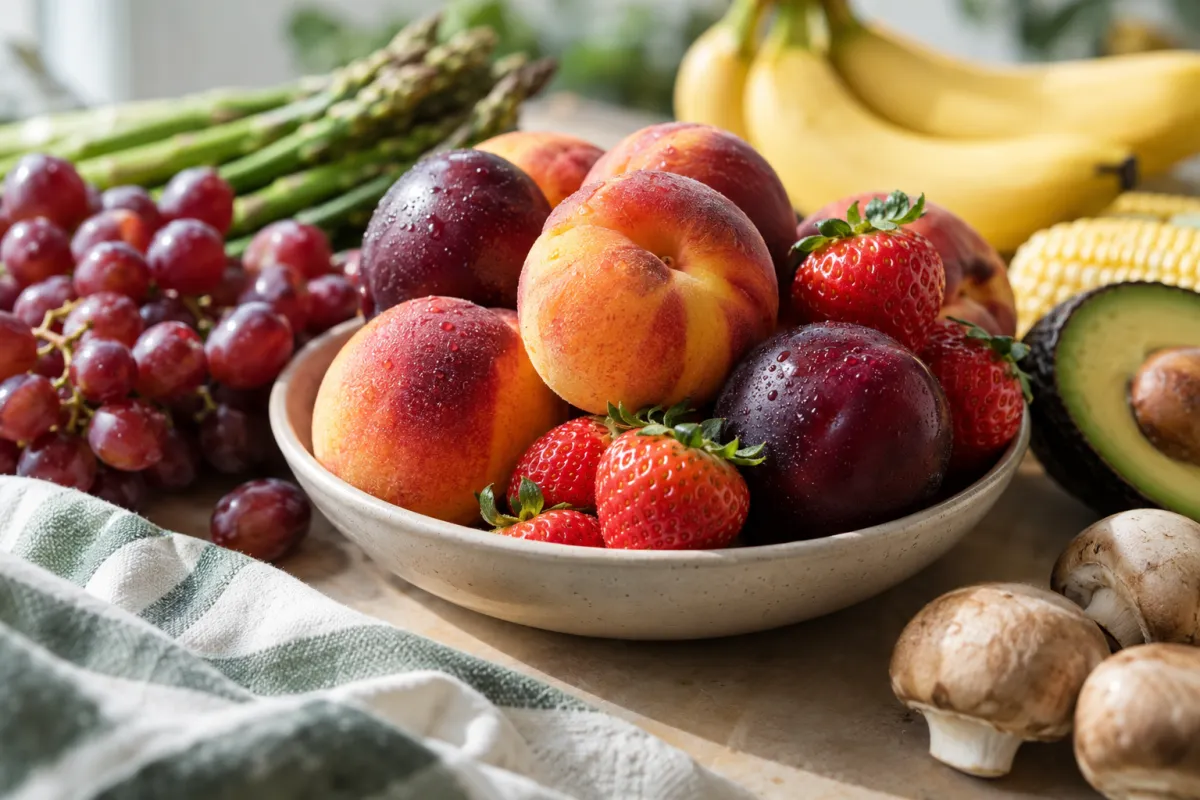
Peaches, plums, strawberries and grapes had some of the highest PFAS pesticide detection rates, with more than 80% of samples carrying at least one in the analyses highlighted by EWG.
At the other end, avocado, papaya, sweet corn, asparagus, bananas and mushrooms had among the lowest detection rates.
Within the EWG's broader Dirty Dozen list of the most pesticide-contaminated produce generally, PFAS pesticides were detected on 63% of samples.
Where This Actually Comes From
Fludioxonil is typically applied as a post-harvest treatment. It is sprayed directly onto the outside of fruit after picking to prevent mould during storage and transport, rather than being absorbed systemically as the plant grows.
That distinction matters practically.
Unlike a systemic pesticide taken up through the roots and distributed throughout the plant, a surface treatment like this sits primarily on the outside of the fruit. Peeling won't help with every pesticide, but for a post-harvest surface fungicide specifically, it can be a more useful step than it would be for a systemic chemical.
A Regional Data Point Worth Knowing
A separate, more localised EWG analysis of California state testing data found PFAS pesticide residue on 37% of California-grown produce samples. Around 90% of peaches, plums and nectarines and 80% or more of strawberries and grapes were affected.
The analysis was based on 930 samples covering 78 types of non-organic California-grown fruits and vegetables. EWG found PFAS pesticide residues in 348 of those samples.
Fludioxonil was the most frequently detected PFAS pesticide in the California data and is used as a post-harvest fungicide on fruit such as peaches.
This is a useful reminder that the issue is as much an environmental and agricultural story as it is about a single piece of fruit.
What This Looks Like Beyond the US
This is US testing data, drawn from USDA and California state monitoring programs. The USDA dataset is one of the most detailed publicly available produce-level sources for pesticide residues, covering 54,344 samples of 47 fruits and vegetables in the 2026 EWG analysis.
We're not aware of an equivalent, publicly available Australian testing report that breaks PFAS pesticide detections down by produce type in the same way.
Pesticide use and approval lists vary between countries, but many of the same or similar chemicals, including fludioxonil, are used internationally. The US findings therefore provide useful context for understanding the potential exposure pattern, even though they should not be treated as direct measurements of produce sold in other countries.
What This Means Practically
1. Prioritise the higher-detection produce
Peaches, plums, strawberries and grapes are among the produce types where PFAS pesticide residues were frequently detected.
If you're choosing organic selectively rather than buying everything organic, these may be reasonable places to prioritise.
2. Peeling can help with some surface treatments
For post-harvest surface treatments such as fludioxonil, peeling can reduce exposure to residues on the skin.
It won't remove every pesticide, particularly systemic pesticides, so it's not a universal solution.
3. Know your lower-detection options
Avocados, papaya, sweet corn, asparagus, bananas and mushrooms were among the produce types with lower pesticide detection rates in EWG's analysis.
These can be useful choices if you're trying to prioritise where organic produce may matter most.
4. Don't let this put you off fruit and vegetables
This isn't a reason to eat less fruit and veg overall.
Even EWG, the group behind the testing, stresses that a diet rich in fruits and vegetables remains essential. Its Shopper's Guide is intended to help consumers reduce pesticide exposure while continuing to eat plenty of produce.
The takeaway is less about avoiding fruit and vegetables and more about understanding which choices may make the biggest difference.
The Bottom Line
More than a third of conventional produce samples in EWG's 2026 analysis carried at least one PFAS pesticide residue, with detections particularly concentrated in certain fruits such as stone fruit and berries.
A single fungicide, fludioxonil, was the most frequently detected pesticide overall, appearing in 14% of all produce samples and nearly 90% of peaches and plums.
The figures come from US testing, so they shouldn't be read as a direct snapshot of produce in every country. But the broader pattern is worth knowing: PFAS pesticides aren't confined to one crop or one chemical. They are showing up across conventional produce, particularly in some of the fruits we eat regularly.
For shoppers, the practical approach isn't to fear fruit and vegetables. It's to prioritise where you can, wash produce thoroughly, peel when appropriate, and keep eating the produce that makes up an important part of a healthy diet.

Facebook
Instagram
X
TikTok