
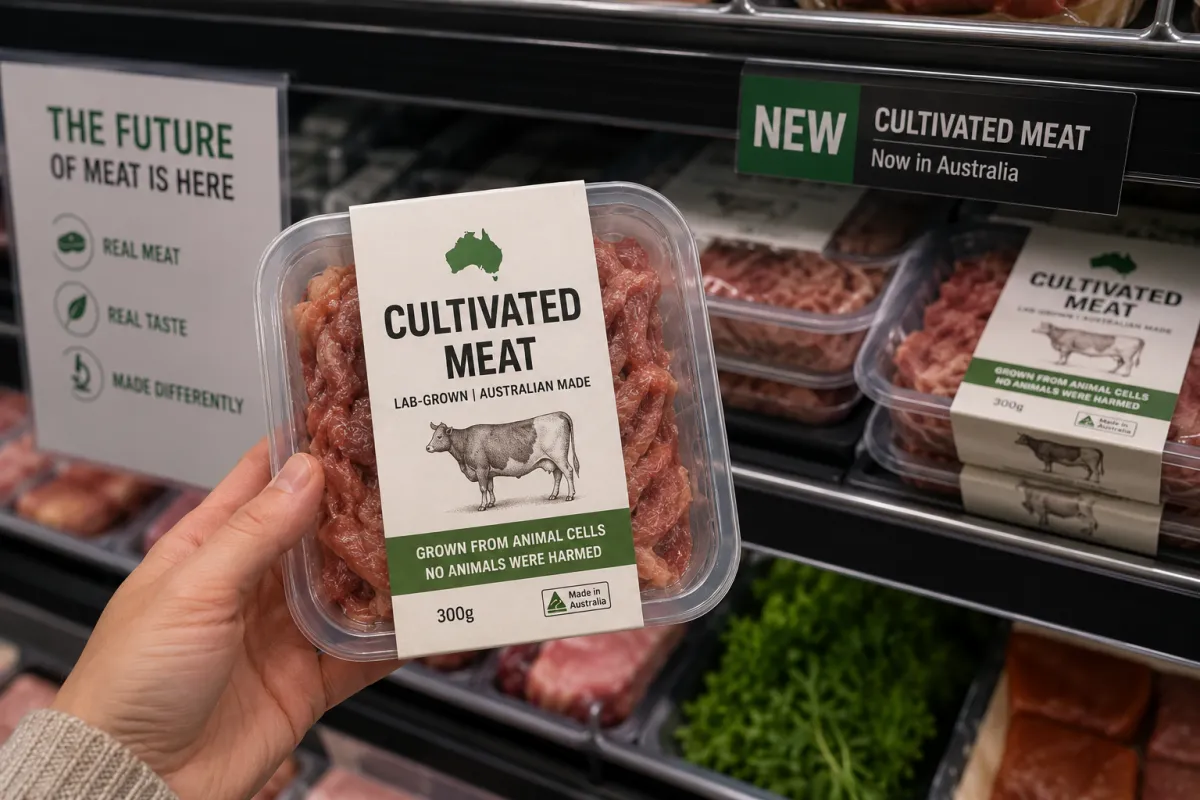
Lab-Grown Meat Is Already For Sale in Australia — Here's What's Actually Happening
Most people assume lab-grown meat is still a few years off — something happening in labs overseas, not on Australian menus yet. It's already here. A cell-cultivated meat product has been legally approved and on sale in Australia since 2025, and a second one is currently working through final approval. Here's what's actually happened, what the label is required to say, and how to tell if you're eating it.
What's Already Approved and On Sale
In April 2025, Food Standards Australia New Zealand (FSANZ) approved cell-cultivated Japanese quail, made by Sydney-based company Vow, sold under its consumer brand Forged. It was Australia and New Zealand's first cultivated meat approval, and it followed a two-year, two-round public consultation process — FSANZ's most thorough assessment pathway.
By July 2025, it was appearing on menus at restaurants including Bottarga and The Lincoln in Melbourne, and Nel, The Waratah and Kitchen by Mike in Sydney. By October 2025, it went further — a smoked quail spread, foie gras and croquettes became available direct to consumers, sold in limited "drops" starting in Sydney, so people could order it to cook at home for the first time.
One detail worth being precise about: it isn't sold as a standalone cut of meat, like a cultivated quail breast. It's approved for use as an ingredient combined with other ingredients — spreads, pâtés, croquettes — not as a raw meat replacement on its own.
What's Coming Next
A second application, from French company Gourmey (now part of a larger entity called Parima), is seeking approval for cell-cultivated duck, intended for products like cultivated foie gras and duck pâté. FSANZ's safety assessment was completed in May 2026 and found no public health or safety concerns. Public consultation on the application closed 22 July 2026, so a final decision could land at any time.
Notably, FSANZ assessed the duck application through its faster "General" pathway rather than the lengthier process used for quail — one industry analysis read this as a sign that regulators now treat cultivated meat as an established, manageable food category rather than something requiring maximum scrutiny each time.
What the Label Is Actually Required to Say
This is the part most people don't know exists yet, because there's been almost no mainstream coverage of it. Since June 2025, a dedicated section of the Food Standards Code — Standard 1.5.4 — makes it mandatory for any cell-cultivated food to carry the words "cell-cultured" or "cell-cultivated" directly alongside the name of the food. In practice, that means a product has to be named something like "cell-cultivated quail," not just "quail" or "Forged parfait" on its own.
This requirement isn't limited to supermarket packaging — it applies to food sold to caterers and restaurants too, so in principle a menu description should reflect it as well, not just a retail label.
It's also worth knowing this wording was a deliberate choice, not an accident. FSANZ specifically considered — and rejected — using the more consumer-friendly terms "cultivated" or "cultured" on their own, on the grounds that shoppers could mistake them for ordinary fermented or cultured foods (think cultured butter or yoghurt). "Cell-cultured" and "cell-cultivated" were chosen specifically because they're harder to misread.
How Common Is It, Really?
Genuinely not common yet. As of now, cultivated meat in Australia means one product line — Vow's quail — sold at a small number of restaurants in Sydney and Melbourne, plus occasional limited-run online "drops" for home delivery. It isn't stocked in major supermarkets, and there's no indication that's imminent. If duck gets approved, that adds a second product line, but the honest picture is that this remains a niche, high-end category for now rather than something in everyday grocery shopping.
What to Actually Look For
1.Check the product name itself, not just the ingredients list — by law, "cell-cultured" or "cell-cultivated" has to appear with the food's name, so it should be visible without digging into fine print.
2.At restaurants, look for the same wording on the menu — the labelling requirement applies to food sold to caterers too, not just packaged retail products.
3.Don't expect to find it accidentally — given how limited distribution still is (specific restaurants, occasional online drops), the realistic risk of unknowingly eating cultivated meat right now is very low. This is more a "here's what's coming" story than an "here's what to check every time you shop" one, at least for now.
4.Watch this space if duck gets approved — that would be a second real signal the category is expanding, worth another look at that point.
Is It Actually Safe?
FSANZ's assessment of the quail product found no toxicological, nutritional or allergenic concerns, and confirmed the cell line was genetically stable. Cell-cultured food producers are also required to maintain full traceability records — from the donor animal through to the final product — and run a documented food safety program covering every stage of production, from cell sourcing through to sterilisation of equipment. That's a meaningfully more detailed safety framework than exists for most conventional food categories, largely because regulators built it from scratch specifically for this technology rather than adapting an older standard.
The Bottom Line
Cell-cultivated meat isn't a future story anymore — it's already legally approved, already being served in Australian restaurants, and already available to order for home delivery in limited runs. A second product, cultivated duck, is close behind. The mandatory "cell-cultured" or "cell-cultivated" labelling is a genuine, enforceable requirement already in the Food Standards Code, which makes this one of the more transparent novel food categories rather than one you'd need to investigate to identify. For now it's a niche, high-end category rather than something showing up in your weekly shop — but that's worth knowing before it changes, not after.

Facebook
Instagram
X
TikTok