Sodium benzoate (211): Side effects and why we question it
Turn over a bottle of flavoured drink or a jar of sauce and you may spot sodium benzoate, sometimes listed as preservative 211. It helps stop food spoiling. But what about the people eating and drinking it?
At Goodnessly, the useful question is not whether an ingredient sounds unfamiliar. It is what the evidence says about possible side effects, who might be sensitive, and where the unanswered questions sit. With sodium benzoate, those distinctions matter.
What is sodium benzoate, and why is it added?
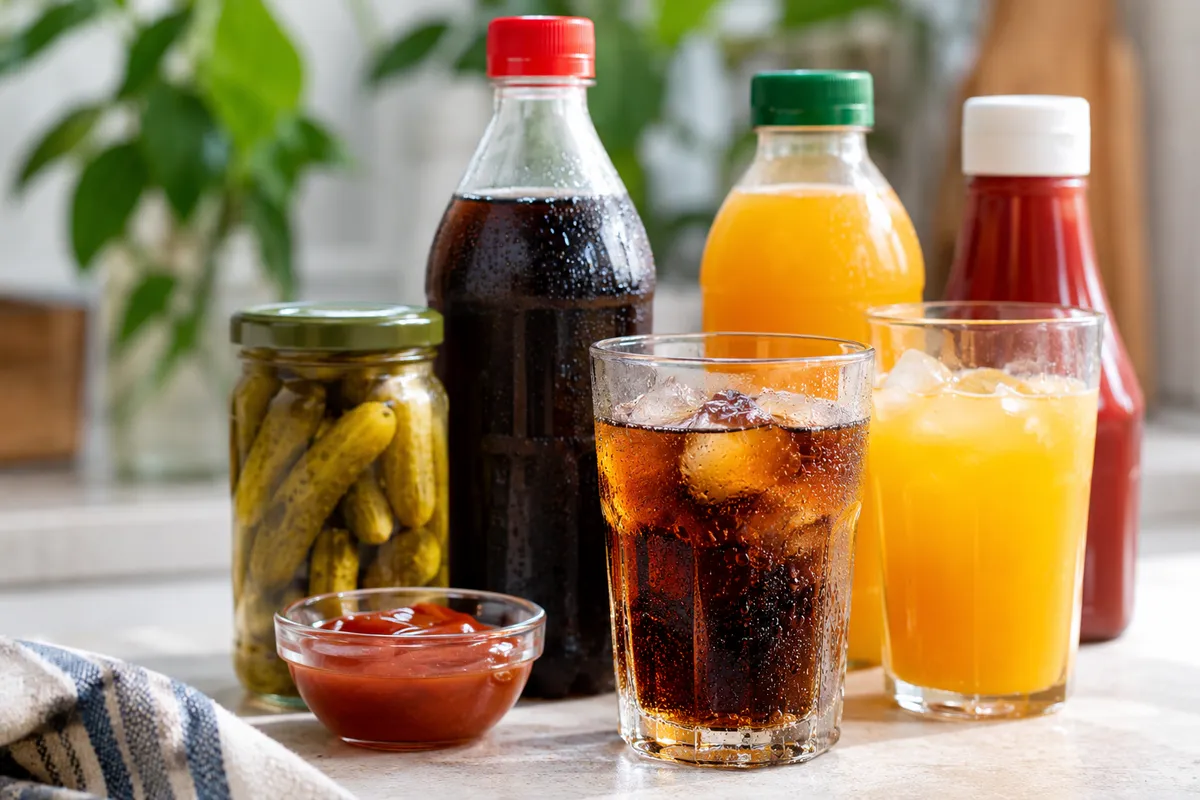
Sodium benzoate is a preservative used to inhibit bacteria, yeasts and moulds. It is particularly useful in acidic foods and drinks. Some soft drinks, fruit drinks, cordials and sauces contain it, although recipes vary and not every product in these categories uses it.
You may see its name, the number 211, or E211 depending on the market. The number is an identifier, not a danger score.
What side effects have been seen in people?
The clearest reason for individual caution is sensitivity. Sodium benzoate can trigger hives (urticaria) or deeper swelling (angioedema) in some susceptible people. That does not make it a common reaction, or mean every unexplained rash comes from this preservative.
In one small study, 47 people who suspected reactions to sodium-benzoate-containing foods underwent a double-blind, placebo-controlled challenge. Only one reacted to sodium benzoate without also reacting to placebo. That supports the possibility of a genuine reaction, while showing why other causes need checking. The result is not an estimate of how many people in the general population are sensitive.
If symptoms repeatedly follow a particular product, keep its ingredient list and discuss the pattern with a healthcare professional. Avoid diagnosing a preservative intolerance from a single episode or trying a home challenge. Breathing difficulty or sudden tongue or throat swelling needs emergency medical help, whatever the suspected trigger.
Does sodium benzoate cause hyperactivity in children?
This is a reason to ask questions, not a settled claim about sodium benzoate on its own.
A widely discussed 2007 trial tested drinks containing sodium benzoate together with mixtures of artificial colours in children aged three and eight to nine. Some analyses found small increases in hyperactivity scores. Because the ingredients were given together, the study could not identify whether sodium benzoate, the colours, or their combination explained the changes.
The European Food Safety Authority (EFSA) described the evidence as limited: effects were small and inconsistent, and their significance for everyday functioning was unclear. It would be misleading to say this trial proved sodium benzoate causes ADHD, or that every child will react.
Why is benzene mentioned alongside sodium benzoate?
There is a real food-formulation issue here, but it needs context. Very small amounts of benzene can form in some drinks containing both benzoate salts and ascorbic acid (vitamin C). Heat and light can encourage the reaction. Benzene is a known human carcinogen; sodium benzoate and benzene are not the same substance.
This is not evidence that every drink with both ingredients contains a harmful amount of benzene. In the US Food and Drug Administration’s 2005–2007 survey, almost all samples had no detectable benzene or levels below the drinking-water benchmark used for comparison. Ten products exceeded that benchmark; manufacturers reformulated or discontinued them. The FDA concluded that the levels found in that survey did not pose a safety concern. Those historical results are not a guarantee about every product sold today.
An ingredient list can flag the combination, but cannot tell you the benzene level. Formulation and testing are manufacturers’ responsibilities. Follow storage instructions and avoid prolonged heat or direct sunlight; storage advice is not a substitute for proper manufacturing controls.
What do safety assessments tell us—and what do they not?
Food-safety assessments consider dose and long-term exposure, not just whether a substance can produce an effect under any conditions. Laboratory and animal research can help identify hazards and set intake guidance, but it is not the same as demonstrating harm in people at typical food intakes.
For example, the Joint FAO/WHO Expert Committee on Food Additives (JECFA) updated its group intake guidance for benzoic acid and related substances in 2021 after reviewing new reproductive-toxicity evidence. That is evidence used in a safety assessment, not proof of reproductive harm in people eating foods containing sodium benzoate.
Regulatory permission is not a promise of zero risk for every person. Equally, a laboratory finding or an unfamiliar ingredient name is not, by itself, a reason to call a food dangerous.
Who may want to pay closer attention?
People with a reproducible pattern of hives or swelling after particular products should seek individual advice. For families, the other useful consideration is repeated exposure: children can consume more relative to their body weight, and regularly choosing the same benzoate-containing drinks may increase intake. That is an exposure question, not proof that a particular child is being harmed.
How to spot preservative 211 on a label
Look for “sodium benzoate”, “preservative (211)” or “preservative (sodium benzoate)”. You may also encounter E211. Labelling conventions differ between countries.
Know the related names: benzoic acid is 210, potassium benzoate is 212 and calcium benzoate is 213. “Benzoates” describes a family, not sodium benzoate alone.
Compare similar products if you prefer to reduce it. Check the actual ingredient list rather than assuming all fruit drinks, sauces or “natural” products have the same recipe.
Consider how often a product is consumed. Plain water is a straightforward alternative to flavoured drinks; there is no need for a complicated “detox” or sweeping food restrictions.
The Goodnessly takeaway
Sodium benzoate deserves a closer look because reactions have been documented in some people, the children’s behaviour research leaves questions unresolved, and certain drink formulations need controls to limit benzene formation. These are different issues with different levels of evidence—not one blanket verdict.
You do not need to fear every bottle with 211 on the label. Read the ingredients, consider what is consumed regularly, and get personalised advice if there is a consistent reaction. Informed choices start with clear information, not alarm.
General information only; not a diagnosis or a substitute for individual medical advice.

Facebook
Instagram
X
TikTok