
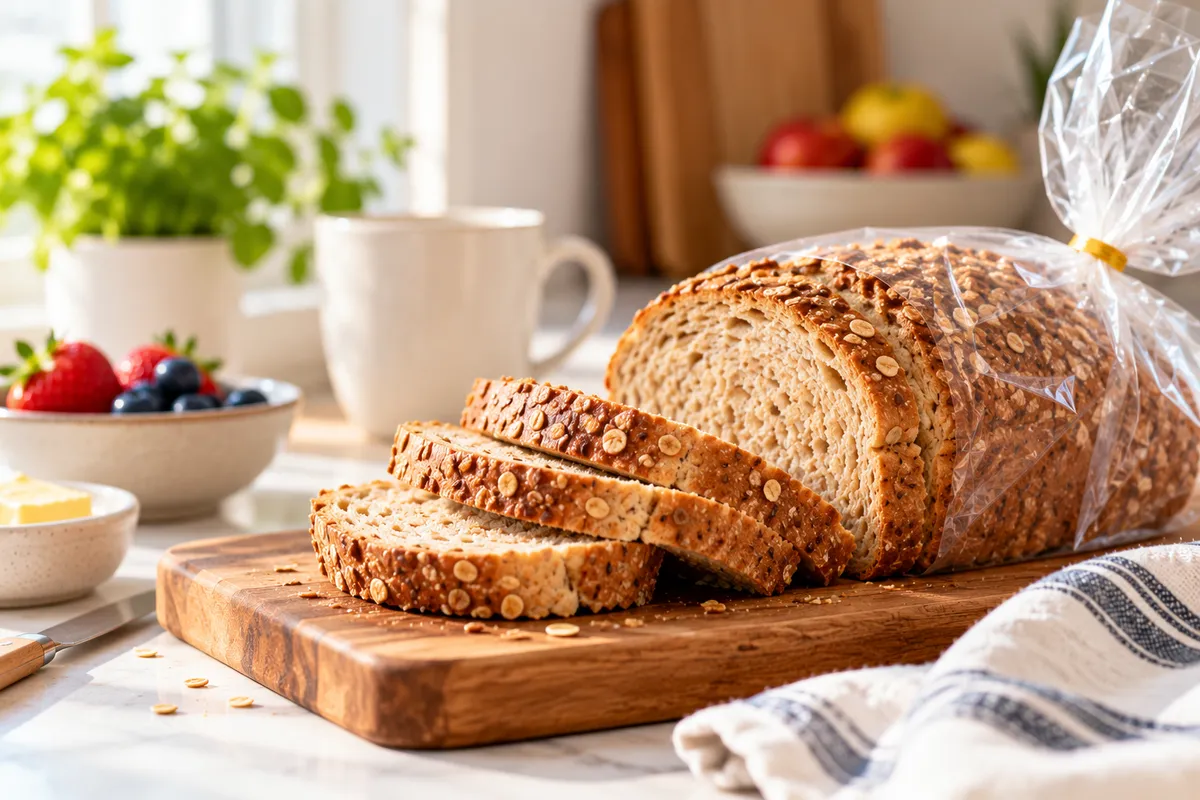
Calcium Propionate (282): The Bread Preservative You Might Find in Your Kitchen
Quick answer: Preservative 282 is calcium propionate, also labelled E282 in the UK and Europe. It’s a mould inhibitor added mainly to packaged bread, wraps and baked goods. Regulators in Australia and New Zealand, the EU and the US permit it. However, one small Australian study found that behaviour worsened in some food-sensitive children when they ate it daily. Goodnessly rates it Limited Risk. It isn’t a reason to panic, but it’s worth knowing about if your child seems sensitive.
Bread is one of those things I almost always have at home. It makes breakfast easier, works for lunchboxes, and saves me on busy mornings. But have you ever checked the ingredients on a packet of bread, wraps or muffins and wondered what the numbers mean? Here’s what you need to know about 282.
What is calcium propionate (282)?
Calcium propionate is the calcium salt of propionic acid. It stops mould from growing in bread and other baked goods, and it does this without interfering with yeast, which is why bakers use it in yeast-raised products. Propionic acid also occurs naturally in some foods, and bacteria in our gut make it when they digest fibre (EFSA, 2014).
It belongs to a small family of related preservatives:
280: propionic acid
281: sodium propionate
282: calcium propionate
283: potassium propionate
Is preservative 282 safe? What regulators say
Australia and New Zealand: permitted by Food Standards Australia New Zealand (FSANZ) in bread and some other foods, within set limits (FSANZ: food additives).
EU and UK: permitted as E282. In 2014 the European Food Safety Authority re-evaluated propionic acid and its salts (E280–E283). It found no genotoxicity or cancer concern and concluded there would be no safety concern at the authorised uses and levels. It also said the available data didn’t allow it to set a numerical acceptable daily intake (ADI) (EFSA Journal 2014;12(7):3779).
United States: classed as “generally recognised as safe” (GRAS) by the FDA.
Why do some people link 282 to behaviour changes?
Where the concern started
Much of the concern traces back to Australian author Sue Dengate and the Food Intolerance Network. For many years the network has collected parent reports of irritability, restlessness, poor concentration and sleep problems that families linked to everyday bread.
The 2002 study
In 2002, Dengate and paediatrician Dr Alan Ruben published a double-blind, placebo-controlled crossover trial in the Journal of Paediatrics and Child Health (Dengate & Ruben, 2002). The 27 children in the study had already improved on an additive-free elimination diet. They ate bread containing calcium propionate daily, and also bread without it, without anyone knowing which was which.
Average behaviour scores were not significantly different between the two.
But 52% of the children’s behaviour worsened with the preservative, compared with 19% who improved.
The authors concluded that irritability, restlessness, inattention and sleep disturbance “in some children may be caused by” the preservative.
What the evidence does and doesn’t show
It suggests a possible effect in a small group of children who were already food-sensitive.
It doesn’t show that 282 affects children in general. The trial was small, its main comparison wasn’t statistically significant, and behaviour was rated only by parents. The Australian Food and Grocery Council published a critique questioning the analysis (letter, 2003), and the authors replied defending their methods (reply, 2003). No larger trial has since confirmed or ruled out the result.
Research in adults
Separate research has looked at how propionate affects metabolism in adults. In a randomised, placebo-controlled study of 28 healthy adults, a single 1,500 mg dose of calcium propionate raised the hormones glucagon and noradrenaline compared with placebo (Adler et al., 2021). An earlier, smaller study of 14 adults found similar hormone changes after a meal containing 1 g of calcium propionate (Tirosh et al., 2019). These were short-term studies. The researchers say more work is needed to know what this means over the long term.
How Goodnessly rates 282: Limited Risk
On our calcium propionate (282) additive page, we say: “Goodnessly rates it Limited Risk under its precautionary scoring because of these study findings.”
In plain terms, it’s permitted and generally well tolerated, but the research is real enough that we flag it. If you suspect your child reacts to it, talk to your GP or a qualified dietitian before cutting out foods.
How to spot 282 on a food label
What it’s called depends on where you shop:
Australia and New Zealand: “Preservative (282)” or “calcium propionate”. Watch for the related 280 and 281 too.
UK and EU: “E282” or “calcium propionate”, usually after the word “preservative”.
United States: listed by name, “calcium propionate”, often with its purpose, for example “(to retard spoilage)” (21 CFR 101.22).
If a pack says “no added preservatives”, it’s still worth reading the ingredient list rather than relying on claims on the front of the packet.
Which breads usually contain 282, and which don’t?
Recipes vary, so the ingredient list (or a quick scan) is the only sure check. But some general patterns help.
More likely to contain 282
Packaged sliced bread made to last a week or more
Wraps and flatbreads
Packaged rolls and buns
English muffins and crumpets
Pizza bases
Packaged cakes and muffins
Less likely to contain 282
Traditional sourdough: the natural acidity of a long ferment helps slow mould, so many sourdough bakers don’t add preservatives. Some “sourdough-style” loaves are made quickly and do include them, so check.
Fresh bread from a local bakery, baked for same-day sale: often preservative-free, but not always. Ask the baker.
Loaves labelled “preservative free” or “no added preservatives”
Frozen and part-baked loaves: freezing does much of the job. Still check the label.
Homemade bread
A label to watch: “cultured wheat” or “cultured dextrose”
Some breads use “clean label” ingredients such as cultured wheat or cultured dextrose instead of 282. They’re made by fermenting wheat or sugar with bacteria that produce acids, which can include propionic acid (American Society of Baking). They do a similar job to 282 without a number on the label, so if your child seems sensitive to 282, keep an eye on these too.
Tip: buy fresh, slice it and freeze it in portions. A preservative-free loaf can then last all week with less waste.
Do you need to avoid 282 completely?
Not necessarily. Calcium propionate does a useful job, and finding it in a product doesn’t make that product unsafe. I also think it’s important not to judge a food by one ingredient. The overall nutrition of what we eat matters too.
If you’d prefer to limit it, choose bread with a shorter ingredient list, try fresh or sourdough loaves, and freeze what you won’t use straight away. Feeding a family is already a lot to think about, so learning to read labels is just one small way to make more informed choices, without the pressure to be perfect.
Check your bread in seconds with Goodnessly
Not sure what’s in your loaf? Download the Goodnessly app and scan the barcode. You’ll see the additives in it, including 282, explained in plain English. You can also browse our full Additives A–Z.
FAQs about preservative 282
Is calcium propionate the same as E282 and preservative 282?
Yes. Calcium propionate is listed as “Preservative (282)” in Australia and New Zealand, “E282” in the UK and EU, and by name in the US.
Is preservative 282 bad for kids?
It’s permitted by food regulators, and most children eat it without obvious problems. One small 2002 Australian study found that behaviour worsened in some food-sensitive children when they ate it daily, but no larger trial has confirmed this. Goodnessly rates it Limited Risk.
Is calcium propionate banned anywhere?
It’s currently permitted in Australia, New Zealand, the EU, the UK and the US.
Does sourdough contain calcium propionate?
Traditional sourdough usually doesn’t, because its natural acidity helps slow mould. Some quicker “sourdough-style” breads do, so check the ingredient list.
What does “cultured wheat” mean on a bread label?
It’s wheat fermented with bacteria to make natural acids, which can include propionic acid. It’s used to keep bread fresh, as an alternative to added 282.
How can I find bread without 282?
Read the ingredient list for “282”, “calcium propionate” or “E282”, look for loaves labelled preservative free, or scan the barcode with the Goodnessly app.
This article is for general information and is not a substitute for individual medical or dietary advice.

Facebook
Instagram
X
TikTok