
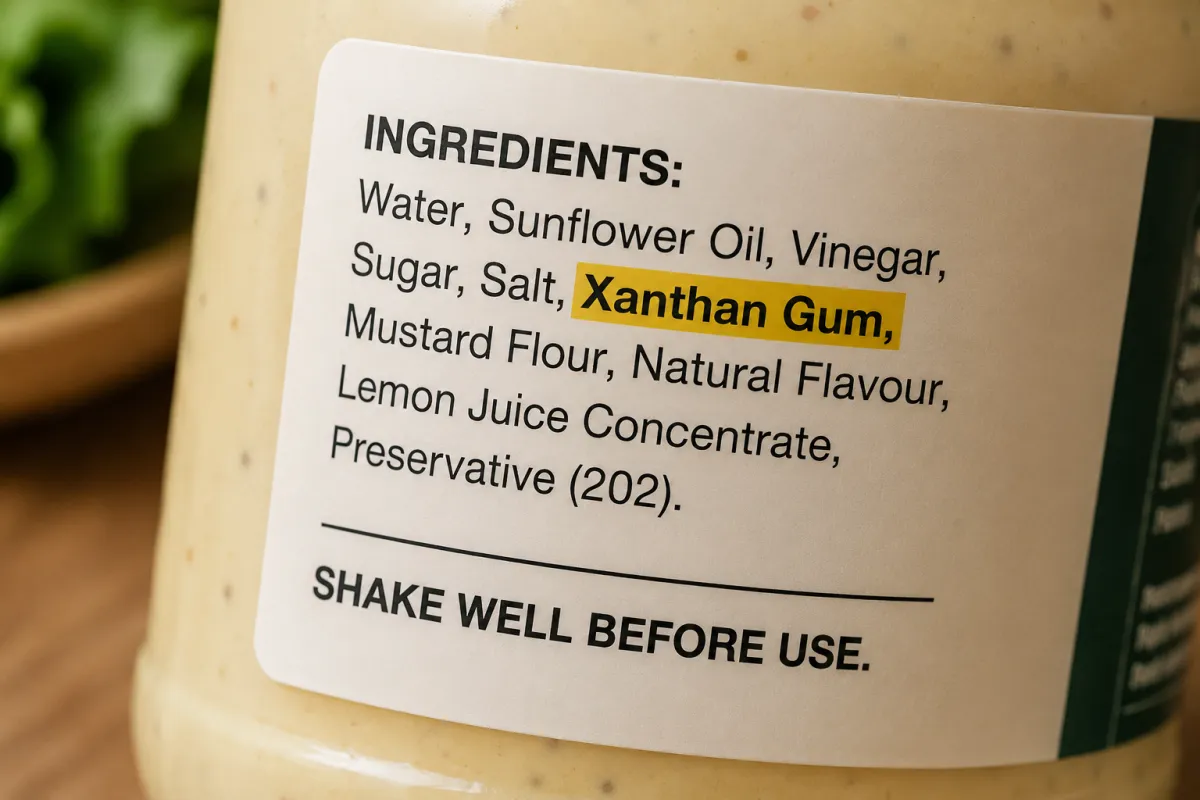
What Is Xanthan Gum — and Why Is It Everywhere?
Xanthan gum sounds like something you'd expect to find in a laboratory, not your pantry. Yet this ingredient appears in everything from salad dressings and sauces to baked goods, puddings, plant-based products and gluten-free foods.
So, what exactly is xanthan gum? How is it actually made? And should you be concerned when you see it on a label?
What Is Xanthan Gum?
Xanthan gum is a food additive used primarily as a thickener, stabiliser and texture enhancer. It helps give foods the consistency consumers expect and can prevent ingredients from separating.
According to the U.S. Food and Drug Administration (FDA), xanthan gum is used in foods including salad dressings, chocolate milk, bakery fillings and puddings to add texture. It is also listed in FDA regulations as an approved food additive.
You may also see it listed as E415 on food labels.
How It's Actually Made
Despite the lab-sounding name, xanthan gum isn't a synthetic chemical — it's a fermentation product. It's made by feeding sugar to a bacteria called Xanthomonas campestris, which produces a gum-like substance as it ferments. That substance is then purified with alcohol, dried and ground into the powder used in food manufacturing. It's a similar broad category of process to how yoghurt or soy sauce is made — bacteria doing the work — rather than something synthesised from scratch in a lab.
One practical note on that fermentation process: the sugar used to feed the bacteria can come from a few different sources, including corn, wheat, soy or dairy. The finished xanthan gum is highly purified and testing generally shows no detectable allergen protein remains, but if you or someone you're cooking for has a severe allergy (not just an intolerance) to one of those crops, it's worth checking with the manufacturer, since the label won't tell you which source was used.
It's also worth knowing that xanthan gum is vegan and naturally gluten-free — which is exactly why it turns up so often in gluten-free baking, standing in for the stretch and structure that gluten would normally provide.
Why Is It in So Many Foods?
Xanthan gum has a particularly useful property: even small amounts can significantly change the texture of a food.
For example, it can help:
Thicken sauces and dressings
Keep ingredients evenly distributed
Improve the texture of gluten-free baked goods
Prevent separation in beverages and sauces
Give foods a smoother, more consistent texture
That makes it especially useful in products where manufacturers need to recreate the texture that would otherwise come from ingredients such as gluten or traditional starches.
Is Xanthan Gum Safe?
This is where things can get confusing online.
Seeing a long chemical-sounding ingredient on a label doesn't automatically mean it is dangerous. Xanthan gum has been evaluated extensively by food-safety authorities.
The European Food Safety Authority (EFSA) re-evaluated xanthan gum (E415) and concluded that there was no safety concern for its use as a food additive under the evaluated conditions. EFSA also reviewed its use in foods intended for infants below 16 weeks of age and found no safety concern at the maximum proposed level for the specific use evaluated.
Regulators haven't set a numerical Acceptable Daily Intake (ADI) for xanthan gum, which reflects a reasonably solid safety record at typical intake levels. That said, it's not a completely free pass — between the digestive effects at higher doses (below) and the allergen-sourcing question above, it's genuinely well-tolerated for most people in the amounts actually used in food, but it's not entirely without caveats, and those caveats matter more for some people (babies, anyone with a severe grain or soy allergy, or anyone eating it in supplement-level doses) than others.
That doesn't mean every food containing xanthan gum is automatically unhealthy, either. It simply means the presence of xanthan gum is worth noting rather than ignoring or panicking over.
What Are the Actual Side Effects?
At the amount typically found in food — usually well under a gram per serve — there's no established side-effect profile for the general population.
The side effects people occasionally ask about only show up at much higher doses, generally studied around 15 grams a day — an amount you'd realistically only encounter through a concentrated supplement, not from eating food. At that level, documented effects include increased gas, softer or more frequent stools, and changes to gut bacteria. For context, that's roughly 15-20 times more than a typical daily dietary intake from packaged food.
One group does warrant a specific note: there have been documented cases of serious intestinal complications in premature infants linked to xanthan-gum-thickened feeds, which is why some infant feeding-thickener products carry specific warnings for this group. This isn't relevant to the amount in a food product on a supermarket shelf, but it's worth knowing if you're dealing with thickened feeds for a premature baby specifically — that's a conversation for a doctor, not a label check.
So, Should You Avoid It?
Not necessarily.
The bigger question is what food the xanthan gum is actually in.
Xanthan gum in a minimally processed food may be a very different nutritional consideration from xanthan gum appearing alongside added sugars, refined starches, excess sodium and numerous other additives in an ultra-processed product.
This is why looking at the entire ingredient list and nutrition profile is more useful than focusing on one ingredient.
The Bottom Line
Xanthan gum is a fermentation-derived thickener evaluated by both the FDA and EFSA, with no safety concern identified at typical food-use levels, including for most infant use. But it's not a completely clean-sheet additive: digestive effects are well documented at higher doses, sourcing from allergenic crops is undisclosed on the label, and premature infants specifically need to avoid thickened feeds containing it. None of that makes it a "nasty" to actively avoid — but it's worth knowing rather than dismissing. Next time you scan a product and see "xanthan gum" or "E415," don't panic. Instead, look at the bigger picture — because understanding your food isn't about fearing every unfamiliar ingredient, it's about knowing what's actually in your food.
Sources: FDA: Xanthan Gum, EFSA: Re-evaluation of xanthan gum (E415) as a food additive, Healthline: Xanthan Gum

Facebook
Instagram
X
TikTok