
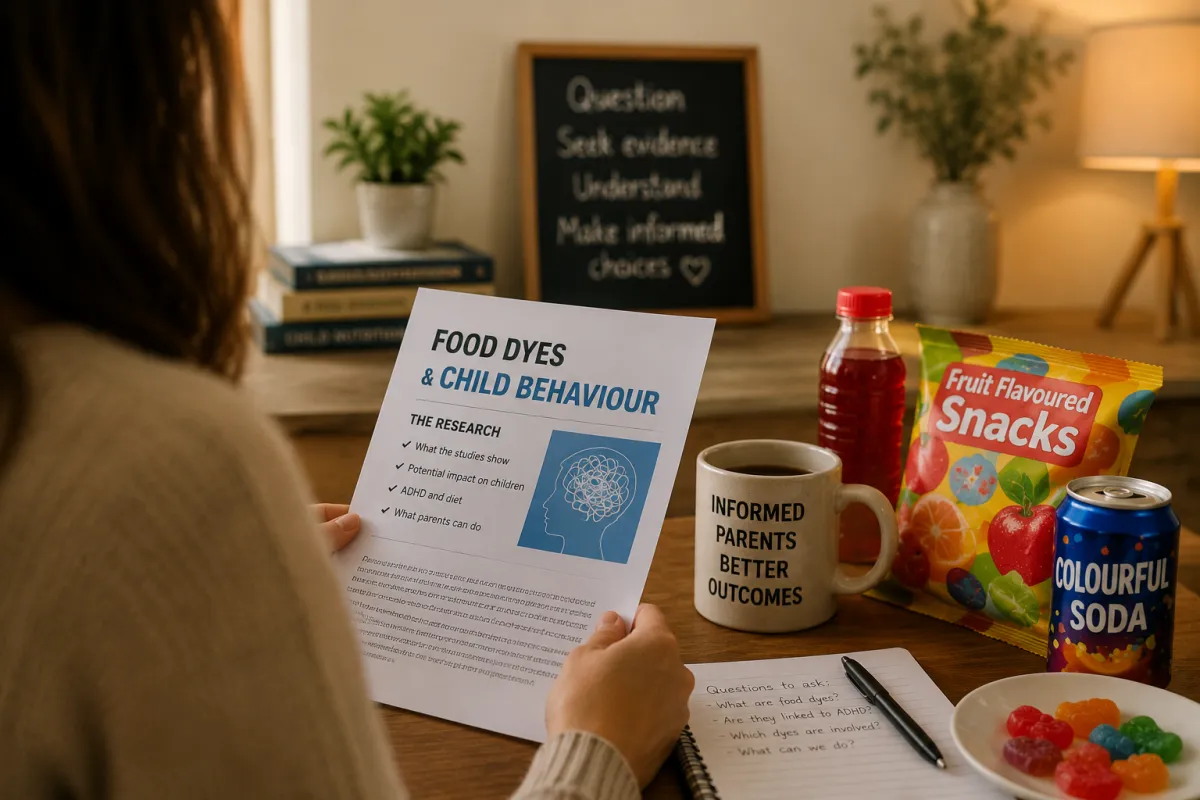
Artificial Food Colours and ADHD: What the Meta-Analyses Actually Show
When parents raise the idea that food dyes might be affecting their child’s behaviour, they’re often met with scepticism. It’s treated as a fringe belief — something anecdotal, unproven, or belonging to the realm of parenting anxiety rather than science.
The research, however, tells a more nuanced story. And for families navigating ADHD, it’s a story worth understanding properly.
What Is a Meta-Analysis and Why Does It Matter?
Before diving into the findings, it’s worth understanding what a meta-analysis actually is — because it matters for how seriously we should take this evidence.
A single study, however well-designed, has limitations. Its sample size may be small. Its methodology may have gaps. Its results may not be replicable. A meta-analysis addresses this by pooling the results of multiple studies on the same topic, running a statistical analysis across all of them, and looking for consistent patterns in the combined evidence.
It is one of the most rigorous tools in research. When multiple meta-analyses on the same question reach the same conclusion, that conclusion carries significant weight.
The Arnold et al. Research
L. Eugene Arnold is a Professor Emeritus of Psychiatry at Ohio State University and one of the leading researchers in the field of ADHD. Over more than two decades, Arnold and various colleagues have conducted and reviewed multiple meta-analyses examining the relationship between artificial food colours (AFCs) and ADHD symptoms in children.
Their body of work draws on dozens of individual studies conducted across multiple countries, involving thousands of children across a range of ages and diagnostic backgrounds.
What the Research Found
The findings across Arnold’s meta-analyses are consistent:
Artificial food colours produce a small but statistically significant increase in hyperactivity in children.
This is not a dramatic or universal effect. It is not being claimed that food dyes cause ADHD. But the effect is real, it is reproducible across studies, and it is statistically meaningful.
Several key findings emerge from the research:
1. The effect is present in the general child population Just as the Southampton Study found, the hyperactivity effect of artificial food colours is not limited to children already diagnosed with ADHD. It is observable, to varying degrees, across the general child population.
2. The effect is stronger in children with ADHD Children already diagnosed with ADHD show a notably larger response to artificial food colours than neurotypical children. For these children, ongoing exposure to synthetic dyes in their daily diet may be measurably worsening their symptoms — adding an environmental layer on top of an existing neurological condition.
3. The effect is stronger in children with sensitivities Some children appear to have a particular sensitivity to artificial food colours, independent of an ADHD diagnosis. For these children, the behavioural impact of dye consumption can be more pronounced and more consistent.
4. The effect is dose-relevant The research suggests the effect is related to the level of exposure. Children consuming artificial food colours across multiple products throughout the day — as many children do — accumulate a higher total intake, which corresponds to a greater behavioural impact.
5. Removal of dyes produces measurable improvement Studies within the meta-analyses that tested dietary elimination — removing artificial food colours from the child’s diet — found corresponding improvements in hyperactivity measures. This adds weight to the causal relationship rather than a purely correlational one.
Which Food Colours Are Involved?
The artificial food colours consistently flagged across this body of research overlap significantly with the six dyes from the 2007 Southampton Study. They include:
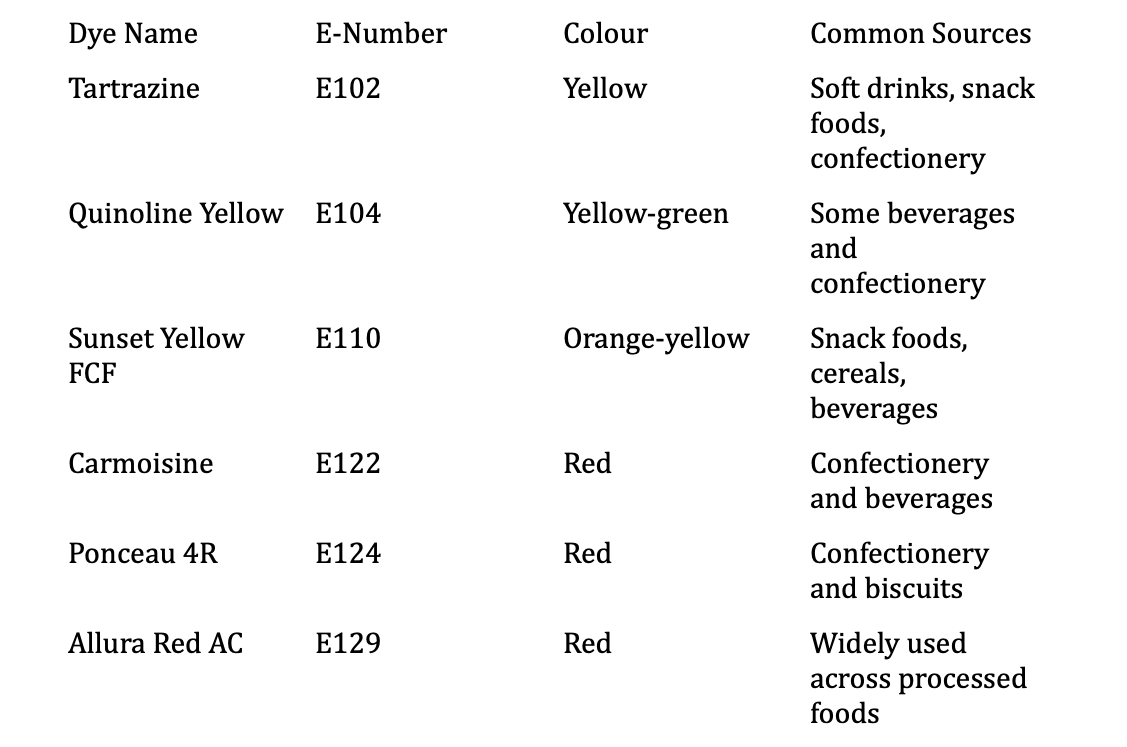
These are synthetic, petroleum-derived dyes. They have no nutritional value. They exist purely for visual appeal — to make food look more vibrant, more appealing, and more consistent in colour.
All six remain fully approved in Australia.
How Does This Fit With What We Know?
The Arnold meta-analyses sit within a broader body of evidence that has been building for decades.
The 1970s saw early research by Dr Benjamin Feingold suggesting that artificial colours and salicylates affected behaviour in hyperactive children — findings that were initially dismissed but have since been partially vindicated by more rigorous research.
The 2007 Southampton Study provided the clearest population-level evidence of a behavioural effect in ordinary children.
The Arnold meta-analyses add a further layer — showing that this effect is consistent across many studies, is particularly significant for children with ADHD, and is strong enough to warrant clinical consideration.
In 2011, the American Academy of Pediatrics acknowledged that for some children with ADHD, dietary modification including the removal of artificial food colours may lead to clinical improvement. This is not a fringe position. It is mainstream paediatric medicine acknowledging the evidence.
Why Hasn’t More Changed in Australia?
The honest answer is that food regulation moves slowly, and the relationship between the food industry and regulatory bodies is complex. The argument consistently used by regulators — including FSANZ here in Australia — is that the effect size is small, that population-level intake is low, and that the evidence does not meet the threshold for regulatory action.
What this argument doesn’t fully account for is the cumulative picture. A child who eats flavoured yoghurt for breakfast, a fruit strap in their lunchbox, a coloured snack after school, and a soft drink at a birthday party has consumed a significantly higher dose of artificial colours than population averages suggest. For a child with ADHD, who may already be navigating medication, therapy, and the daily challenges of their condition, that cumulative exposure is worth taking seriously.
The UK and EU chose the precautionary path. Warning labels, voluntary reformulation, and a significant reduction in the use of these dyes in food marketed to children. Australia has not followed.
What Can Parents Do?
The research doesn’t suggest that removing artificial food colours will cure ADHD or eliminate hyperactivity. But for many families — particularly those with children already diagnosed with ADHD or those noticing unexplained behavioural patterns — it is a practical, low-risk dietary change worth trying.
A structured elimination approach is most useful: remove the dyes consistently for four to six weeks and observe whether behaviour changes. This is best done in consultation with a paediatrician or dietitian, particularly for children on medication.
For day-to-day shopping, the practical challenge is identifying which products contain these dyes. Reading every ingredient list carefully is possible but time-consuming.
Scanning with the Goodnessly app flags all of these dyes automatically when you scan a product barcode — giving you an immediate, clear answer without needing to know every E-number by heart.
The Bottom Line
The research linking artificial food colours to ADHD symptoms is not fringe science. It is a consistent finding across multiple rigorous meta-analyses, conducted by respected researchers, published in peer-reviewed journals.
The effect is real. It is statistically significant. And it is strongest in the children who are already most vulnerable — those diagnosed with ADHD and those with particular sensitivities.
Australia allows all of the dyes implicated in this research, with no warning labels and no regulatory push to reformulate.
As a parent, that means the responsibility for knowing what’s in your child’s food falls to you. But it doesn’t have to be hard.

Facebook
Instagram
X
TikTok