
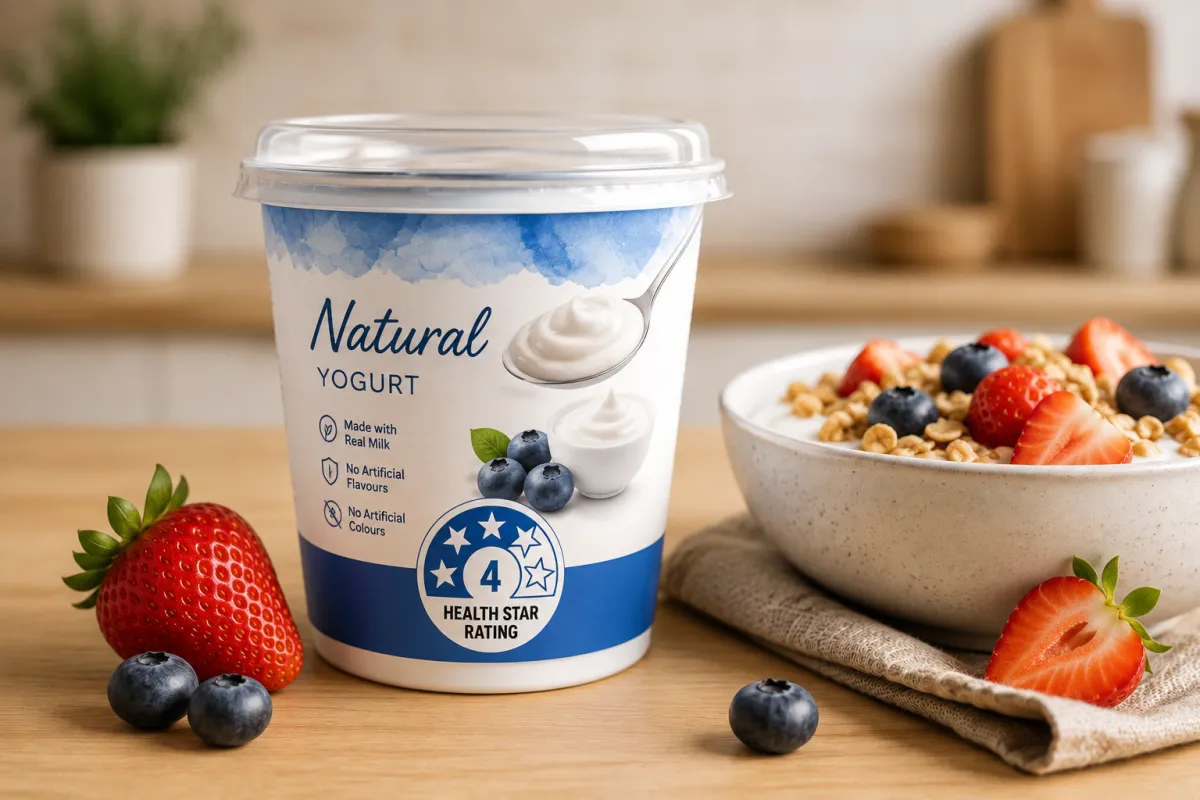
Health Star Ratings Are Going Mandatory — But a New Investigation Shows How Easily They're Gamed
Australia's Health Star Rating is about to stop being optional. After years of underwhelming voluntary uptake, food ministers have directed regulators to draft legislation making it compulsory on packaged food. At almost the same time, a major investigation aired the system's biggest weakness: it's genuinely easy to game, and some products are already proving it.
Here's what's actually changing, what a recent investigation found, and why a star rating alone doesn't tell you as much as it looks like it does.
Why Mandatory Ratings Are Happening Now
The Health Star Rating has been voluntary since it launched in 2014, and voluntary uptake simply hasn't worked. The industry's own target was to have 70% of eligible products carrying a rating by November 2025 — the actual figure came in at roughly 32-35%. Faced with that shortfall, Australian and New Zealand food ministers formally directed Food Standards Australia New Zealand (FSANZ) in February 2026 to begin drafting legislation to make the rating mandatory across all packaged food.
The public health argument is straightforward: a rating system only helps shoppers compare products if most products actually display one. Right now, most don't.
What the July Investigation Actually Found
On 29 July 2026, an ABC Four Corners investigation into Australia's food labelling system produced two examples that are hard to forget: Nestlé's Milo chocolate-flavoured cereal, which is high in sugar, carries a 4-star rating. Coke Zero, which nutrition experts describe as having almost no nutritional content at all, carries 3.5 stars.
Industry insiders told the investigation that manufacturers can and do actively manage their products' star ratings — not by making them meaningfully healthier, but by adjusting the specific inputs the algorithm scores. Common tactics include replacing sugar with non-nutritive sweeteners, replacing fat with emulsifiers or gums, and adding ingredients like fibre powder or protein isolate that lift the score without changing how processed or nutritionally balanced the product actually is.
This isn't a new concern in isolation — a 2020 study already found that around three-quarters of ultra-processed foods displaying a star rating scored 2.5 stars or higher, which most consumers interpret as a "healthy" pass mark.
Why This Happens: What the Algorithm Actually Measures
The Health Star Rating scores products on a handful of nutrients — energy, saturated fat, sugar, sodium, plus "positive" components like protein, fibre, and fruit/vegetable/nut/legume content. What it doesn't directly measure is how processed a food is, or what specific ingredients (rather than nutrient totals) went into achieving that profile. That gap is exactly what makes the system gameable: a product can hit good numbers on the nutrients being measured while still being built almost entirely from refined ingredients, artificial sweeteners and additives.
Researchers at the George Institute for Global Health have already tested a fix — reassessing over 25,000 products using a modified algorithm that penalises ultra-processed classification directly, based on the NOVA system. The result: products like protein bars, sugary cereals, refined white bread and diet soft drinks scored measurably lower under the revised system than they do today. FSANZ hasn't adopted this change, but it shows the current gaps are fixable, not inherent to the idea of a star rating.
The Alternative on the Table: Warning Labels
Australia isn't the only country reconsidering its approach. Mexico introduced blunt, high-contrast warning labels (flagging products high in sugar, salt or fat) rather than a positive star score, and has seen consumers measurably shift their purchasing habits since. Canada and the United States have both moved toward similar warning-label approaches in the past year, and in July 2026 the Indian Supreme Court asked that country's food regulator to consider the same model. Some Australian public health researchers argue a warning-label system would be harder to game than a positive star score, since there's no algorithm to optimise around — either a product exceeds a threshold or it doesn't.
Whether Australia moves toward warning labels or sticks with a reformed star system remains an open question. What's settled, for now, is that stars are becoming mandatory before that bigger debate is resolved.
What This Means for Your Shopping
1.A high star rating isn't the same as "minimally processed" — the algorithm doesn't check for that directly, so a heavily reformulated product can still score well.
2.Check the ingredient list alongside the stars, not instead of it — if a high-scoring product has a long list of unfamiliar ingredients, sweeteners or emulsifiers, that's worth noticing even if the star count looks reassuring.
3.A 4-star cereal or a 3.5-star soft drink is still exactly what it is — mandatory ratings will make stars more visible, not necessarily more meaningful, until the algorithm itself changes.
4.This is exactly why we score more than nutrients alone — Goodnessly's Goodness Score factors in additives and organic content specifically because a single nutrient-based number, on its own, is provably gameable.
The Bottom Line
Making Health Star Ratings mandatory will fix the visibility problem — most products will finally display one. It won't, on its own, fix the accuracy problem a national investigation just put back in the spotlight: a system built around a handful of measurable nutrients can be optimised without the underlying product becoming any less processed. Worth remembering that a star rating is one data point, not the whole picture — especially while Milo can carry 4 stars and Coke Zero can carry 3.5.

Facebook
Instagram
X
TikTok