
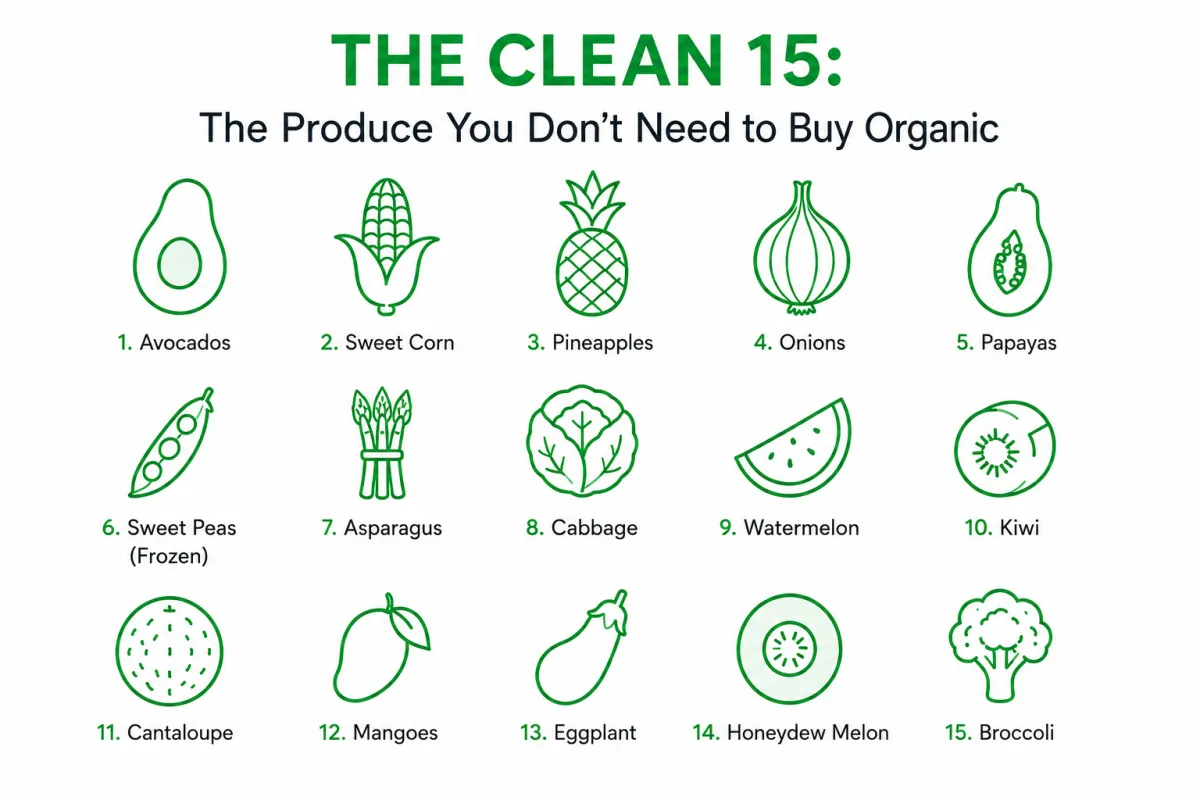
The Clean 15: The Produce You Don’t Need to Buy Organic — And Why “Organic” Doesn’t Mean What Most People Think
The conversation around organic food often gets framed as all-or-nothing. Either you buy everything organic and do it properly, or you don’t bother. For most families, neither extreme is realistic or necessary.
The Environmental Working Group’s Clean 15 exists precisely to cut through that noise. It’s the practical counterpart to the Dirty Dozen — a list of the 15 fruits and vegetables consistently found to carry the lowest pesticide residue, where buying conventional is a perfectly reasonable choice.
Understanding both lists is how you make genuinely informed decisions with a real-world budget.
The 2025 Clean 15
Based on USDA testing data, the following fruits and vegetables showed the lowest pesticide residues in 2025:
Avocados — consistently the cleanest item on the list; fewer than 2% of samples showed any detectable pesticide residues
Sweet corn — very low residue; note that much US sweet corn is genetically modified (GM), though conventional non-GM corn is widely available in Australia
Pineapple — thick outer skin provides a natural barrier; flesh consistently tests clean
Onions — natural pest resistance and dry outer layers contribute to very low residue
Papaya — low residue profile; papaya grown in Australia is not GM
Frozen sweet peas — blanching process used before freezing reduces residues further
Asparagus — short growing season and minimal pest pressure contribute to low residue
Honeydew melon — thick rind protects the flesh; very low residue detected
Kiwi — the fuzzy skin provides some protection; consistently low in testing
Cabbage — natural pest resistance and outer leaves that are typically removed contribute to low residue
Mushrooms — grown in controlled environments, often indoors; minimal pesticide use
Mangoes — thick skin and tropical growing conditions; consistently clean in testing
Sweet potato — lower pest pressure than regular potatoes; consistently low residue
Watermelon — thick rind; flesh tests consistently clean
Carrots — despite being a root vegetable grown in soil, carrots consistently test with low pesticide residue in Clean 15 data
Nearly 65% of Clean 15 samples showed no detectable pesticide residues whatsoever. For context, on Dirty Dozen items like strawberries, detectable residues are found on the vast majority of samples tested.
Why Some Produce Is Cleaner Than Others
The factors that determine where produce falls on the pesticide residue spectrum include:
Skin thickness and permeability Produce with thick, inedible outer skins — avocados, pineapples, melons, mangoes — tends to carry lower residues in the edible flesh. The skin acts as a physical barrier. Thin-skinned produce eaten whole — strawberries, grapes, spinach — has no such protection.
Natural pest resistance Some plants have natural compounds that deter pests, reducing the need for pesticide application. Onions, asparagus, and cabbage are examples.
Growing environment Produce grown in controlled environments (mushrooms) or with naturally lower pest pressure (many tropical fruits) requires fewer pesticide applications.
Processing before consumption Frozen peas undergo a blanching process before freezing that further reduces residue levels. Produce that is typically peeled before eating (bananas, avocados) has lower residue in the consumed portion.
A Critical Point: Organic Doesn’t Mean Additive-Free
This is one of the most important and most misunderstood aspects of organic food, and it’s worth addressing directly.
What Does "Organic" Actually Mean?
Organic certification primarily guarantees how the food was produced, not how healthy it is.
At its core, organic certification means the produce or ingredients were grown without synthetic pesticides, synthetic fertilisers, genetically modified organisms (GMOs), and certain other prohibited substances. It also typically requires higher animal welfare standards for meat, eggs, and dairy.
However, organic standards vary significantly between countries:
Australia: Certified organic must meet the Australian Certified Organic (ACO) or NASAA standards. It is quite strict regarding chemical use and prohibits GMOs. Australian organic is generally well-regarded internationally.
European Union: Very strict standards. Prohibits synthetic pesticides and fertilisers, GMOs, and has strong rules around animal welfare and biodiversity.
United States (USDA Organic): One of the most recognised certifications globally. Allows some synthetic substances on its approved list and has faced criticism for being less strict than the EU in certain areas.
Canada: Similar to the US but with its own Canadian Organic Standards.
Important: What Organic Does NOT Mean
The organic label does not tell you:
Whether the product is healthy overall
Whether it is low in sugar, salt, or saturated fat
Whether it is minimally processed
Whether it is suitable for children or people with food sensitivities
What Can Still Be in Certified Organic Packaged Foods:
Organic sugar (still sugar — same effect on blood sugar and teeth)
Organic seed oils (still highly processed and high in omega-6)
Natural flavours (a very broad category that can include many compounds)
Natural preservatives and colours (e.g. annatto / E160b, which is linked to hyperactivity in some sensitive children)
High amounts of salt or refined organic flour
Highly processed organic snacks, muesli bars, cereals, and lollies
Bottom line:
Organic is a statement about farming and production practices — not a guarantee of nutritional quality or healthfulness.
A product can be certified organic while still being ultra-processed, high in sugar, or containing additives that affect sensitive individuals. Always read the full ingredient list.
The front of the pack is marketing.
The back of the pack is information.
How to Use Both Lists Practically
The combined Dirty Dozen and Clean 15 framework gives you a practical decision tree:
For fresh produce: - Dirty Dozen items → buy organic when available and budget allows, prioritising the items your family eats most frequently - Clean 15 items → buy conventional without concern - Everything else → use your judgement based on how the produce is eaten (peeled vs. whole), how frequently it’s consumed, and budget
For packaged organic products: - The organic label is a starting point, not an endpoint - Still read the ingredient list - Check for added sugars, seed oils, and additives — organic or otherwise - For children, still look for the synthetic dyes and preservatives known to affect behaviour, even in products marketed as organic or natural
Annatto (E160b) — the natural dye worth knowing about: One natural additive that parents of sensitive children should be aware of is annatto, a natural colouring derived from the seeds of the achiote tree. It’s used widely in organic and “natural” products as an alternative to synthetic dyes. However, research — particularly the Feingold Association’s work — suggests that some children who react to synthetic food colours also react to annatto. It’s not a synthetic additive, but it’s not universally neutral either.
What This Means for Your Shopping Approach
The most practical approach to organic food combines:
Strategic organic purchasing based on the Dirty Dozen — highest residue, highest priority
Confident conventional purchasing for Clean 15 items
Label reading for packaged products regardless of organic labelling
Whole food prioritisation — unpackaged, minimally processed foods carry fewer hidden ingredients whether organic or conventional
The goal is not perfection. It’s informed decision-making with the information available to you.
Scanning packaged products with Goodnessly — whether they’re labelled organic or conventional — shows you the full ingredient picture so you can see what you’re actually buying, not just what the front of the pack wants you to believe.
The Bottom Line
The Clean 15 is your permission to shop conventional without guilt for a significant portion of your produce. Use the budget you save to prioritise organic on the Dirty Dozen items that matter most.
And remember: organic is about how something was grown. It is not a guarantee that what you’re buying is nutritionally sound, low in additives, or appropriate for every member of your family.
Read the label. Always.

Facebook
Instagram
X
TikTok