
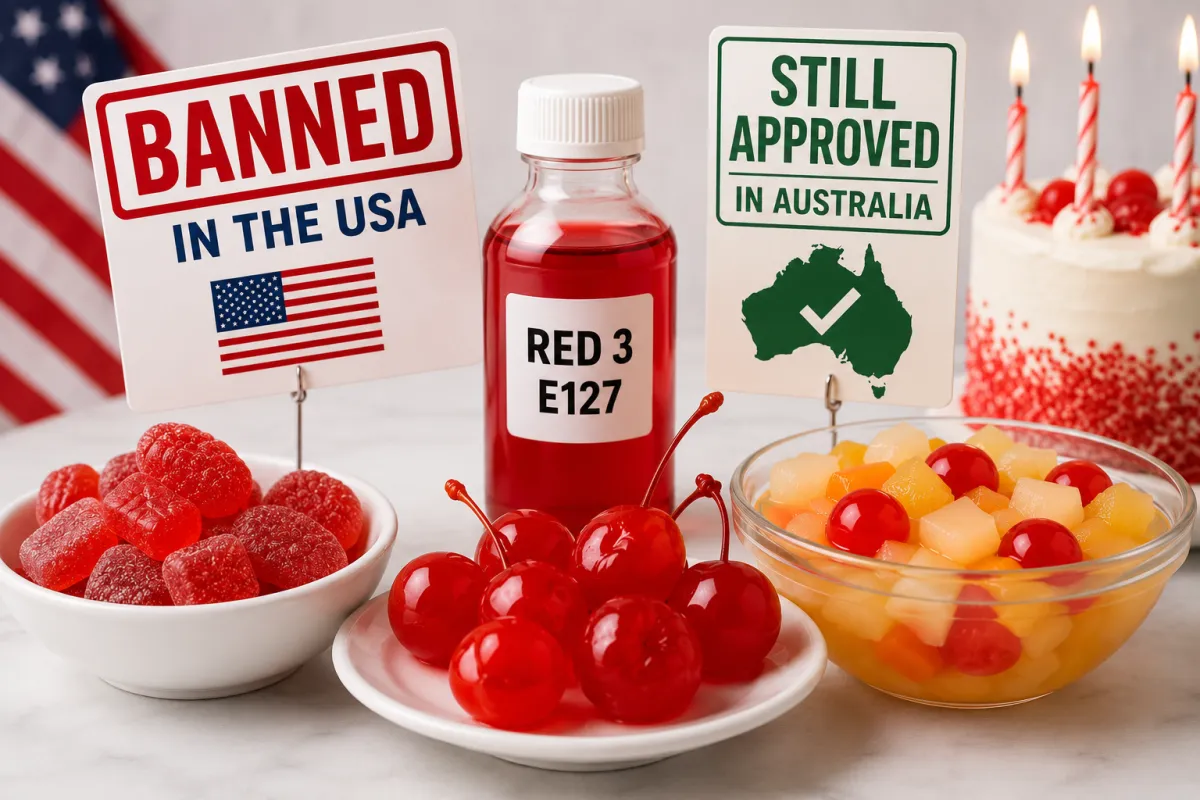
The US Just Banned Red 3 Food Dye. Australia Still Allows It. Here’s What You Need to Know.
In January 2025, the US Food and Drug Administration took a step that food safety advocates had been pushing for since 1990. They banned Red 3 — a bright pink synthetic food dye that had been quietly linked to thyroid tumours in animal studies for decades.
The decision made headlines in the US. Here in Australia, it barely registered. And yet E127 — as it’s listed on Australian labels — is still fully approved by Food Standards Australia New Zealand (FSANZ) and still showing up in products on our supermarket shelves.
If you have children, or if you’re someone who pays attention to what goes into your body, this is worth understanding.
What Is Red 3, and Where Does It Hide?
Red 3 is a synthetic food dye derived from petroleum. Its scientific name is erythrosine, and it produces a vivid cherry-pink colour that’s difficult to replicate naturally. In the US it was
known as FD&C Red No. 3. In Australia and the EU it’s listed as E127.
You’ll find it in:
• Glacé cherries and cocktail cherries
• Some lollies and confectionery
• Canned fruit cocktail
• Certain medications, particularly cough syrups and vitamins
• Some baked goods and decorations with pink or red colouring
It’s not in everything, but it’s in enough everyday products that most Australian families will
encounter it regularly without realising.
Why Did the FDA Finally Ban It?
The FDA’s decision came down to a piece of US legislation called the Delaney Clause. This law states that if a food additive is shown to cause cancer in animals at any dose, it cannot remain approved — full stop.
Studies on Red 3 showed that at high doses it caused thyroid tumours in male rats. The
mechanism involves disruption of thyroid hormone levels, which at chronically elevated
concentrations promotes tumour growth.
Here’s where it gets uncomfortable: the FDA identified this cancer link in 1990. That same year, they banned Red 3 from cosmetics and externally applied drugs. But they left it in food and ingested medications for another 35 years. The delay was largely attributed to industry lobbying and a protracted regulatory process.
The FDA’s January 2025 ruling gave food manufacturers until January 2027 to reformulate, and drug manufacturers until January 2028.
The science nuance worth knowing: The doses used in the rat studies were significantly higher than what a person would typically consume from food. Some scientists argue the thyroid tumour mechanism observed in male rats doesn’t directly translate to human physiology. However, under the Delaney Clause, that distinction doesn’t change the outcome — animal carcinogenicity is the legal threshold, and Red 3 crossed it.
The Southampton Study: A Bigger Picture on Food Dyes and Kids
Red 3 is one piece of a much larger conversation about synthetic food dyes and children’s health.
In 2007, researchers at the University of Southampton published a landmark study in The Lancet. The study involved 153 children from the general population — not children specifically diagnosed with ADHD or other behavioural conditions. Children were given drinks on different days: one containing a mixture of six synthetic food dyes plus the preservative sodium benzoate, and one a placebo.
The results were clear. Children who consumed the dye mixture showed a statistically
significant increase in hyperactive behaviour — more impulsive, less focused, harder to settle. And this effect was observed across the general child population, not just those with pre-existing sensitivities.
The six dyes tested were:
• Tartrazine (E102) — yellow dye found in soft drinks, snack foods, confectionery
• Quinoline Yellow (E104) — yellow-green dye found in some beverages and
confectionery
• Sunset Yellow (E110) — orange-yellow dye found in snack foods, cereals, beverages
• Carmoisine (E122) — red dye found in confectionery and beverages
• Ponceau 4R (E124) — red dye found in some confectionery and biscuits
• Allura Red (E129) — red dye, one of the most widely used synthetic dyes globally
All six remain approved in Australia today.
What the UK Did. What Australia Did.
The UK government’s response to the Southampton Study was significant. The Food Standards Agency recommended that manufacturers voluntarily remove the six dyes from their products.Warning labels were made mandatory for any product that still contained them — labels stating: “may have an adverse effect on activity and attention in children.”
Most major UK manufacturers reformulated entirely, removing the dyes rather than carrying the warning label.
The European Food Safety Authority (EFSA) reviewed the Southampton data in 2008 and
confirmed the findings were consistent with the study’s conclusions.
Australia’s response was different. FSANZ reviewed the same research and concluded that Australian intake levels of these dyes were low enough that no regulatory action was required. No warning labels. No reformulation push. No public communication campaign.
That review was completed in 2009. It has not been substantially revisited since.
Why This Matters for Australian Families
The gap between what the research shows and what our food labels tell us is significant. These aren’t obscure additives buried in niche products — they’re in everyday foods that children consume regularly. Fruit straps, flavoured milk, lollies, yoghurt pouches, party food.
The argument that “our intake levels are low” may be technically accurate in aggregate. But it doesn’t account for children who eat these products daily, or children who are particularly sensitive to these compounds, or the cumulative effect of multiple additives consumed together.
If your child experiences hyperactivity, difficulty concentrating, eczema, or unexplained
behavioural changes, their diet — specifically their additive intake — is genuinely worth
investigating. It won’t be the answer for everyone. But for some families it makes a meaningful difference.
How to Check Your Products
Checking for these dyes manually means reading ingredient lists carefully and knowing which E-numbers to look for. It’s possible, but it’s time-consuming — particularly in a busy
supermarket with kids in tow.
The Goodnessly app was built to make this easier. Scan any product’s barcode and the app will flag synthetic dyes, preservatives, and any other additives with known health concerns — instantly, so you can make an informed decision right there in the aisle.
You don’t need to overhaul everything at once. Start with the products your family eats every day and go from there. Small, consistent changes are far more sustainable than trying to do everything at once.
The Bottom Line
The US banning Red 3 after 35 years is a reminder that food regulation moves slowly, and that
the burden of staying informed often falls on consumers. Australia has strong food standards in many areas, but our approach to synthetic food dyes lags behind the UK and EU in meaningful ways.
You deserve to know what’s in your food. And you shouldn’t need a science degree to find out.

Facebook
Instagram
X
TikTok