
The 2025 Dirty Dozen: Which Fruits and Vegetables Have the Highest Pesticide Residue — and What to Do About Itg Post
Every year, the Environmental Working Group (EWG) — an independent US-based non-profit research organisation — publishes its annual Shopper’s Guide to Pesticides in Produce. The centrepiece of that guide is the Dirty Dozen: a ranked list of the 12
fruits and vegetables found to carry the highest pesticide residue based on testing of thousands of produce samples.
The 2025 list has been updated, with two new additions and a couple of changes worth understanding. If you’re trying to make practical, evidence-based decisions about when organic is worth it — this is the list to know.
The 2025 Dirty Dozen
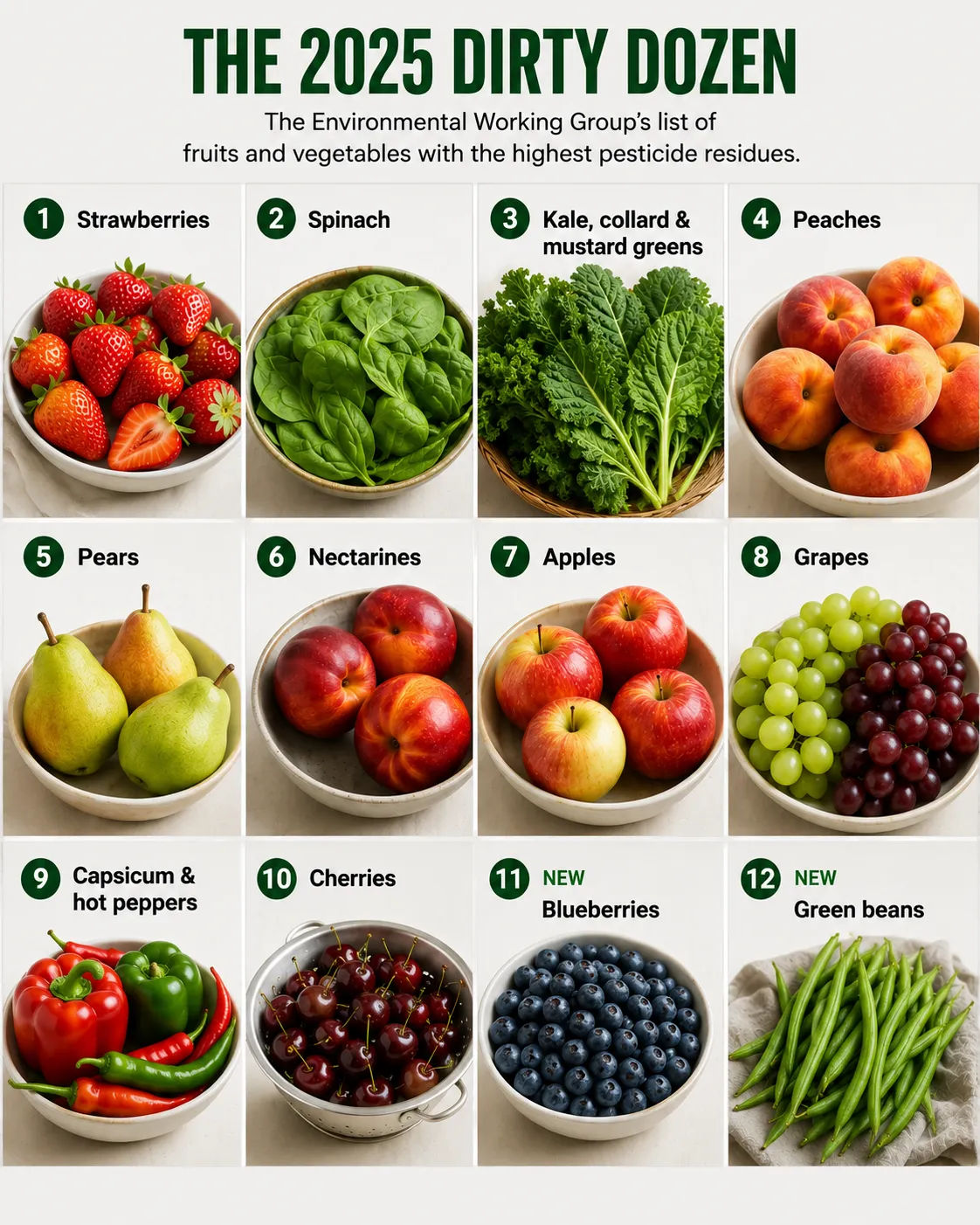
The Environmental Working Group’s 2025 Dirty Dozen, ranked from highest to lowest pesticide residue:
Strawberries — consistently at the top of the list; multiple pesticide residues detected on nearly every sample tested
Spinach — high residue levels; pesticides absorb readily into leaves
Kale, collard & mustard greens — grouped together; frequently tested positive for concerning pesticides including DCPA (Dacthal)
Peaches — thin skin, high residue; commonly treated with fungicides post-harvest
Pears — residues detected on a high percentage of samples
Nectarines — similar profile to peaches; skin absorbs pesticide readily
Apples — one of the most consumed fruits; frequently treated post-harvest with diphenylamine (DPA)
Grapes — multiple fungicide residues common; also applies to raisins
Capsicum & hot peppers — broad spectrum of pesticide residues detected
Cherries — high residue across conventional samples
Blueberries (new to 2025 list) — rising pesticide residue levels moved them onto the list this year
Green beans (new to 2025 list) — organophosphate insecticides including acephate flagged in testing
Dropped from the list this year: Celery and tomatoes, which showed lower relative residue levels in 2025 sampling compared to the new additions.
What Is the EWG and How Is the Dirty Dozen Compiled?
The Environmental Working Group is a non-profit organisation focused on research and advocacy in the areas of agricultural subsidies, toxic chemicals, drinking water pollutants, and corporate accountability. Their annual Shopper’s Guide to Pesticides in Produce has been published since 1995.
The Dirty Dozen is compiled using data from the United States Department of Agriculture (USDA) and the US Food and Drug Administration (FDA), which test tens of thousands of produce samples each year for pesticide residues. The EWG analyses this data and ranks produce based on:
The percentage of samples with detectable pesticide residues
The number of different pesticides detected
The concentration of residues detected
It’s worth noting that all produce tested is washed and peeled as appropriate before testing — meaning the residues detected are what remains after normal consumer preparation. This is an important point: washing helps but does not eliminate residue, particularly on thin-skinned fruits.
Why Does Pesticide Residue Matter?
The presence of pesticide residue on produce does not automatically mean harm. Regulatory agencies in both Australia and the US set Maximum Residue Limits (MRLs) — the maximum concentration of a pesticide residue permitted in or on food — and most conventional produce falls within these limits.
However, there are several reasons why reducing pesticide exposure where practical is worth considering, particularly for children:
Children are more vulnerable than adults Children eat more food relative to their body weight than adults, which means their exposure per kilogram of body weight is proportionally higher. Their developing organ systems — particularly the brain, endocrine system, and liver — are also more sensitive to chemical disruption than fully developed adult systems.
Cumulative exposure MRLs are set for individual pesticides on individual foods. They don’t account for the cumulative effect of consuming multiple pesticide residues across multiple foods throughout the day — which is the reality of a typical diet. Research into the combined effects of low-level exposure to multiple pesticides simultaneously is limited, and the precautionary principle suggests reducing overall exposure where possible.
Endocrine-disrupting pesticides Some pesticides approved for use in conventional agriculture are classified as endocrine disruptors — chemicals that interfere with hormonal systems. Children going through developmental stages are particularly sensitive to endocrine disruption. Several pesticides found on Dirty Dozen produce — including certain fungicides used on strawberries and organophosphates used on green beans — have been identified as potential endocrine disruptors.
Organophosphates and neurodevelopment Organophosphate pesticides, which appear in testing of several Dirty Dozen items including green beans, have been studied extensively in relation to neurodevelopmental effects in children. Research published in peer-reviewed journals has linked higher organophosphate exposure to increased risk of ADHD and cognitive development impacts in children.
A Note on Australian Produce
The Dirty Dozen is compiled from US testing data. Australian produce is regulated under a separate framework administered by the Australian Pesticides and Veterinary Medicines Authority (APVMA), which sets its own MRLs and approved pesticide list.
There are some differences between what is approved in the US and Australia. However, many of the same pesticide classes are used on the same produce categories in both countries, and Australian testing of produce — conducted by state governments and FSANZ — consistently shows residue patterns in similar produce categories to those flagged in US testing.
The Dirty Dozen is best understood as a practical guide to which types of produce are structurally more likely to carry higher residues — due to their growing conditions, skin thickness, post-harvest treatment practices, and pest management needs — rather than as a definitive statement about Australian-specific residue levels.
The core principle holds: thin-skinned produce eaten whole, grown in soil with intensive pest management, will generally carry higher residue than thick-skinned produce or produce that is peeled before eating.
The Clean 15: Where Conventional Is Fine
Equally useful is the EWG’s Clean 15 — the produce with the lowest pesticide residue, where buying conventional is generally a reasonable choice. The 2025 Clean 15 includes:
Avocados
Sweet corn
Pineapple
Onions
Papaya
Frozen sweet peas
Asparagus
Honeydew melon
Kiwi
Cabbage
Mushrooms
Mangoes
Sweet potato
Watermelon
Carrots
Nearly 65% of Clean 15 samples had no detectable pesticide residues at all. Thick skins, different growing conditions, and lower pest pressure contribute to the lower residue profiles of these items.
A Practical Approach for Families
Going fully organic is not necessary, and for many families it’s not financially realistic. The Dirty Dozen framework is specifically designed to help prioritise where organic spending makes the most impact.
A practical starting framework:
Buy organic for the Dirty Dozen items your family eats most frequently — particularly anything consumed skin-on, eaten raw, or eaten in large quantities by children
Buy conventional for Clean 15 items without concern
For everything else — make decisions based on what’s available, affordable, and practical
For most Australian families with young children, prioritising organic strawberries, apples, grapes, and spinach covers a significant portion of regular pesticide exposure because these are high-frequency foods in most children’s diets.
Practical tips: - Frozen organic options are often significantly cheaper than fresh organic and retain most of their nutritional value - Farmers’ markets sometimes offer lower-spray or spray-free produce that isn’t certified organic but carries lower residue - Growing your own strawberries, herbs, and leafy greens — even in pots — is a practical way to eliminate pesticide exposure on high-residue items
The Bottom Line
The 2025 Dirty Dozen update confirms what the research has consistently shown: certain types of produce carry meaningfully higher pesticide residues than others, and thin-skinned fruits and leafy greens eaten whole are the priority areas for organic purchasing.
Blueberries and green beans joining the list this year is a useful reminder that the landscape shifts — pesticide use practices change, and staying informed matters.
You don’t need to overhaul your entire grocery shop. Start with the items your family eats most often from the Dirty Dozen list, and work from there.
Small, consistent changes are the foundation of a genuinely healthier diet — and knowing which changes matter most is exactly where to start.

Facebook
Instagram
X
TikTok