
What is E103?
Alkanet, also called alkannin — a natural red-burgundy plant dye still permitted in Australia, but not approved in the EU or US since the 1980s.
E103 (alkanet or alkannin) is a natural red dye extracted from the root of the alkanet plant. Despite being plant-derived, it hasn't been approved for food use in the EU since 1984 or in the US since 1988, though it remains permitted in Australia and Canada. Reported concerns include skin and eye irritation on contact, and limited long-term human safety data. Goodnessly rates it Avoid.
Download our app to check additives in everyday foods
Read the FAQ →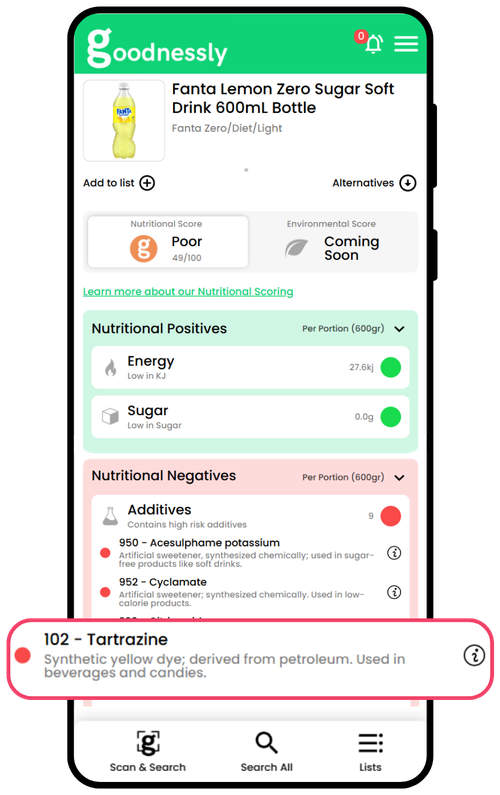
What is alkanet?
Alkanet (or alkannin) is a natural dye extracted from the roots of Alkanna tinctoria, a plant in the borage family that grows around the Mediterranean, including southern France. The root's outer layer is dark red, and the extract gives a deep red to burgundy colour in oily or fatty environments, shifting toward violet in alkaline conditions. It's fat-soluble rather than water-soluble, which shapes where it can practically be used. Historically, "E103" was also briefly used in Europe (before 1977) for an entirely different, synthetic azo dye called Chrysoine resorcinol — a naming overlap worth knowing about if you come across older references to E103.
What's it used for?
- Colouring wine a deep red-burgundy shade
- Colouring confectionery and some processed foods
- Used traditionally in some Indian dishes, including certain versions of Rogan Josh, under the name "Ratan Jot"
- Also used outside food in cosmetics, oils and ointments
Where you'll find 103 on the shelf
A fairly uncommon colourant, mostly limited to specific traditional and wine-related uses.
Is alkanet safe? What the research says
Alkanet's story is unusual for a natural colourant: rather than being widely approved with a formal intake limit, it has been withdrawn from most major markets, with only a handful of countries, including Australia, still permitting it.
| Region | Status | What this means |
|---|---|---|
| AU/NZ Australia & New Zealand (FSANZ) | Permitted | Permitted for limited colouring uses, one of a small number of markets, alongside Canada, where alkanet remains approved. |
| EU European Union | Not approved | Alkanet has not been approved for food use in the EU since 1984. |
| US United States (FDA) | Not approved | Not listed among the FDA's approved food colours; alkanet has not been permitted for food use in the US since 1988. |
Direct contact with alkanet can cause skin, eye or mucous membrane irritation in some people. Long-term human safety data at typical dietary exposure levels is limited compared to more extensively studied colourants, which is part of why most major regulators haven't renewed its approval.
- No recent reconsideration for EU or US approval: alkanet's status has remained unchanged in most major markets for decades, reflecting the limited modern safety data available rather than any single new finding.
This section is checked periodically rather than continuously — if you're reading this well after the date above, it's worth confirming nothing has changed before citing it.
Who might want to limit or avoid it
- Anyone with sensitive skin or a history of contact irritation, since direct exposure to alkanet has been linked to skin and eye irritation
- People with asthma, given some sources note occasional adverse reactions in sensitive individuals
- Anyone who prefers ingredients with current approval across major regulatory regions, given alkanet's absence from EU and US food law since the 1980s
Goodnessly rates E103 Avoid. Its natural origin doesn't automatically make it low-risk — the lack of current approval in the EU and US, combined with limited modern human safety data, places it in our highest-caution category.
How to spot it on a label
E103 must be declared clearly. Look out for:
- Alkanet
- Alkannin
- 103 or E103
- "Colour (103)" in the ingredients list
It's uncommon in mainstream Australian packaged food, appearing mostly in wine and some speciality products.
Related additives
Frequently asked questions
Is alkanet natural?
Yes — alkanet (or alkannin) is extracted from the roots of the Alkanna tinctoria plant, a member of the borage family. Being natural doesn't automatically make it low-risk, which is part of why it isn't currently approved in the EU or US.
Why isn't E103 approved in the EU or US anymore?
The EU withdrew approval in 1984 and the US in 1988. Limited modern human safety data, along with reports of skin and eye irritation on contact, are part of why approval hasn't been renewed in these markets, even though it remains permitted in Australia and Canada.
Is E103 the same as the old Chrysoine dye?
No, though they share history. Before 1977, the E103 code in Europe referred to a completely different synthetic dye called Chrysoine resorcinol. That dye was later withdrawn and the E103 designation was reused for the natural alkanet extract discussed here.
Does Goodnessly rate E103 as safe, caution, or avoid?
Goodnessly rates E103 (Alkanet / Alkannin) as Avoid. Its natural origin doesn't automatically make it low-risk, and the lack of current EU or US approval, combined with limited modern safety data, places it in our highest-caution category.
Don't decode labels by hand
Scan any product with the Goodnessly app to instantly see its full additive breakdown, kept current as new research like this comes to light.
Download our app to check additives in everyday foods