
What is E1422?
A modified starch that keeps sauces, ready meals and frozen desserts smooth and stable, often listed simply as "modified starch" on the label.
E1422 (acetylated distarch adipate) is a modified starch made by chemically treating ordinary starch to make it more heat, freeze and acid-resistant. Every major food safety authority has reviewed it and found no safety concern at typical use levels, with no formal daily intake limit set anywhere. Goodnessly rates it Caution, mainly due to open questions around sourcing and processing rather than acute toxicity.
Download our app to check additives in everyday foods
Read the FAQ →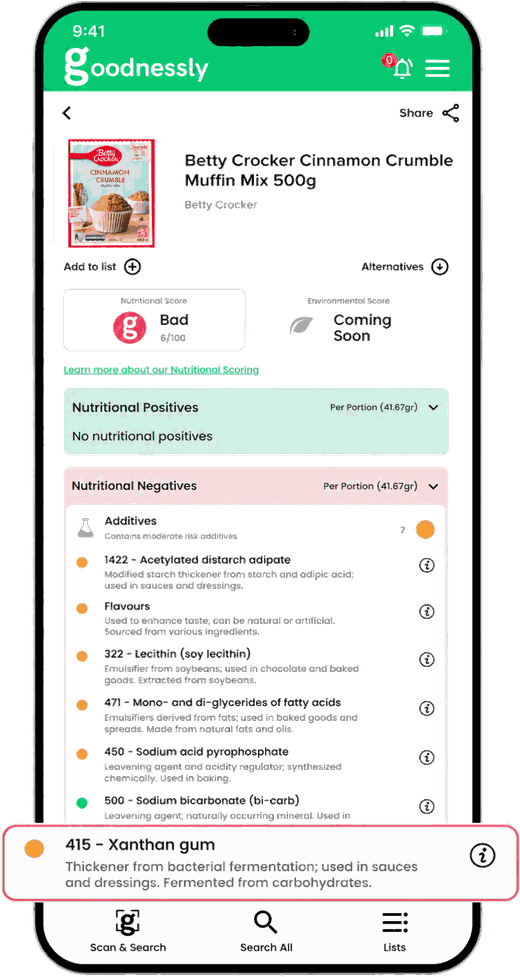
What is E1422?
E1422 is made by chemically treating native starch (usually from maize, tapioca, potato or wheat) with two agents: acetic anhydride, which improves freeze-thaw stability, and adipic anhydride, which cross-links the starch molecules so they hold up better under heat, acid and mechanical stirring. The result behaves much like ordinary starch as a thickener, but performs far more reliably in processed food — it won't break down or turn watery after freezing, reheating or sitting on a shelf.
What's it used for?
- Thickening sauces, gravies and soups so they stay smooth through reheating
- Stabilising ready meals and frozen dinners so they look right after thawing
- Improving texture in dairy desserts, yoghurts and custards
- Binding fruit and vegetable fillings without weeping liquid
- Used in some infant weaning foods for its stability
Where you'll find 1422 on the shelf
Anywhere a product needs to survive freezing, reheating or a long shelf life without losing texture.
Is E1422 safe? What the research says
E1422 is one of the most thoroughly reviewed additives in this directory — EFSA's 2017 re-evaluation covered the entire modified-starch family together, drawing on decades of toxicology data.
| Region | Status | What this means |
|---|---|---|
| AU/NZ Australia & New Zealand (FSANZ) | Permitted, no limit | Permitted in food generally, including infant weaning foods, with no maximum level set. |
| EU European Union (EFSA) | Permitted, no ADI | Listed as E1422. EFSA's 2017 re-evaluation covered the whole family of modified starches (E1404–E1452) together, including animal studies at doses up to 31,000mg per kilogram of bodyweight per day with no adverse effects found, and concluded no numerical Acceptable Daily Intake was needed. |
| US United States (FDA) | GRAS | Holds Generally Recognized As Safe status for general food use. |
Modified starches aren't absorbed intact — they're broken down by digestive enzymes much like ordinary starch, with a small resistant portion fermented by gut bacteria in the colon. Some consumer-advocacy sources note two secondary considerations worth knowing: the manufacturing process can involve industrial solvents, and modified starch may have a mild effect on blood glucose response in some people, though neither has been identified as a safety concern by regulators.
- No significant regulatory changes since 2017: EFSA's group re-evaluation remains the most recent comprehensive review, and no restrictions have followed. The European Commission has since requested additional specification data to refine the standards, without identifying any new risk.
This section is checked periodically rather than continuously — if you're reading this well after the date above, it's worth confirming nothing has changed before citing it.
Who this matters to
- People with coeliac disease or a wheat allergy — E1422 can occasionally be derived from wheat starch, in which case it must be declared as "modified wheat starch" on the label, but plain "modified starch" alone doesn't tell you the source
- Anyone avoiding genetically modified ingredients, since maize is a common raw material and is frequently GM-derived
- People closely monitoring blood glucose, given some sources note a possible mild glycaemic effect, though this hasn't been identified as a safety concern by regulators
Goodnessly rates E1422 Caution. This reflects open questions around sourcing, manufacturing and minor metabolic considerations rather than any established toxicological risk — the underlying safety data is some of the most extensively reviewed of any additive in this directory.
How to spot it on a label
E1422 is often declared generically. Look out for:
- Acetylated distarch adipate
- Modified starch
- 1422 or E1422
- "Modified wheat starch" if wheat-derived (an allergen declaration, not a different additive)
Ready meals, sauces and dairy desserts are the most common places to find it.
Related additives
Frequently asked questions
Is E1422 the same as modified starch?
E1422 is one specific type of modified starch — acetylated distarch adipate. Ingredient lists often just say "modified starch" without specifying which of the roughly twenty approved variants is used, which is why the generic term and the E number don't always line up one-to-one.
Is E1422 gluten-free?
Usually, but not always. E1422 is most commonly made from maize, tapioca or potato starch, all naturally gluten-free. It can occasionally be made from wheat starch, in which case it must be declared as "modified wheat starch" for allergen labelling purposes.
Is E1422 natural or synthetic?
It starts as a natural plant starch, then undergoes chemical modification (acetylation and cross-linking with adipic acid) to improve its stability under heat, freezing and acidic conditions. Regulators classify it as safe either way, since the modification process itself has been extensively reviewed.
Does Goodnessly rate E1422 as safe, caution, or avoid?
Goodnessly rates E1422 (Acetylated Distarch Adipate) as Caution. EFSA's 2017 group re-evaluation found no safety concern and no need for a formal daily intake limit, based on extensive toxicology data. The caution reflects open questions around sourcing and processing rather than an established safety risk.
Why is modified starch used instead of regular starch?
Ordinary starch breaks down and turns watery when frozen, reheated, or exposed to acidic or high-shear conditions during manufacturing. Modified starches like E1422 are chemically reinforced to hold their texture through these processes, which is why they're common in frozen meals, sauces and dairy desserts.
Don't decode labels by hand
Scan any product with the Goodnessly app to instantly see its full additive breakdown, kept current as new research like this comes to light.
Download our app to check additives in everyday foods
At Goodnessly we aim to educate and empower individuals to make informed choices about everyday products.
© 2026 Goodnessly. All rights reserved.
Facebook
Instagram
X
TikTok