What is E150a?
Plain caramel — the simplest of the four caramel colour classes, made by heating sugar alone with no chemical catalysts, and the one that avoids the controversy attached to its more processed siblings.
E150a (plain caramel, or Caramel Colour Class I) is made simply by heating sugar, without the ammonium or sulfite compounds used in the other three caramel colour classes. Unlike Class III and IV caramel (the type behind most caramel-colour controversy), E150a doesn't produce 4-MeI, the compound at the centre of that concern. On the label, "caramel colour" alone doesn't reveal which class was used, which is the main reason Goodnessly takes a cautious approach to the category rather than treating each class separately at the point of scanning. Goodnessly rates it Caution.
Download our app to check additives in everyday foods
Read the FAQ →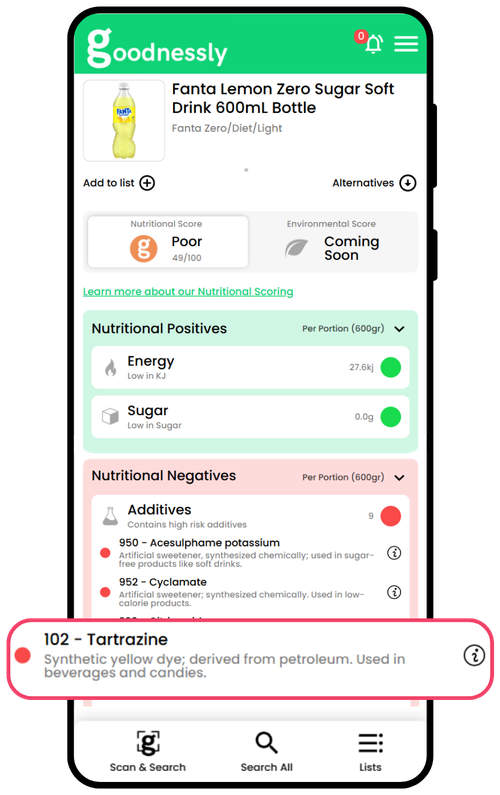
What is plain caramel?
Plain caramel is made through simple caramelisation: sugar (typically sucrose or glucose syrup) is heated at high temperature until it browns, with no ammonium or sulfite compounds added as processing aids. This makes it the least chemically processed of the four caramel colour classes (E150a–E150d), and importantly, it doesn't generate 4-methylimidazole (4-MeI), a nitrogenous byproduct formed only when ammonium compounds are used in the higher classes, which is the substance behind most of the wider "caramel colour" controversy. On food labels, all four classes are usually just listed as "caramel colour" or "150," so consumers generally can't tell which specific class is used from the ingredient list alone.
What's it used for?
- Colouring baked goods a golden-brown shade
- Used in some sauces and gravies
- Confectionery requiring a caramel colour
- Some savoury snack coatings
Where you'll find 150a on the shelf
Anywhere a golden-brown or caramel shade is wanted.
Is plain caramel safe? What the research says
E150a specifically has one of the cleanest profiles among the four caramel colour classes.
| Region | Status | What this means |
|---|---|---|
| AU/NZ Australia & New Zealand (FSANZ) | Permitted | Permitted as a food colour, must be declared as "caramel colour" or by number. |
| EU European Union (EFSA) | Permitted | Listed as E150a. EFSA's 2011 re-evaluation of all four caramel colour classes found no genotoxic or carcinogenic concern for Class I specifically, since it doesn't contain the ammonium-derived compounds present in Class III and IV. |
| US United States (FDA) | GRAS | Holds Generally Recognized As Safe status, and is considered the most minimally processed of the four caramel colour classes under US Food Chemical Codex classification. |
Standard ingredient labels typically just say "caramel colour" or "150" without specifying which of the four classes (E150a, b, c or d) was actually used, so consumers generally can't distinguish the simplest form from the more processed ones at a glance.
- Manufacturing shifts toward lower-byproduct methods: some caramel colour producers have developed modified production processes specifically to reduce byproduct formation in the more processed classes, reflecting ongoing industry and regulatory attention to the caramel colour category as a whole.
This section is checked periodically rather than continuously — if you're reading this well after the date above, it's worth confirming nothing has changed before citing it.
Who this matters to
- Anyone who prefers to know exactly which caramel colour class is in a product, though this generally isn't disclosed on labels beyond the E150a code itself if stated
- Otherwise, no population group has a specific safety-based reason to limit E150a specifically
Goodnessly rates E150a Caution, reflecting a cautious approach to the broader caramel colour category. On its own merits, E150a specifically has one of the cleanest profiles of the four classes, since it doesn't produce the 4-MeI byproduct associated with the more processed Class III and IV variants.
How to spot it on a label
Caramel colours are often labelled generically. Look out for:
- Caramel colour
- 150 or 150a
- "Colour (150a)" in the ingredients list, when the specific class is stated
Baked goods, sauces and confectionery are the most common places to find it.
Related additives
Frequently asked questions
Is E150a the same as the caramel colour linked to health concerns?
Not quite. Most of the controversy around caramel colour concerns Class III (E150c) and Class IV (E150d), which use ammonium compounds during production and can generate a byproduct called 4-MeI. E150a is made without any ammonium or sulfite compounds, and doesn't produce 4-MeI.
Can I tell which caramel colour class is in a product?
Usually not from the ingredient list alone. Most labels simply say "caramel colour" or "150" without specifying class, though some products do state the full E150a designation.
Does Goodnessly rate E150a as safe, caution, or avoid?
Goodnessly rates E150a (Plain Caramel) as Caution, reflecting a cautious approach to the broader caramel colour category. E150a specifically has one of the cleanest profiles of the four classes, since it doesn't produce the 4-MeI byproduct associated with the more processed variants.
Don't decode labels by hand
Scan any product with the Goodnessly app to instantly see its full additive breakdown, kept current as new research like this comes to light.
Download our app to check additives in everyday foods