What is E150c?
Ammonia caramel — the colour behind soy sauce and beer, made with a process that produces two documented byproducts, one of which prompted regulators to set this class a lower safe intake limit than its siblings.
E150c (Class III caramel colour) is made by heating carbohydrates with ammonium compounds alone, no sulfite. This process generates measurable levels of 4-methylimidazole (4-MeI), classified by IARC as "possibly carcinogenic to humans," typically found at 163–180mg per kilogram of colour material, close to the EU's 200mg/kg cap for this class. It also produces a separate byproduct called THI, linked to immune cell depletion in animal studies, which is part of why EFSA set Class III a lower Acceptable Daily Intake than the other three caramel classes. EFSA's own assessment found toddlers and high-consumption adults could still exceed this limit. Goodnessly rates it Avoid.
Download our app to check additives in everyday foods
Read the FAQ →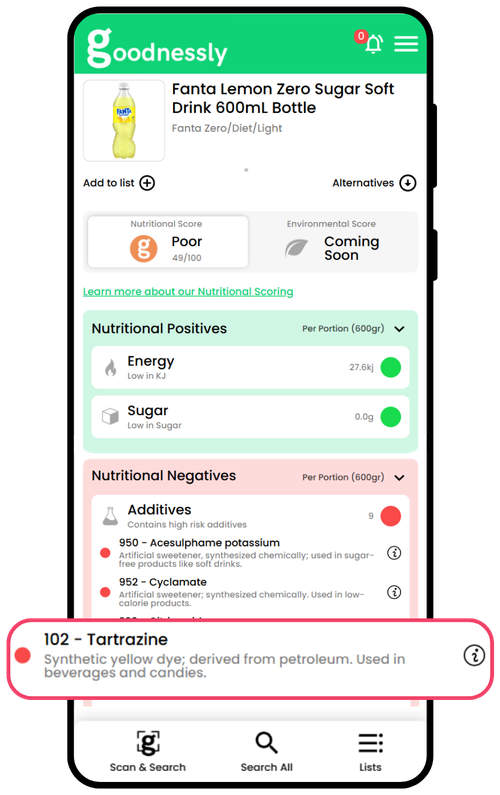
What is Class III caramel colour?
E150c is produced by heating sugar with ammonium compounds like ammonium hydroxide or ammonium carbonate, but no sulfite. This gives it a positive colloidal charge, the opposite of Class IV (E150d), which makes it useful in different applications: it binds well in systems that benefit from a positive charge, like bakery coatings, beer and soy sauce, whereas the sulfite-based Class IV suits acidic, negatively-charged systems like cola. It's resistant to light, oxidation and temperature fluctuations, which is part of its appeal as a colourant.
What's it used for?
- Colouring soy sauce
- Beer and some malt beverages
- Bakery coatings and glazes
- Confectionery matrices requiring a stable brown
Where you'll find 150c on the shelf
Common in soy sauce, beer and bakery products.
Is Class III caramel colour safe? What the research says
E150c is the only caramel colour class EFSA gave its own, lower safe intake limit, reflecting genuine uncertainty in the underlying data.
| Region | Status | What this means |
|---|---|---|
| AU/NZ Australia & New Zealand (FSANZ) | Permitted | Permitted as a food colour, must be declared as "caramel colour" or by number. |
| EU European Union (EFSA) | Permitted, lower ADI for this class | Listed as E150c. EFSA's 2011 re-evaluation set Class III a specifically lower Acceptable Daily Intake of 100mg per kilogram of bodyweight per day, compared to 300mg/kg for the other three classes, reflecting greater uncertainty in the data for this class. A 2012 refined assessment using industry-supplied use levels still found toddlers and high-consumption adults could exceed this limit. The EU caps 4-MeI content at 200mg per kilogram of finished colour. |
| US United States | GRAS, monitored | Considered GRAS when specification limits are met, with 4-MeI monitored as part of good manufacturing practice. California lists 4-MeI under Proposition 65, with a 29-microgram daily no-significant-risk threshold. |
Analytical studies have measured 4-MeI in Class III caramel at roughly 163–180mg per kilogram of colour material, close to the 200mg/kg EU cap. The ammonia process also produces a separate byproduct, THI (2-acetyl-4-tetrahydroxybutylimidazole), which has been linked to immune cell depletion in animal studies and is a documented concern specific to this class rather than Class IV.
- EFSA's own exposure-exceedance finding: even using refined, industry-supplied consumption data rather than worst-case assumptions, EFSA's 2012 reassessment still found that toddlers and adults with high E150c food consumption could exceed the class-specific ADI.
- No recent resolution of the THI question: unlike 4-MeI, which has been extensively studied, THI has received comparatively less follow-up research since the animal studies that first identified the immune cell depletion effect.
This section is checked periodically rather than continuously — if you're reading this well after the date above, it's worth confirming nothing has changed before citing it.
Who might want to limit or avoid it
- Anyone who consumes soy sauce or beer regularly, given this class's specifically lower ADI and EFSA's finding that high-consumption adults could exceed it
- Parents of toddlers, given EFSA specifically flagged this age group as able to exceed the safe intake limit for this class
- Anyone who prefers ingredients with a fully resolved safety profile, given the comparatively limited follow-up research on the THI byproduct
Goodnessly rates E150c Avoid. It's the only caramel colour class EFSA assigned its own, lower Acceptable Daily Intake, and toddlers and high-consumption adults have been found able to exceed even that lower limit, which places it in our highest-caution category.
How to spot it on a label
Caramel colours are often labelled generically. Look out for:
- Caramel colour
- 150 or 150c
- "Colour (150c)" in the ingredients list, when the specific class is stated
Soy sauce and beer are the most common places to find it.
Related additives
Frequently asked questions
What's the difference between E150c and E150d?
Both use ammonium compounds and can generate 4-MeI, but E150c uses no sulfite, giving it a positive colloidal charge, while E150d adds sulfite too, giving it a negative charge suited to acidic drinks like cola. E150c is more commonly used in soy sauce and beer.
Why does E150c have a lower safe intake limit than the other caramel classes?
EFSA's 2011 re-evaluation assigned Class III a specifically lower Acceptable Daily Intake (100mg/kg bodyweight/day, versus 300mg/kg for the other classes), reflecting greater data uncertainty for this class, including questions around a byproduct called THI linked to immune cell effects in animal studies.
Does Goodnessly rate E150c as safe, caution, or avoid?
Goodnessly rates E150c (Class III Caramel Colour) as Avoid. It's the only caramel colour class EFSA assigned its own, lower Acceptable Daily Intake, and toddlers and high-consumption adults have been found able to exceed even that lower limit, which places it in our highest-caution category.
Don't decode labels by hand
Scan any product with the Goodnessly app to instantly see its full additive breakdown, kept current as new research like this comes to light.
Download our app to check additives in everyday foods