What is 150b?
Caustic sulphite caramel — a brown colour made by heating sugars with sulphite compounds, one of the four classes of caramel colour.
Caramel II (150b), also called caustic sulphite caramel, is a brown food colour made by heating carbohydrates in the presence of sulphite compounds. It is permitted in Australia, New Zealand, the EU and the US. EFSA re-evaluated the caramel colours in 2011 and set a group Acceptable Daily Intake of 300 milligrams per kilogram of body weight per day for the four classes combined. Goodnessly rates it Hazardous Risk.
Download our app to check additives in everyday foods
Read the FAQ →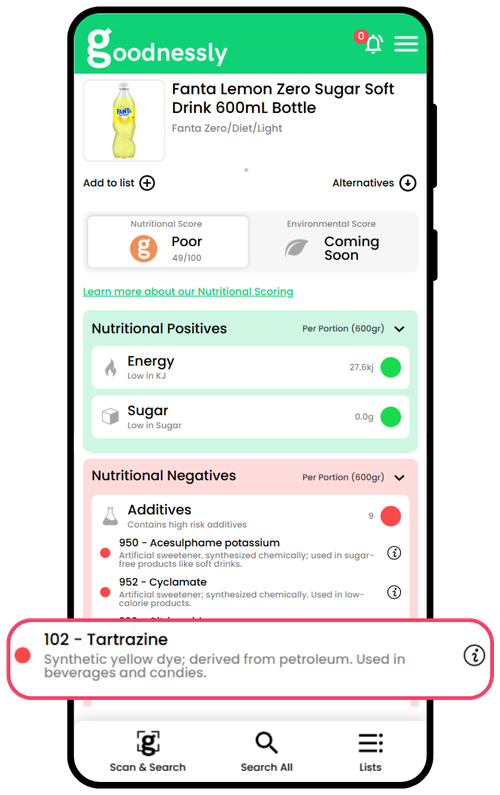
What is caramel II (caustic sulphite caramel)?
Caramel colours are grouped into four classes depending on which reactants are used during heating. Class II (150b) is made with sulphite compounds but without ammonium compounds, which separates it from Caramel III (150c) and Caramel IV (150d). It gives a brown to dark-brown tint and is less common on labels than Caramel I (150a) or Caramel IV.
What's it used for?
- Brown colouring in some spirits, liqueurs and flavoured drinks
- Colour in some sauces, gravies and seasonings
- Occasional use in desserts and confectionery
- Colour standardising where batches vary in shade
Where you'll find 150b on the shelf
It turns up mostly in drinks and savoury products where a consistent brown shade is wanted.
Is caramel ii safe? What the research says
EFSA's 2011 re-evaluation found the caramel colours were not genotoxic or carcinogenic, and estimated exposure to Caramel II was below its limit. EFSA did note that by-products of caramel manufacture, such as 5-HMF and furan, may be present at levels that could be of concern, and recommended maximum levels for them in the specifications. People sensitive to sulphites sometimes ask about Caramel II, because sulphite compounds are used to make it.
| Region | Status | What this means |
|---|---|---|
| AU/NZ Australia & New Zealand (FSANZ) | Permitted | Listed as caramel II (150b) in the Food Standards Code. Declared as "colour (150b)" or by name. |
| EU European Union (EFSA) | Permitted | Authorised as E150b under Regulation (EC) No 1333/2008. EFSA (2011) set a group Acceptable Daily Intake of 300 milligrams per kilogram of body weight per day for E150a–d. |
| US United States (FDA) | Permitted | Caramel is listed as a colour additive exempt from certification under 21 CFR 73.85. |
JECFA set a separate Acceptable Daily Intake for Caramel II of 0–160 milligrams per kilogram of body weight per day (2000 evaluation). EFSA's 2011 opinion found exposure to Caramel II was below the limit, unlike some other caramel classes.
- EFSA 2011 re-evaluation: EFSA re-evaluated all four caramel colours and set a group Acceptable Daily Intake of 300 milligrams per kilogram of body weight per day (with a separate individual limit for Caramel III).
- JECFA position: JECFA's Acceptable Daily Intake of 0–160 milligrams per kilogram of body weight per day for Caramel II (2000) remains in place.
- Labelling in AU/NZ: FSANZ requires the class to be identified by name or number, so 150b should appear distinctly rather than as just "caramel".
This section is checked periodically rather than continuously — if you're reading this well after the date above, it's worth confirming nothing has changed before citing it.
Who might want to limit or avoid it
- People who prefer to limit processed colours generally
- People with sulphite sensitivity who want to be cautious, as sulphite compounds are used in its manufacture (talk to your doctor about your own situation)
- Anyone who regularly drinks dark spirits or flavoured drinks and wants to keep an eye on colour intake
Goodnessly rates 150b Hazardous Risk. Its sulphite-based manufacture and EFSA's note on possible by-products such as 5-HMF and furan in caramel colours place it in our Hazardous Risk category.
How to spot it on a label
Look out for:
- Caramel II
- Caustic sulphite caramel
- 150b or E150b
- Colour (150b)
Look closely at the class letter: 150a, 150b, 150c and 150d are different products.
Related additives
Frequently asked questions
Is Caramel II the same as burnt sugar?
Not quite. Plain caramel (Caramel I, 150a) is made by heating sugars without ammonium or sulphite compounds. Caramel II (150b) is made with sulphite compounds, which gives it different chemical properties and a separate additive number.
Is Caramel II safe to eat?
It is permitted by FSANZ, the EU and the FDA. In 2011 EFSA set a group Acceptable Daily Intake for the caramel colours and found that estimated exposure to Caramel II was below it.
Does Caramel II contain sulphites?
Sulphite compounds are used to make it. Whether residual sulphite in a finished food is significant depends on the product and use level, so people with sulphite sensitivity should check with their doctor and read labels carefully.
How does Goodnessly rate 150b?
Goodnessly rates 150b (Caramel II) as Hazardous Risk, because of its sulphite-based manufacture and EFSA's note on possible by-products such as 5-HMF and furan in caramel colours.
Don't decode labels by hand
Scan any product with the Goodnessly app to instantly see its full additive breakdown, kept current as new research like this comes to light.
Download our app to check additives in everyday foods