What is E150d?
Sulfite ammonia caramel — the deep, stable brown colour behind cola and soy sauce, made using a process that generates a compound tested colas have contained at levels above California's own safety threshold.
E150d (Class IV caramel colour) is made by heating carbohydrates with both ammonium and sulfite compounds, a process that generates a byproduct called 4-methylimidazole (4-MeI), classified by IARC as "possibly carcinogenic to humans" based on lung tumours in mice. Independent testing has found some colas containing roughly 130 micrograms of 4-MeI per can, well above California's 29-microgram safety threshold, prompting several major manufacturers to reformulate. Genotoxicity tests for 4-MeI itself came back negative, and EFSA's own assessment didn't find cause for concern at the exposure levels it evaluated. Goodnessly rates it Avoid.
Download our app to check additives in everyday foods
Read the FAQ →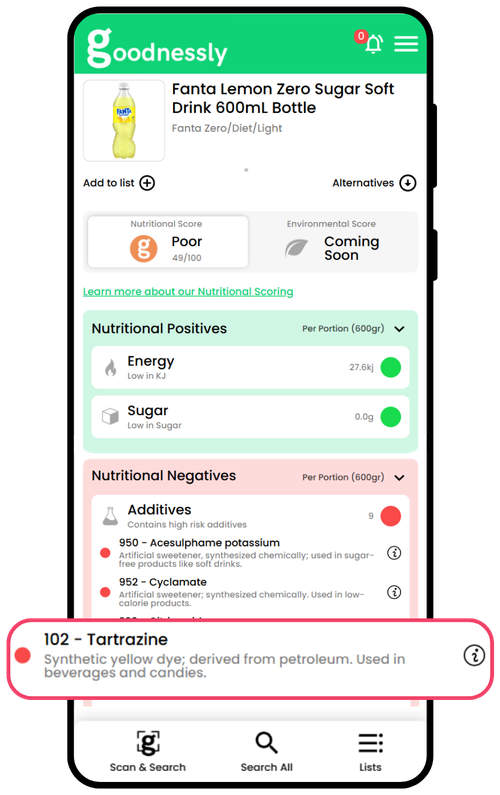
What is Class IV caramel colour?
E150d is produced by heating sugar with both ammonium and sulfite compounds together, sometimes called "sulfite ammonia caramel." This specific combination gives it a strong negative charge that holds up well across a wide pH range, which is exactly why it's the caramel colour of choice for acidic products like cola, where a differently-charged caramel would clump or separate. This is genuinely different from the plain caramel (E150a) covered elsewhere in this directory, which uses no ammonium or sulfite compounds at all and doesn't generate the byproduct discussed below.
What's it used for?
- Colouring cola and other dark soft drinks
- Soy sauce and vinegar
- Sauces and compound seasonings
- Tea and coffee-based ready-to-drink beverages
Where you'll find 150d on the shelf
The caramel colour behind most dark, acidic drinks and condiments.
Is Class IV caramel colour safe? What the research says
E150d's story centres almost entirely on one compound, 4-MeI, and the gap between how regulators have assessed it in theory versus what's actually been measured in real products.
| Region | Status | What this means |
|---|---|---|
| AU/NZ Australia & New Zealand (FSANZ) | Permitted | Permitted as a food colour, must be declared as "caramel colour" or by number. |
| EU European Union (EFSA) | Permitted, byproduct capped | Listed as E150d. EFSA's 2011 group re-evaluation set an ADI of 300mg per kilogram of bodyweight per day for Class I, II and IV caramels, and judged that realistic 4-MeI intake from Class III and IV caramel didn't raise a concern at the levels it assessed. EU specification caps 4-MeI content in the finished colour at 250mg per kilogram. |
| US United States | Permitted, California warning threshold | Permitted federally, but California lists 4-MeI under Proposition 65 as a chemical known to cause cancer, requiring a warning label if daily exposure exceeds 29 micrograms. Independent testing found some 12oz cola cans containing around 130 micrograms of 4-MeI, prompting several manufacturers to reformulate specifically for the California market. |
4-MeI is classified by IARC as Group 2B ("possibly carcinogenic to humans") based on lung tumours in mice at high doses. Genotoxicity tests (Ames test, micronucleus assay) for 4-MeI have come back negative, supporting a non-genotoxic mode of action rather than direct DNA damage. Even the Center for Science in the Public Interest, which petitioned the FDA to restrict 4-MeI, acknowledged that the sugar content of cola presents a greater health risk than the caramel colour itself.
- Manufacturer reformulation: after California's Prop 65 listing, several major soft drink manufacturers lowered the 4-MeI content of their caramel colour specifically to stay under the state's warning-label threshold, an industry response that itself suggests the original real-world levels were considered high enough to matter.
- The regulatory gap remains unresolved: EFSA's theoretical exposure assessment and California's real-world product testing point in somewhat different directions, and this gap hasn't been fully reconciled.
This section is checked periodically rather than continuously — if you're reading this well after the date above, it's worth confirming nothing has changed before citing it.
Who might want to limit or avoid it
- Anyone who drinks cola or dark soft drinks regularly, given documented 4-MeI levels in some products above California's own safety threshold
- Anyone who prefers ingredients that don't carry an active IARC classification, even one based on animal studies at high doses
- Anyone avoiding sulphites for other reasons, given the sulphite-based production process, though the finished colour itself isn't a declared allergen
Goodnessly rates E150d Avoid. Genotoxicity tests for 4-MeI were negative and EFSA's theoretical exposure assessment didn't find cause for concern, but real-world testing has found cola containing 4-MeI levels above California's own regulatory threshold, which is enough to place it in our highest-caution category.
How to spot it on a label
Caramel colours are often labelled generically. Look out for:
- Caramel colour
- 150 or 150d
- "Colour (150d)" in the ingredients list, when the specific class is stated
Cola and other dark, acidic soft drinks are the most common places to find it.
Related additives
Frequently asked questions
Is the caramel colour in cola dangerous?
The evidence is genuinely mixed. 4-MeI, the byproduct of concern, has a negative result on standard genotoxicity tests, and EFSA's theoretical exposure assessment didn't find a concern. But independent testing has found some colas containing 4-MeI levels above California's own Prop 65 safety threshold, which is why several manufacturers reformulated specifically for that market.
What's the difference between E150a and E150d?
E150a (plain caramel) is made by heating sugar alone, with no ammonium or sulfite compounds, and doesn't generate 4-MeI. E150d is made with both ammonium and sulfite compounds, which does generate 4-MeI as a byproduct, but gives the colour the stability needed for acidic products like cola.
Does Goodnessly rate E150d as safe, caution, or avoid?
Goodnessly rates E150d (Class IV Caramel Colour) as Avoid. Genotoxicity tests for 4-MeI were negative and EFSA's theoretical exposure assessment didn't find cause for concern, but real-world testing has found cola containing 4-MeI levels above California's own regulatory threshold, which is enough to place it in our highest-caution category.
Don't decode labels by hand
Scan any product with the Goodnessly app to instantly see its full additive breakdown, kept current as new research like this comes to light.
Download our app to check additives in everyday foods