What is E171?
Titanium dioxide — a white pigment colour used to whiten or brighten foods. Still permitted in Australia and New Zealand and in the US, but no longer authorised as a food additive in the EU after 2022.
Titanium dioxide (E171) is an inorganic white colouring used so confectionery, coatings, dairy desserts and similar products look brighter or more opaque. In May 2021 EFSA concluded it could no longer be considered safe as a food additive because a concern for genotoxicity of TiO2 particles that may be present in E171 could not be ruled out, and no Acceptable Daily Intake could be set. The EU then removed food authorisation under Commission Regulation (EU) 2022/63. FSANZ reviewed the evidence and reported no evidence that dietary exposure to food-grade titanium dioxide is a concern for human health, so AU/NZ permissions remain. The US FDA still lists it for colouring foods generally (typically not more than 1% by weight). JECFA in 2023 reaffirmed an ADI of “not specified”. Goodnessly rates it Caution.
Download our app to check additives in everyday foods
Read the FAQ →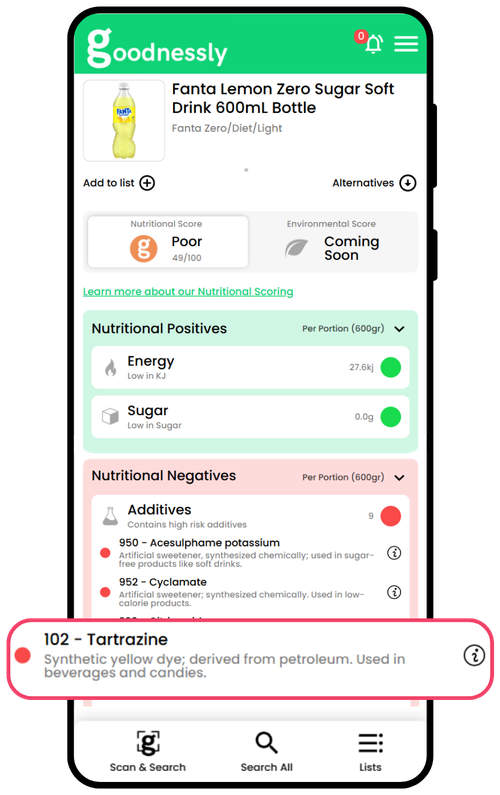
What is titanium dioxide?
Titanium dioxide (TiO2, INS/E 171) is an insoluble white inorganic pigment. Food-grade material is used as a colour so products look whiter, brighter or more opaque. It is not a flavour, preservative or nutrient — its technological purpose is purely visual. Particle-size makeup of commercial E171 has been a focus of recent safety reviews: EFSA noted that a substantial share of constituent particles by number can be below 100 nm, which is part of why nanoparticle studies featured in the 2021 assessment.
What's it used for?
- Whitening or brightening confectionery coatings and sugar shells
- Opacity and colour in chewing gum and similar products
- Whitening dairy desserts, iced confectionery and some bakery icings
- Other permitted colour uses where a bright white look is wanted (subject to local rules)
Where you'll find 171 on the shelf
In Australia and New Zealand you may still see it declared on whitened sweets and coatings. EU-formulated products should no longer add it as a food colour after the 2022 ban took full effect.
Is titanium dioxide safe? What the research says
Regulators do not all agree. The EU removed food authorisation after EFSA’s 2021 opinion; Australia/New Zealand and the United States still permit food use, and JECFA in 2023 reaffirmed an ADI of “not specified”. The split is why Goodnessly keeps a Caution rating rather than treating a regional ban as a global Avoid.
| Region | Status | What this means |
|---|---|---|
| AU/NZ Australia & New Zealand (FSANZ) | Permitted | Listed as titanium dioxide (171) among colourings permitted at Good Manufacturing Practice in the Food Standards Code. After EFSA’s 2021 opinion, FSANZ reviewed key evidence on food-grade TiO2 and reported no evidence that dietary exposure is a concern for human health; it took no action to change permissions and continues to monitor new information. |
| EU European Union (EFSA / EUR-Lex) | Banned in food | EFSA’s May 2021 opinion concluded that TiO2 particles have the potential to induce DNA strand breaks and chromosomal damage (not gene mutations), that a genotoxicity concern for particles that may be present in E171 could not be ruled out, and that E171 could no longer be considered safe as a food additive (no ADI set). Commission Regulation (EU) 2022/63 then removed food authorisation; after a short transition, foods could no longer be placed on the market with E171 as an additive (with a limited medicines-colour footnote outside ordinary food use). |
| US United States (FDA) | Permitted | Listed as a colour additive for foods generally under 21 CFR 73.575, typically not more than 1% by weight of the food, exempt from batch certification. As of the latest checks for this page, that listing remains in force; a citizen petition seeking revocation (CAP 3C0325) has been filed and was recorded as under review — not the same as a completed ban. |
JECFA (97th meeting, 2023) evaluated titanium dioxide (INS 171) and, citing very low oral absorption and the absence of an identifiable dietary hazard in the evidence it judged relevant, reaffirmed the ADI “not specified” first established decades earlier. That conclusion differs from EFSA’s 2021 genotoxicity-uncertainty finding — a real scientific disagreement, not a drafting quirk.
- EFSA 2021 (genotoxicity wording): the Panel concluded that TiO2 particles have the potential to induce DNA strand breaks and chromosomal damage, but not gene mutations. A concern for genotoxicity of TiO2 particles that may be present in E171 could therefore not be ruled out; several possible modes of action might operate in parallel, and whether a threshold applies was uncertain. General toxicity evidence was not conclusive in the same way. EFSA did not itself ban the additive — that was a risk-management step.
- EU ban (Regulation 2022/63): Commission Regulation (EU) 2022/63 of 14 January 2022 amended Regulation (EC) No 1333/2008 to remove food authorisation for E171. It entered into force on 7 February 2022, with placement-on-the-market allowed until 7 August 2022 for products made under the previous rules, then sell-through until minimum durability or use-by.
- FSANZ review: FSANZ assessed food-grade TiO2, distinguished some nanoparticle/water-gavage study designs from typical dietary use, and concluded there was currently no evidence that dietary exposure to food-grade titanium dioxide is a concern for human health. Permissions in the Food Standards Code were left in place.
- JECFA 2023: the Committee reaffirmed ADI “not specified”, noting uncertainties in genotoxicity testing for poorly soluble particles but also the absence of carcinogenicity in the long-term dietary studies it judged adequate for INS 171, plus very low oral absorption.
This section is checked periodically rather than continuously — if you're reading this well after the date above, it's worth confirming nothing has changed before citing it.
Who this matters to
- Shoppers who prefer to follow the strictest major-region rule of thumb and avoid additives the EU has removed from food
- People who want to minimise insoluble particle colours while the scientific picture remains split between EFSA and FSANZ/JECFA/FDA
- Anyone comparing AU/NZ-labelled products with EU-reformulated versions of the same brand families
- People who have been advised by a clinician to limit particular food colours or particle-based additives
Goodnessly rates E171 Caution. That matches our CSV orange rating and reflects a genuine regulatory split: still permitted in Australia/New Zealand and the US, banned as a food additive in the EU after EFSA could not rule out a genotoxicity concern. Caution is not Avoid — we are not treating the EU ban as proof of definite harm, and we are not ignoring FSANZ’s and JECFA’s more reassuring food-grade conclusions.
How to spot it on a label
Titanium dioxide is usually declared by name or code when used as a colour. Look out for:
- Titanium dioxide
- 171 or E171
- "Colour (171)" or "Colour (titanium dioxide)"
- Related white/brightness colours on some labels: calcium carbonate (170), or other opacifying colours where used instead
Whitened confectionery coatings, chewing gum and iced desserts are among the more common places to look in Australia.
Related additives
Frequently asked questions
Is titanium dioxide banned in Australia?
No. Titanium dioxide (171) remains a permitted food colour under the Australia New Zealand Food Standards Code. After EFSA's 2021 opinion, FSANZ reviewed food-grade titanium dioxide and reported no evidence that dietary exposure is a concern for human health, so it did not change AU/NZ permissions. The EU ban applies to the EU market, not automatically to Australia or New Zealand.
Why did the EU ban E171?
EFSA's May 2021 opinion concluded that titanium dioxide could no longer be considered safe as a food additive. A central reason was that a concern for genotoxicity of TiO2 particles that may be present in E171 could not be ruled out, so no safe daily intake level could be established. Risk managers then removed food authorisation through Commission Regulation (EU) 2022/63. EFSA's role was scientific assessment; the ban itself was a Commission/Member State decision.
Is titanium dioxide linked to cancer?
Goodnessly does not claim that food-use titanium dioxide is carcinogenic. EFSA's 2021 wording was about genotoxicity uncertainty: the Panel said TiO2 particles have the potential to induce DNA strand breaks and chromosomal damage (not gene mutations), and that a genotoxicity concern could not be ruled out. That is not the same as a conclusion that dietary E171 has been shown to be carcinogenic in people. FSANZ reported no evidence of cancer or other harmful effects in the lifetime dietary studies with food-grade material it reviewed, and JECFA in 2023 likewise pointed to long-term dietary studies without carcinogenicity for INS 171 in the evidence it judged adequate, while still noting genotoxicity-testing limitations for poorly soluble particles.
Does Goodnessly rate E171 as safe, caution, or avoid?
Goodnessly rates E171 (Titanium dioxide) as Caution. That matches our directory CSV (orange). The EU has banned it as a food additive after EFSA could not rule out a genotoxicity concern, while FSANZ still permits it in Australia and New Zealand, the FDA still lists it in the US, and JECFA has reaffirmed an ADI of "not specified". Caution is the rating that fits that split without overstating definite harm or ignoring the EU decision.
Don't decode labels by hand
Scan any product with the Goodnessly app to instantly see its full additive breakdown, kept current as new research like this comes to light.
Download our app to check additives in everyday foods