What is E172?
Iron oxides and hydroxides — inorganic colour pigments (yellow, red, black and blends) used in confectionery, coatings and supplements, assessed as E172.
Iron oxide (E172) is the collective name for iron oxide and hydroxide pigments used as food colours — typically yellow (hydrated ferric oxide), red (ferric oxide) and black (ferrosoferric oxide), plus commercial brown blends. It is permitted in Australia/NZ (GMP colour), the EU (quantum satis in authorised categories) and the US (synthetic iron oxide under 21 CFR 73.200 for specified uses). JECFA set an ADI of 0–0.5 mg/kg body weight per day. EFSA's 2015 re-evaluation concluded that an adequate safety assessment could not be completed because the toxicological database was insufficient, and asked for better particle-size specification data. Goodnessly rates it Avoid.
Download our app to check additives in everyday foods
Read the FAQ →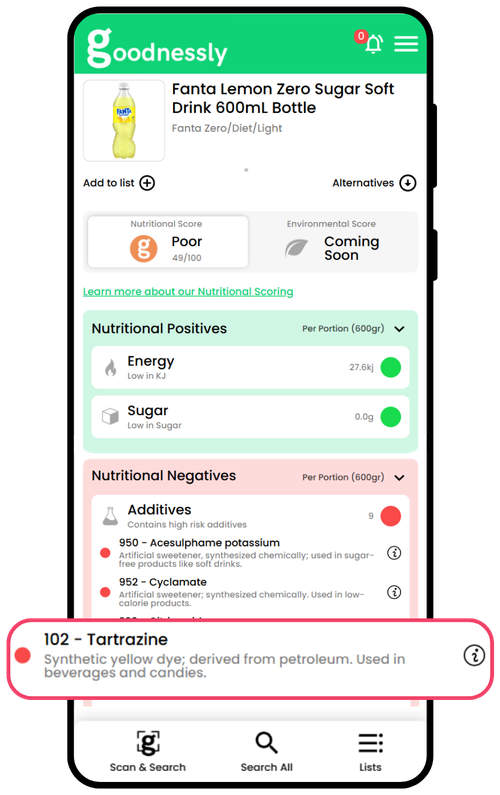
What is iron oxide?
Iron oxide (E172) covers a small family of inorganic iron oxide and hydroxide pigments used to colour food. Yellow iron oxide is typically FeO(OH)·H2O, red is Fe2O3, and black is FeO·Fe2O3; brown shades are usually blends. Absorption of iron from these pigments is generally described as low compared with soluble iron salts. On labels you may see "iron oxide", "iron oxides", "iron oxides and hydroxides", "172", "E172", or a specific shade name with the number.
What's it used for?
- Colouring confectionery, decorations, coatings and fillings
- Colouring dietary-supplement tablets, capsules and coatings (where permitted)
- Colouring some processed meats or sausage casings in markets that allow it
- Providing stable yellow, red, black or brown shades that are less light-sensitive than many natural colours
Where you'll find E172 on the shelf
Most often in brightly coloured confectionery, coated sweets and some supplement coatings — check the ingredients list for 172 or iron oxide.
Is iron oxide safe? What the research says
Iron oxides remain authorised food colours in major markets, but the depth of the modern safety database is thinner than for many other additives. JECFA maintains a numerical ADI, while EFSA in 2015 said it could not complete an adequate assessment with the data then available and flagged particle-size characterisation as a specification gap. That combination — still permitted, but with an incomplete EFSA assessment — is why Goodnessly places E172 in Avoid rather than a lower-caution tier.
| Region | Status | What this means |
|---|---|---|
| AU/NZ Australia & New Zealand (FSANZ) | Permitted (GMP colour) | Listed as iron oxides (172) among colours permitted at good manufacturing practice in the Australia New Zealand Food Standards Code (Schedule 16 / related colour schedules). Use is limited to food categories that allow those GMP colours, and the additive must be declared by name or number when used as a food additive colour. |
| EU European Union (EFSA) | Authorised; no ADI (EFSA 2015) | Authorised as E172 (iron oxides and hydroxides) under Regulation (EC) No 1333/2008, generally at quantum satis in Group II colour categories (with category-specific rules). EFSA's 2015 re-evaluation concluded that an adequate safety assessment could not be carried out because a sufficient biological and toxicological database was not available, and recommended that particle size and particle-size distribution be included in the specifications. Follow-up data work has been noted as ongoing on EFSA's food-colours topic pages. |
| US United States (FDA) | Listed colour (21 CFR 73.200) | Synthetic iron oxide is listed as a colour additive exempt from certification under 21 CFR 73.200 for specified uses and limits (including sausage casings, hard/soft candy and chewing gum under GMP conditions, and dietary-supplement tablets/capsules with an elemental-iron daily limit). It is not a free-for-all colour for every food category — use must match the listed conditions. |
Wording matters: EFSA's 2015 conclusion was that the database was inadequate for a full assessment — not a finding that E172 has been proven harmful at authorised uses. Iron from these pigments is poorly absorbed relative to many dietary iron sources; particle-size questions are about characterisation and data gaps, not a consumer diagnosis. Goodnessly's Avoid rating reflects those gaps plus a preference to minimise non-essential synthetic colours when alternatives exist.
- EFSA 2015 re-evaluation (E172): could not complete an adequate safety assessment due to an insufficient toxicological database; recommended particle-size specifications; JECFA ADI of 0–0.5 mg/kg bw/day noted for context.
- EFSA colours follow-up: iron oxides remain listed among authorised colours with follow-up of the re-evaluation described as ongoing on EFSA topic pages (checked September 2026).
- US use limits unchanged in principle: 21 CFR 73.200 continues to restrict synthetic iron oxide to specified food/supplement uses rather than unrestricted colouring of all foods.
This section is checked periodically rather than continuously — if you're reading this well after the date above, it's worth confirming nothing has changed before citing it.
Who might want to limit or avoid it
- People who prefer to minimise synthetic food colours when a naturally coloured or uncoloured option is available
- Anyone following clinical advice to limit unnecessary additives, including inorganic colour pigments
- Shoppers comparing coatings and confectionery who want to avoid E171/E172-style mineral colours as a set
Goodnessly rates E172 Avoid. Iron oxides remain permitted within set rules in Australia/NZ, the EU and the US, but EFSA's 2015 finding that the safety database was inadequate for a full assessment, the particle-size specification gap, and the fact that colour is rarely nutritionally essential place it in our highest-caution category.
How to spot it on a label
Look for the name or number on coloured confectionery, decorations and some supplement coatings:
- Iron oxide / iron oxides / iron oxides and hydroxides
- 172 or E172
- Colour (172) or food colouring (172)
- Shade descriptions paired with 172 (yellow, red, black, brown)
Often appears on brightly coated sweets and tablet coatings; not every brown or red food uses iron oxide — check the number.
Related additives
Frequently asked questions
What is Iron oxide (E172) made from?
E172 is a group of inorganic iron oxide and hydroxide pigments (yellow, red and black forms, plus blends). They are manufactured mineral pigments used for colour, not a flavour or preservative.
Is iron oxide the same as dietary iron supplements?
No. Food-colour iron oxides are poorly absorbed pigments used for appearance. Iron supplements use different, more bioavailable iron compounds. Do not treat E172 on a candy label as a meaningful iron source.
Did EFSA ban iron oxide?
No. EFSA's 2015 opinion said the toxicological database was insufficient for an adequate assessment and asked for better specifications; E172 remains an authorised EU food colour pending follow-up data. That is different from a ban.
Does Goodnessly rate E172 as safe, caution or avoid?
Goodnessly rates E172 (Iron oxide) as Avoid. It remains permitted within set rules, but the incomplete EFSA assessment and our preference to minimise non-essential synthetic colours place it in the highest-caution category.
Don't decode labels by hand
Scan any product with the Goodnessly app to instantly see its full additive breakdown, kept current as new research like this comes to light.
Download our app to check additives in everyday foods